





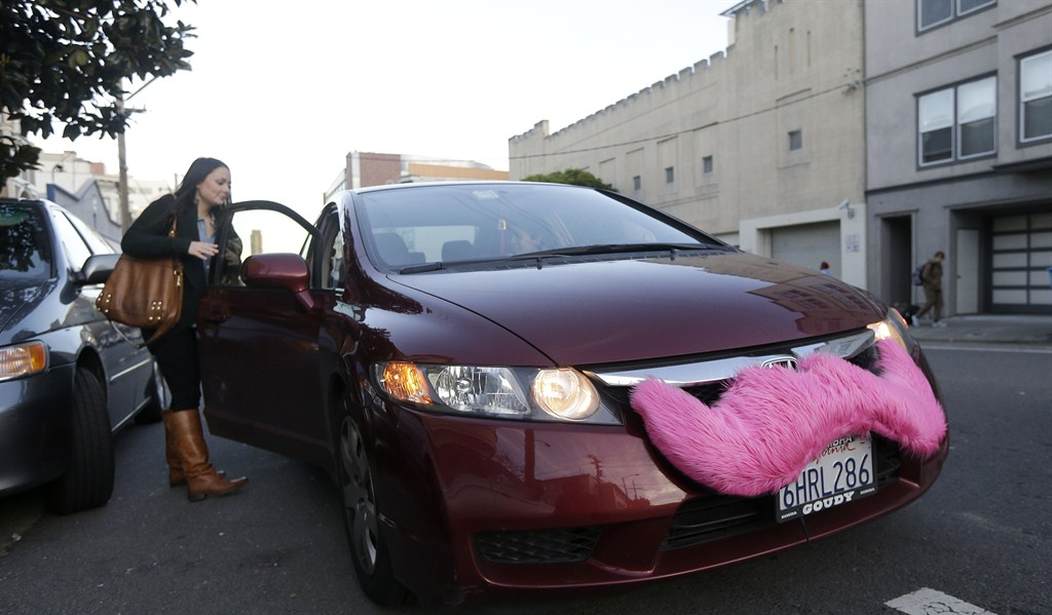
We’re on the verge of a revolution in mass transit, but city, local and state governments — who in theory are “supposed” to be on the advance guard of progress in this realm — are mostly behind the curve.
The revolution is peer-to-peer (P2P) ride sharing, courtesy of such smart phone apps as Uber and Lyft. The counter-revolution is government.
Politicians like nothing better than to regulate private, for-profit transit (taxis, limo and van services) and, better yet, spend billions and billions of other people’s money to set up elaborate and very inefficient mass transit systems that service only a small fraction of their metro area commuters.
The new P2P services — trendily dubbed “the sharing economy” — allow drivers to pick up passengers and deliver them where they want. The connections and monetary arrangements (payments) are made over the Internet, on the Uber or Lyft services. The process is simple, powerful. People who’ve used it find it far superior to old taxi service: quicker, more convenient, more pleasant, and sometimes (often?) less costly.
The new services are flexible, getting people where they want to go. The old model of taxi service relies on human-centered dispatch, happenstance, and a restricted number of providers.
This last factor, the fact that taxis are regulated in virtually all major cities, and — like licensing schemes everywhere — has as its major effects the reduction of supply, reduction in service, rigidity of adapting to peak flow demands, and increased prices to consumers.
And mass transit is even worse. Bus and light rail lines are rigid, with time schedules and an expensive set stock of cars to haul people around in. These rigidities limit both when and where a commuter is to be picked up. Many commuters are inconvenienced most of the time. It is not uncommon to find commuters stranded after hours, forced to walk long distances, or — defeating the purpose of mass transit in the first place — hire taxis.
The new P2P system accesses the capital people have already sunk into their private automobiles, and allows for great flexibility in response to commuter demand. This is especially the case when Uber has (controversially) raised prices during higher demand periods. The higher prices entice more Uber drivers — people who might usually only pick up riders during their own commutes or errand runs — onto the roads, picking up more passengers.
What is obvious to most people who’ve used these new services is that they are far, far better than the old way of doing things. Since the Uber and Lyft apps charge customers from their phones, no cash need change hands. These services provide a truly public good that more readily adapts to a greater diversity of private needs. The “public” part isn’t a uniform schedule, forcing all to conform to its centrally planned regime. P2P contracting is public by satisfying the demands of more private individuals — in all their variety.
It’s quite amazing. It’s a whole new world. Economist Russ Roberts thinks that it will become something even more revolutionary when driverless cars are added to the mix.
Of course, regulators on the city and metro planning boards are freaking out. It doesn’t fit their models. Though the sheer niftiness factor obviously improves over both old-school mass and taxi models of transit contracting, the old-school regulators have an ace up their sleeves.
Fear.
It can’t be safe, can it? All those regular, unregulated folks running about privately helping each other? What about crime?
Well, there’s an app for that.
Actually, it’s a function of the apps in question. Drivers rate commuters; commuters rate drivers. Before you agree to be driven anywhere, you can nix a driver based on his previously accumulated (de)merits. The same goes for drivers nixing potential commuters.
This method of leveraging reputation (a crucial element in capitalism of the brick-and-mortar period) has every reason to work better than government micro-management and “oversight.”
There are, after all, crimes in taxis, too.
Though governments have fought against these services (my home state of Virginia recently prohibited Uber from operating in the state), it’s not always clear that these regulatory prohibitions make any sense. They don’t seem to serve the public at all. They are like building sand castles to withstand the encroachment of the tides.
What’s at base the problem?
In theory, governments are supposed to provide us public goods. When they mess about in private production and distribution, the theory goes that government improves upon markets.
The trouble is, folks in government find it a lot easier to provide private goods than public goods, improving the lot of the few at the expense of the many.
Honk if you understand why.
It’s becoming pretty obvious — if it wasn’t obvious years ago — that your typical metro regulation of taxis, selling exorbitant “medallions” to limit entry into the taxi business, has nothing to do with serving customers. It has everything to do with that most ancient of government activities: protecting the “incumbent” producers in a market from competition, while also making them beholden to government. To donation-accepting politicians, specifically.
What we think of as a “basic government function” is really little more than graft. Corruption.
And the real challenge that might cripple the future comes not from competitive taxi services. Indeed, as I wrote recently in my Common Sense e-letter, in some localities taxi drivers are demanding to be allowed to service consumers using the new P2P app systems.
The real challenge? The most dangerous crippling agent?
Government. Corrupt local government.
Behind the times by tradition and training, it’s now being shown how irrelevant and counter-productive “regulation” can be.
Join the Conversation
VIP members get the ability to comment on articles.