





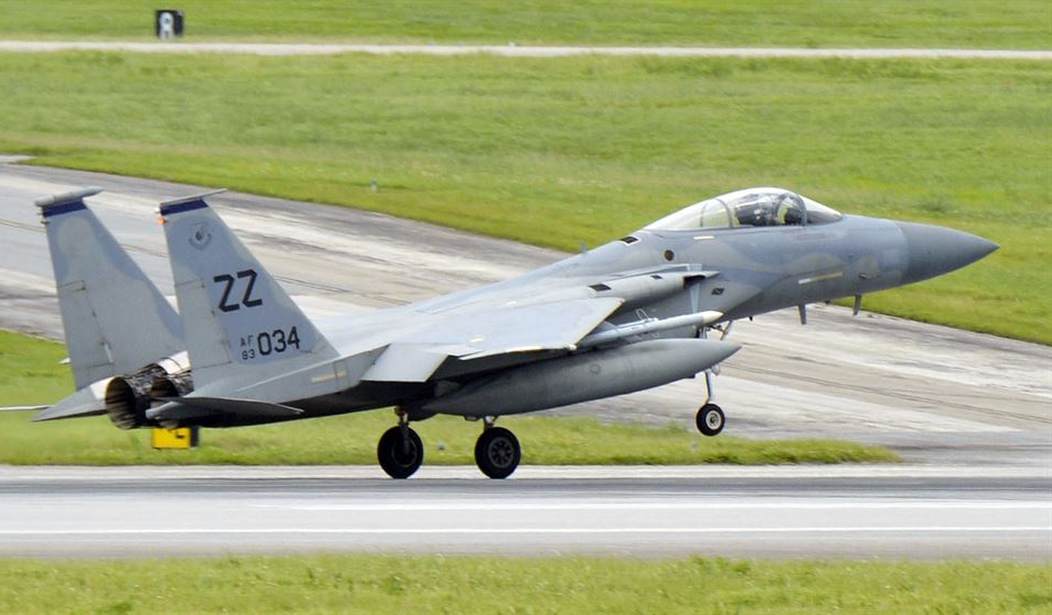
The Schwarzenegger-movie heroics and flat-out audacity the Air Force and her sister services displayed recovering the two downed airmen from a rocky corner of Iran is something in which every American should take enormous pride. No other country on Earth who could mount this operation (155 aircraft flying for hours in the dark) or would put so much at risk to recover two of its own. This speaks volumes about the culture and ethos of the American military and the men and women who serve.
When the chips are down, competence, moral clarity, and commitment are what actually matter.
I recently spoke to a friend who was a Weapons Systems Officer (colloquially, a “Wizzo”) on an F-15E Strike Eagle, and he reminded me we pulled off the rescue largely because the U.S. Air Force and Israelis had almost completely eliminated any Iranian threat. The Iranian Air Force does not exist, and Iranian surface-to-air defenses were reduced to a collection of still-smoking holes in the ground.
“We were operating in a permissive environment,” my Wizzo friend told me of the rescue operation, “but that isn’t always going to be the case.”
In other words, if the Strike Eagle had been shot down somewhere where the Air Force did not enjoy complete air superiority, say, over mainland China, the robust recovery operation would not have been possible. There would be a much more limited combat search and rescue operation, if any. There would be no loitering A-10s or C-130s landing on austere runways in the dark with time to unpack small helicopters. “Dude-44 Bravo” might have had to stay “holed-up” on the side of that mountain for several days, or weeks, or try to contact friendlies on the ground, or make his way on-foot out of hostile territory.
Or worse, the enemy might have captured him.
My friend’s words brought me back to the Air Force Academy, the training I received there, and the importance of keeping the military focused on the mission.
In the 1980s every cadet spent three weeks of the summer between the freshman and sophomore year in SERE – Survival, Evasion, Resistance and Escape training. The Air Force would bring down instructors from the main SERE school at Fairchild Air Force Base in Washington to train cadets on what it meant to survive in the wilderness if they crashed, or God forbid, to survive and evade the enemy if we were shot down. The sergeants who trained us were a weathered and rough handed lot ominously, and accurately, called “snake eaters.” (A cooked snake, by the way, is a feast in these circumstances. F-16 pilot Captain Scott O’Grady was shot down in Bosnia recounted eating ants and leaves for six days while evading capture. Medal of Honor recipient Colonel George “Bud” Day was shot down and ate berries and uncooked frogs while evading the Viet Cong.)
Another part of the training simulated what it meant to be a prisoner of war. Even for fit 18- and 19-year-olds, the resistance training was unforgiving, mentally exhausting (Yoko Ono, we’re looking at you), and sometimes downright brutal. But it was a stark reminder of what we could expect from the enemy if captured. Everyone understood we might find ourselves in a horrible place, beyond the reach or help of our comrades-in-arms, maybe injured, and likely alone.
The reality of going from winged hunter to grounded prey has always been part of the Air Force’s culture. Lieutenant Colonel Jimmy Doolittle and his Raiders provide a good example. When Doolittle’s bombers launched from the USS Hornet in 1942, they knew the best-case scenario after dropping their bombs over Tokyo was to turn west until they ran out of fuel and then bail-out over Japanese-occupied China. The Raiders sewed “blood chits” into their flight jackets (as did the Flying Tigers before them) that downed pilots could present to Chinese villagers offering rewards to keep them from the Japanese Army. Doolittle and his Raiders took-off knowing that nobody was coming for them. Yet they still went.
But this is not unusual. American airmen always go.
(Note: The Doolittle Raiders kept a case containing 80 silver goblets and a bottle of 1896 Hennessy in Harmon Hall at the Air Force Academy. The surviving Raiders would meet annually and turn over goblets of those who passed the year before. When there were only two Raiders left, they would open the Hennessy and drink a last toast their comrades.)
This history and tradition of perseverance in the face of staggering adversity are integral to the training of young officers. It is part-and-parcel of cadets’ training at the Air Force Academy.
A visitor to the Academy who stands on the Chapel Wall to watch the cadet squadrons form into neat blue squares and march into Mitchell Hall for the noon meal will see to the immediate right a dormitory named after the Academy’s sole Medal of Honor recipient, Captain Lance P. Sijan.
Captain Sijan did not win his Medal of Honor leading a brilliant strike on a North Vietnamese position or putting himself at risk to save friendly forces in contact on the ground. Captain Sijan posthumously won his medal for his actions as a prisoner of war.
Captain Sijan was shot down over North Vietnam in 1967 and successfully evaded capture for 46- days. When the enemy caught him, emaciated and injured, Sijan overpowered his guard and unable to run, crawled on a badly broken leg into the jungle, again trying to escape. When the North Vietnamese re-captured him a few hours later, they put him in Hoa Lo prison, the notorious “Hanoi Hilton,” the same place where John McCain was held. There, the North Vietnamese kept Sijan in solitary confinement. The North Vietnamese interrogated and tortured him. Sijan remained defiant throughout, and when he was too weak to stand and could do nothing else, would snarly and growl at the North Vietnamese guards from the floor of his cell because he knew his appearance scared them. Sijan encouraged his fellow prisoners to resist their captors and planned to attempt more escapes until he died in captivity on January 22, 1968.
Every Academy graduate knows well the story of Captain Lance P. Sijan.
We will learn more about “Dude 44 Bravo” in the coming days and weeks, and it may turn out he is an Air Force Academy graduate. Maybe he knew Sijan’s story, or maybe he learned about him in SERE training. Regardless, the Air Force should bring “Dude 44 Bravo” to the Academy to speak to cadets (and to the public) and let them know the thing I am certain he counted on most while he was downed – faith in his comrades, and the unshakeable knowledge they would literally move mountains to find him and bring him home.
Editor’s Note: Do you enjoy Townhall’s conservative reporting that takes on the radical Left and woke media? Support our work so that we can continue to bring you the truth.
Join Townhall VIP and use promo code FIGHT to receive 60% off your membership.


Join the Conversation
VIP members get the ability to comment on articles.