








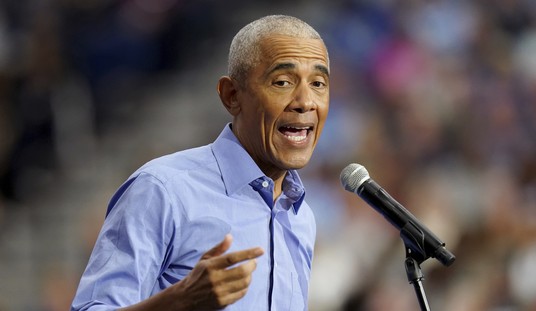
"The situation in Afghanistan is deteriorating," said President Obama, as he announced deployment of 17,000 more U.S. troops.
"I'm absolutely convinced that you cannot solve the problem of Afghanistan, the Taliban, the spread of extremism in that region, solely through military means."

"(T)here is no military solution in Afghanistan," says Secretary of Defense Robert Gates. Said U.S. Commander Gen. David McKiernan yesterday, U.S. and NATO forces are "stalemated."
Such admissions by our military and political leadership in a time of war call to mind other words heard back in 1951, when Gen. Douglas MacArthur delivered his farewell address to the Congress:
"(O)nce war is forced upon us," said MacArthur, "there is no other alternative than to apply every available means to bring it to a swift end. War's very object is victory, not prolonged indecision.
"In war, there is no substitute for victory."
But if victory over the Taliban has been ruled out by the United States, have the Taliban ruled out a victory over the American Empire to rival the one their fathers won over the Soviet Empire?
What price are we prepared to pay, in "prolonged indecision," to avert such an end to a war now in its eighth year?
America had best brace herself for difficult days ahead.
For stepping back from the dreary prognosis for Afghanistan, a new reality becomes clear. The long retreat has begun.
Whether it is in the 23 months Gen. Petraeus favors, or the 16 months Obama promised, the United States is coming home from Iraq.
The retreat from Central Asia is already underway. Expelled from the K-2 air base in Uzbekistan in 2005, the United States has now been ordered out of the Manas air base in Kyrgyzstan. Abkhazia and South Ossetia, ripped away from Georgia by Russia last August, are never going to be returned. And we all know it.
Georgia and Ukraine, most realists now realize, are not going to be admitted to NATO. We're not going to fight Russia over the Crimea. And the U.S. anti-missile missiles and radars George Bush intended to deploy in Poland and the Czech Republic will not now be deployed.
For Washington has fish to fry with Russia, and the price of her cooperation is withdrawal of U.S. military forces from her backyard and front porch. And the warm words flowing between Moscow and Washington suggest the deal is done.
With tensions rising in Korea, too, it is hard to believe President Obama will bolster ground forces on the peninsula, when even Donald Rumsfeld was presiding over a drawdown and a shifting of U.S. troops away from the DMZ.
In Latin America, the United States seems reconciled to the rise of an anti-American radical-socialist coalition, led by Venezuela's Hugo Chavez and embracing Bolivia, Ecuador, Nicaragua and Cuba.
Partisans of President Bush may blame Obama for presiding over a strategic retreat, but it is the Bush administration that assured and accelerated such a retreat.
As Robert Pape of the University of Chicago writes in The National Interest: "America is in unprecedented decline. The self-inflicted wounds of the Iraq war, growing government debt, increasingly negative current-account balances and other internal economic weaknesses have cost the United States real power in today's world of rapidly spreading knowledge and technology. If present trends continue, we will look back at the Bush administration years as the death knell of American hegemony."
Pape's harsh verdict is rooted in his reading of history, that the "size of an economy relative to potential rivals ultimately determines the limits of power in international politics."
In other words, when a great nation's share of world product shrinks, the nation's strategic position follows. Between 2000 and 2008, the U.S. share of world product plunged from 31 percent to 23 percent, and is expected to fall to 21 percent by 2013 -- a decline of 32 percent in 13 years. China's share of world product over the same period will more than double to 9 percent.
Pape went back to the 19th century to correlate the rise of the great powers like Britain and the commensurate growth in their share of world product. He found the Bush decline had no precedent.
"America's relative decline since 2000 of some 30 percent represents a far greater loss of relative power in a shorter time than any power shift among European great powers roughly from the end of the Napoleonic Wars to World War II. It is one of the largest relative declines in modern history. Indeed, in size, it is clearly surpassed by only one other great-power decline, the unprecedented internal collapse of the Soviet Union in 1991."
With an economy still three times that of China, America continues to be the world's most powerful nation, fully capable of defending all of its vital interests. We can no longer, however, defend every ally to whom we made a commitment over the six decades since NATO was formed.
Obama's assignment: Rebuild U.S. productive power, and execute a strategic withdrawal from non-vital commitments.
Join the Conversation
VIP members get the ability to comment on articles.