





Almost no one disagrees that our two major political parties, the oldest and third-oldest in the world, have become increasingly extreme and estranged over the past decade. It's a startling contrast with the state of political conflict in the dozen or so years after the fall of the Soviet empire.
In 1992, Bill Clinton ran on a moderate Democratic Leadership Council platform and, after the implosion of Hillary Clinton's health care plan and the election of Republican congressional majorities in 1994, mostly governed accordingly.
This was the natural reaction of a politician who found an unusually wide range of policy positions acceptable and who was aware that Democrats had lost five of the six previous presidential elections by an average of 10 percent of the popular vote.
In 2000, George W. Bush ran as a compassionate conservative, distancing himself from the abrasiveness of congressional Republicans and the militant liberalism of congressional Democrats.
This was the natural reaction of a politician with a narrower range of acceptable policies and an awareness that hostile mainstream media would do everything possible to delegitimize a confrontational approach.
Both presidents took stands -- generally supported by elites and at the time not particularly unpopular with voters -- in favor of free trade and extensive immigration. And in the 1995-2005 decade, their approaches, including bipartisan compromises on major issues, seemed to produce popular results.
Those days are long gone, and similar approaches are angrily attacked. Contrast the platforms of Bill Clinton 1996 and Hillary Clinton 2016. Contrast the policies of George W. Bush and Donald Trump.
My earlier attempt at a general rule explaining this is that a party's wingers -- left-wing Democrats, right-wing Republicans -- grow increasingly discontent when their party is on the brink of, and after, losing a congressional majority. My updated version is that party politicians have, unlike candidates Clinton in 1992 and Bush in 2000, been operating in reckless disregard of losing congressional majorities.
In retrospect, the tea party rebellion that broke out in Barack Obama's first year in office and swept the 2010 midterm elections was also a rebellion against Bush policies -- budget deficits, the Medicare prescription drug entitlement, the bank and auto bailouts.
The House Republican rebels who pushed the 2013 government shutdown and ousted Speaker John Boehner in 2015, acting out of purism, jeopardized Republican majorities. Similarly, their unwillingness to support measures to revise Obamacare prevented moving policy in a conservative direction and gave increased leverage to House Democrats.
President Trump has taken to blaming Republican leaders Mitch McConnell and Paul Ryan for such failures. This week, according to Politico, vice presidential aide Nick Ayers has been urging donors to stop funding congressional Republicans. "If we're going to be in the minority again, we might as well have a minority who are with us, as opposed to the minority who helped us become a minority," he said.
Democrats, currently with their smallest congressional minority since the 1920s, seem eager to take stands risking perpetuation of that status. It's reminiscent of Hillary Clinton's shift on abortion from her husband's "safe, legal and rare" to supporting Medicaid abortions and her abasement in repudiating his anti-crime policies in deference to the preposterous claims of #BlackLivesMatter.
Her willingness to take such risks was evidently based on the notion that demographic change -- increasing numbers of nonwhite voters -- guaranteed a Democratic victory.
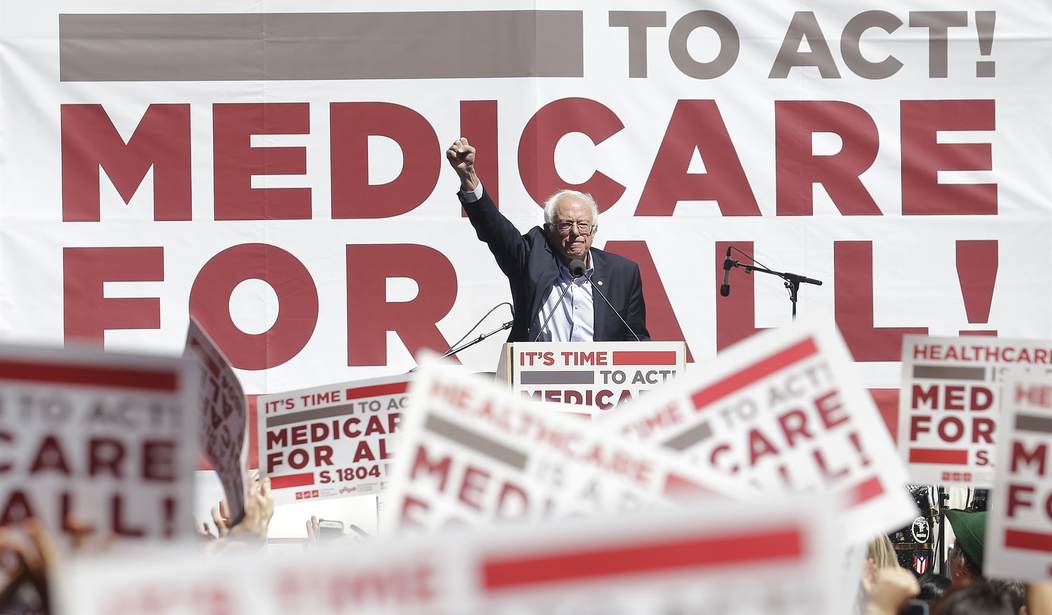
Despite her defeat, that assumption and confidence that Trump's unpopularity will doom Republicans seem to be shared by many Democrats. Thus, 16 Democratic senators, including some mentioned as possible 2020 nominees, have endorsed single-payer health care, a policy voted down resoundingly in purple Colorado and abandoned in shambles in deep blue Vermont.
The rush to the extremes in both parties threatens to derail an obvious compromise on immigration triggered by Trump's announcement that he would withdraw Obama's (legally dubious) Deferred Action for Childhood Arrivals program, which granted protection from deportation and permission to work to "dreamers," immigrants brought here illegally as children.
As William Galston, a veteran of the Clinton White House argued in "The Wall Street Journal," a compromise is obvious: a bill giving legal status to dreamers but including tougher border and internal enforcement, such as mandatory E-Verify.
Some Republicans oppose giving legal status to dreamers, despite its overwhelming popularity. Some Democrats are insisting on giving legal status to not only dreamers but practically all immigrants and will most likely resist effective enforcement measures, despite their widespread popularity. So it's possible that neither side will get what it wants.
One might get the impression that large segments of both parties are determined to lose the next congressional and presidential elections -- and that both deserve to.



Join the Conversation
VIP members get the ability to comment on articles.