





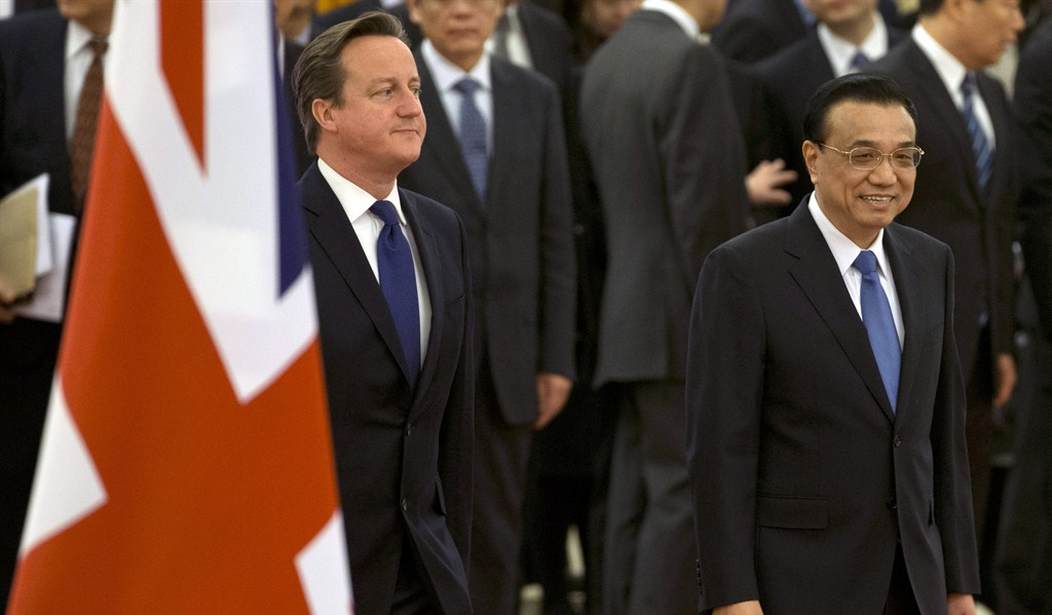
LONDON -- British politics has a familiar look to Americans, with a center-right Conservative Party and a center-left Labour Party resembling America's Republicans and Democrats.
Britain's parliamentary system, however, presents a contrast with the U.S. Constitution on the surface. A prime minister whose party has a majority in the House of Commons can pass any law he or she likes, since members of Parliament almost always vote on party lines.
The House of Lords can delay or amend legislation, but can be overridden by a Commons majority. The monarch theoretically has a veto, but it has not been exercised for hundreds of years and is unthinkable today.
Local governments are creatures of Parliament, subject to national law and can even be abolished. Margaret Thatcher snuffed out the left-wing Greater London Council in 1986.
So theoretically, the British live under what has been called a prime ministerial dictatorship. Yet in practice it isn't working that way.
At the moment British politics seems stalemated in a way not wholly unlike the way American politics is stalemated, with a Democratic president tussling with a Republican House, with different states pursuing different policies, often at odds with the federal government.
The cause, when you get to the bottom of it, is the same: Voters who are unwilling to make crisp and clear choices between two closely competitive national political parties.

Such was the case in the last general election in May 2010. Labour Prime Minister Gordon Brown was ousted, but Conservative leader David Cameron fell just short of a parliamentary majority, with 307 of 650 seats.
So Cameron formed a coalition government with the Liberal Democrats that has proved surprisingly durable but not entirely unfractious.
Achievements include Education Secretary Michael Gove's academics, freeing most United Kingdom schools from union control and seniority assignments, and Iain Duncan Smith's welfare-to-work program eliminating perpetual unemployment benefits.
After long stagnation, the British economy is finally growing again, and two recent polls show Conservatives ahead of Ed Miliband's increasingly leftish Labour party -- contrary to the usual British pattern in which the party in power lags behind.
This raises the possibility of a Conservative victory in the election scheduled for May 2015. But the party faces two serious obstacles.
One is that the district boundaries heavily favor Labour. Its old industrial seats are losing population while fast-growing affluent areas lean Conservative. But the Lib Dems refused to approve new boundaries after Conservative backbenchers scuppered their attempt to maintain perpetual leverage by granting more power to the Lords, where no party has a majority.
The other is the emergence of UKIP, the United Kingdom Independence Party, which wants Britain out of the European Union and limits on immigration from poor countries.
Cameron has promised to renegotiate Britain's terms with the EU and to hold a referendum on staying in on the new terms in 2017. But UKIP averages 14 percent in recent polls -- votes that might otherwise go Conservative.
Hovering over all this is the referendum on Scottish independence scheduled for September 18. Tony Blair's Labour government granted Scotland its own parliament in 1999, and the current Chief Minister, Alex Salmond of the Scottish Nationalist party, favors independence.
Polls show independence trailing. British politicians have made it clear that an independent Scotland cannot keep the pound. European nations facing separatist movements will surely keep Scotland out of the E.U. and the euro.
But not every poll shows the anti-independence vote over 50 percent. Labourites are nervous; their party wins most Scottish seats in the national parliament. Conservatives are nervous lest they be known as the party that lost Scotland.
The coalition government has achieved -- or missed out on -- most of its legislative goals and last week sent the House of Commons out of session early. The immediate contests on the political calendar are elections to the European Parliament May 22.
Few in Britain care much about the European Parliament; turnout in these elections is low and the party in power usually does dismally. Polls are all over the lot, with three parties -- Labour, Conservatives, UKIP -- in the lead.
As for 2015, Labour leader Ed Miliband's leftist strategy suggests he's going after 35 percent of the vote and hoping the district boundaries will produce victory. But if you plug the numbers from the latest public poll into the electoralcalculus.co.uk website, you find neither major party with a majority.
Sound familiar?






Join the conversation as a VIP Member