





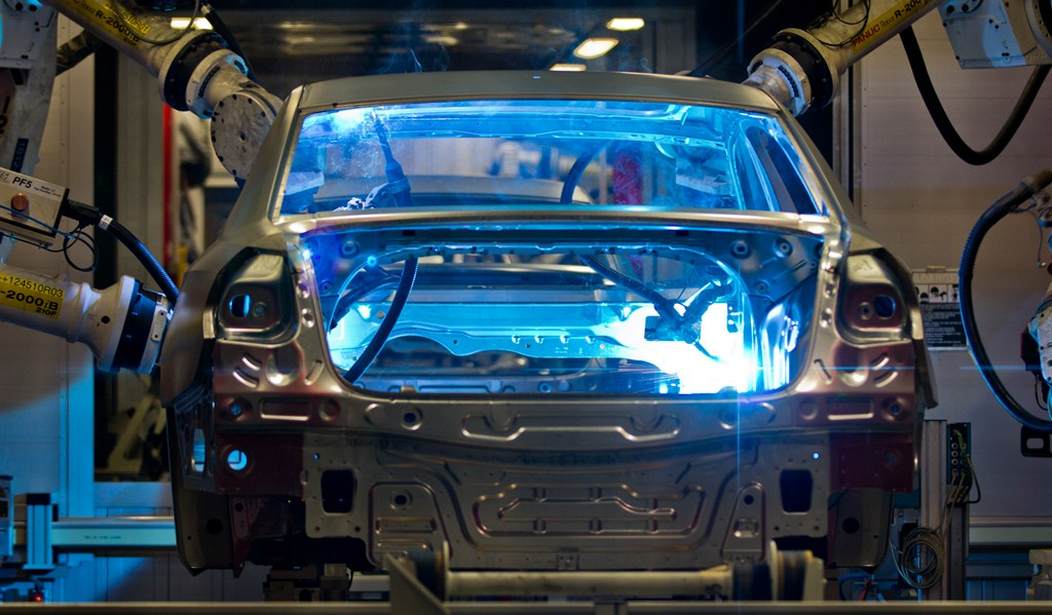
It is 611 miles from the United Auto Workers headquarters in Detroit to Volkswagen's assembly plant in Chattanooga, Tenn. It's a long day's drive, about 10 hours almost entirely on Interstate 75, but it turned out to be too far for the UAW.
Or so one must judge from the results of the unionization election last week in Chattanooga. Volkswagen employees voted 712-626 against certifying the UAW as their bargaining agent.
That's not an overwhelming margin. But it's significant. Volkswagen, unlike most employers, didn't oppose the union. It supported it, opening its factory to union organizers but not opponents, announcing it wanted the UAW as a partner in a worker's council similar to the company's council with its IG Metall union in Germany.
Knowledgeable analysts like Steven Pearlstein in the Washington Post clearly anticipated a union victory. Many expressed hopes that it would herald successful UAW organizing drives in other foreign-manufacturer plants in the South and Midwest.
But workers made another choice. It's a big setback for the UAW, whose chances of organizing other foreign-manufacturer plants -- where managements oppose unionization -- seem as minimal as ever.
And it's a repudiation of the UAW model of unionism, which goes back to the sit-down strikes of early 1937, which enabled the union to organize General Motors and Chrysler (Ford would be organized later, in 1941).
1937 was 77 years ago. To get a sense of how long ago that was, if you go back 77 years before that year, you are in the early weeks of 1860, before Abraham Lincoln delivered the Cooper Union speech that made him a leading candidate in that year's presidential election.
America's economy changed a lot in those 77 years. And it has changed a lot in the 77 years since 1937.
The appeal of the UAW to autoworkers in the 1930s is not hard to understand. The auto companies managed workers according to the theories of Frederick W. Taylor, whose time-motion studies prescribed the most efficient ways to perform simple operations on a moving assembly line.
Taylor believed workers should be treated like stupid animals, incapable of adaptation or initiative, who needed to be disciplined to perform the same simple function all day.
Workers hated that work. But they knew in the Depression years that there were many unemployed men who would be happy to take their place.
The UAW argued that, thanks to the National Labor Relations Act of 1935, it could protect workers' jobs and that its shop stewards could protest assembly line speedups by stopping the whole assembly line.
The NLRA's adversarial process came to dominate labor-management relations and attract other workers. By the early 1930s, 35 percent of private sector workers had union representation.
That number has fallen drastically since then. There was a slight uptick last year, according to the Labor Department, but the number is still just 7 percent.
Why the shift against unions? The auto industry is a good example. Adversarial unionism prevented the Detroit-based automakers from adopting the flexible labor relations employed by non-unionized foreign-based automakers.
In addition, the Detroit firms' managers were themselves hooked on Taylorism. They saw workers as a lower class of beings who needed to be bridled and saddled like horses.
As a result, foreign-owned automakers produced vehicles of much higher quality. In adversarial-union plants, some workers delighted in sabotaging their cars. In non-union plants, workers came forward with suggestions on how to make them better.
It took a long time for the UAW and Detroit management to acknowledge the problem. As Megan McArdle points out in her new book "The Up Side of Down," organizations that have long been successful are reluctant to change their ways during years of slow, sometimes imperceptible decline.
UAW president, Bob King, says that his union has learned to be cooperative with management. Improved quality of Detroit-made cars and anecdotal evidence that has come my way tend to support that claim.
But Chattanooga's VW workers don't seem to think they need the union to cooperate with the company. They're already working together -- and new hires make union-level wages.
And workers can't help but notice that the UAW helped push General Motors and Chrysler -- and, indirectly, Detroit -- into bankruptcy.
The bottom line is that the 1930s adversarial union model has little appeal to workers today. And that few Americans want to head on the road to Detroit.


Join the Conversation
VIP members get the ability to comment on articles.