







My great-great grandfather was a hero of the Civil War--a soldier of the Ohio Cavalry who was wounded and captured. He almost died in the most notorious and horrific Confederate prisoner of war camp.
As a child, each Memorial Day, I heard the stories about the War Between the States as my dad put flowers on his great granddad’s grave. The stories were not told with animosity. Just facts. But I developed my own prejudice against Southerners based on those facts.
As time went on, I delved into study about the horrors of slavery and spent a great deal of time researching the civil rights movement and Martin Luther King, Jr’s. theories on passive resistance. My negative feelings about the South strengthened.
After reading voraciously and eventually spending time in the South, I developed some understanding that the Civil War was a terrible time to be an American—on either side. There were bigger forces at play that pulled in many bit players, many who were not necessarily guilty or immoral. As I grew in my faith, I understood that no one is responsible for the sins of their forefathers. We all stand before God individually.
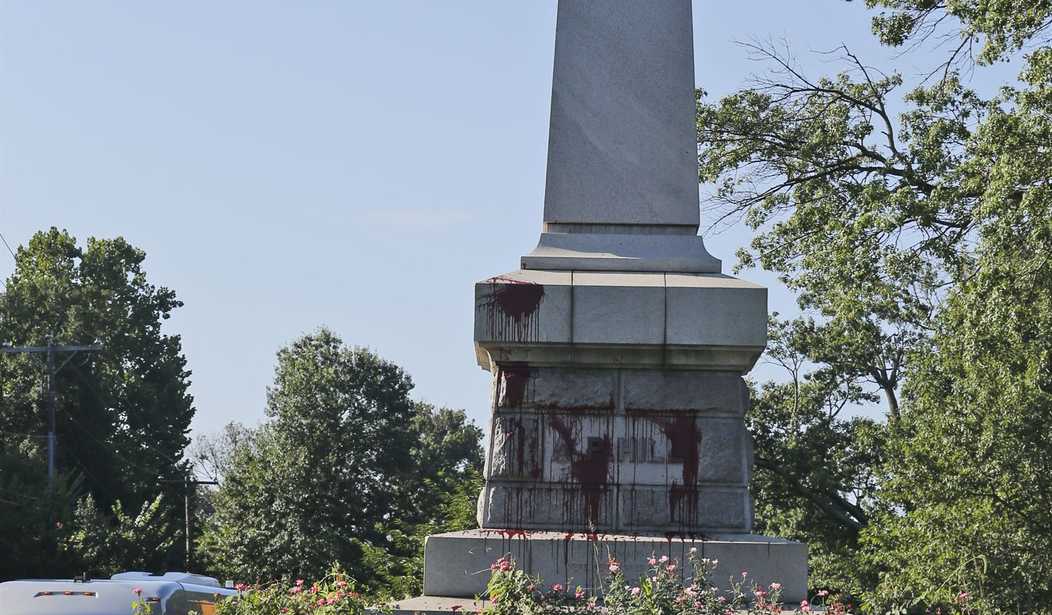
So, I do not cringe when I see a statue of Robert E. Lee. I just see it for what it is—a bit of history. History is mostly the story of forces for evil and good battling it out, but it is always more nuanced than we make it. It is often about little guys being dragged into the battles of the big guys—the elite.
My granddad was a little guy who could have just as easily been forced to serve under Robert E. Lee if my ancestors had settled a little farther south. That is the raw truth.
It was the idea of this Yankee girl to create my organization’s latest project to protect monuments (www.protectmonuments.org). As I have been interviewed about the project, the same question comes up: “What about the Confederate monuments?”
My contemplation led me to wonder how I would feel if I drove to Georgia where my great-great granddad was wounded, and I saw a statue of the Confederate soldier who shot him. Would I wish to get a sledgehammer and destroy it? No. It would not even occur to me. If my children were with me, I would use it as an opportunity to tell them the history of the war, the evil of slavery, and their great-great-great grandfather’s bravery.
This horrible war, that pitted family members against family members and countrymen against countrymen, provides numerous lessons about mankind’s long history of sin and forgiveness. And I want my children to know that even if man does not forgive man, God always forgives those who ask.
If I met the great-great granddaughter of that soldier would I feel any animosity toward her? Absolutely not. I cannot blame her for the actions of her forefather any more than I can take credit for my ancestor’s heroism.
Upon further thought, I realized that it is likely that the young soldier who shot my grandfather did not come from a wealthy family with slaves. It is possible he did not feel he was fighting for the evil of slavery, but to protect his family from descending forces. Through history, most soldiers are dragged into conflicts not of their choosing.
I would like to think that our country is still capable of fact finding, reason and empathy. We must strive to engage in civil discourse especially when it relates to the most sensitive subjects.
The slogan of our project to protect monuments is “Discussion. Not Destruction.” Can America still do that? Or must we pick at old historical wounds until we are bleeding?
Prejudice--or prejudging--is a natural part of the human experience. We do it daily in a million ways. We can grow out of it by acquiring new experiences and knowledge and respectfully interacting with those with whom we disagree. And, I would suggest, by asking God to open our hearts and minds to truth and forgiveness.


Join the Conversation
VIP members get the ability to comment on articles.