





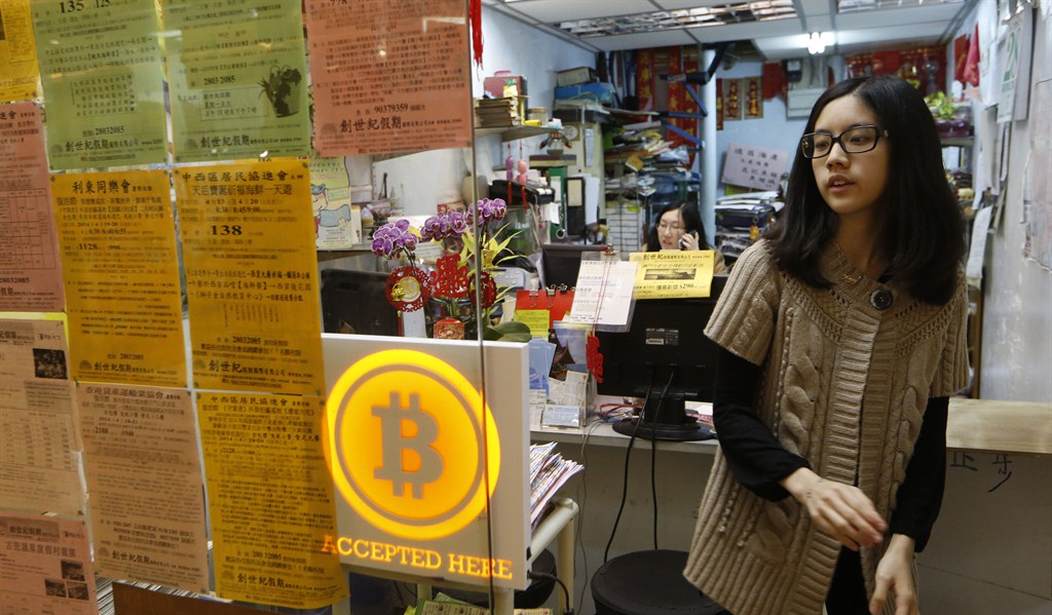
Just before the bankruptcy of the Mt. Gox bitcoin digital-money (or virtual-currency) exchange, Japanese finance minister Taro Aso predicted the inevitable failure. “No one recognizes them as a real currency,” he told reporters. “I expected such a thing to collapse.”
I totally agree with Mr. Aso. For weeks and weeks I have been tweeting and broadcasting that bitcoin is not real money. It is not a reliable medium of exchange, nor is it a reliable store of value. It has no central-bank regulation, network operations, or even centralized issuance. And because of its wild price fluctuations, bitcoin can never be a reliable payment system.
The virtual currency originally offered a way to make transactions across borders without third parties like banks. But the collapse of Mt. Gox -- with 850,000 bitcoins unaccounted for, summing to $425 million of losses, according to many reports -- illustrates the grand failure of this digital experiment.
Venture capitalist Ezra Galston writes in the Wall Street Journal, “without a regulatory framework, credible payment processors -- such as PayPal, Dwolla or Square -- cannot service bitcoin exchanges. And because payment processors are vital for converting fiat currencies into virtual deposits, bitcoin operators will be forced to move downstream into the black market.” Mr. Gaslton concludes by asserting that “the bitcoin community must embrace external regulation to ensure that credible vendors may participate in payment processing.”
Hundreds of bitcoin supporters have tweeted attacks at me for arguing that bitcoin is not real money. But historically, money must be a reliable medium of exchange, and a reliable store of value. Bitcoin meets neither of these definitions.
How can you transact using so-called digital money when prices fluctuate by hundreds of dollars in the space of an hour, or less? You might think you bought something for $500. But by the time the retailer processes payment, the so-called digital-currency price drops to $100.
Both buyers and sellers lose big because bitcoin is not a reliable medium of exchange with a dependable store of value. It is backed by nothing but pure speculation. You can’t even hedge it, because there’s no interest rate. You can barely even get a price quote -- not for the value of the product being bought or sold, but for the value of the monetary medium of exchange.
Years ago, Arthur Laffer warned that many currencies around the world lacked “the moneyness of money.” He was referring to third-world-type currencies. But bitcoin would qualify as well.
Now, I’m not going to defend the value of the dollar, which has depreciated substantially over time. But this unfortunate depreciation has happened over long periods of time -- not ten-minute intervals.
Of course, I’d love to see a gold- and commodity-backed dollar. And maybe future bitcoin reformers can restructure in such a way. But the dollar is accepted around the world by governments, banks, businesses, and consumers because it is a reliable medium of exchange, even if its store of value has deteriorated.
The dollar serves as a payment mechanism, has a central issuer, and is regulated. When the bitcoin people created their digital money as a way of avoiding banks and regulators, they forgot, or maybe never learned, the classic day-to-day requirements of a currency.
So fellas, please go back to the drawing board. I’m all for the digital revolution and trading assets online. But money is different. It must conform to certain long-held principles. That’s why bitcoin is not real money now, and why without huge reforms it will never qualify as real money in the future.


Join the Conversation
VIP members get the ability to comment on articles.