







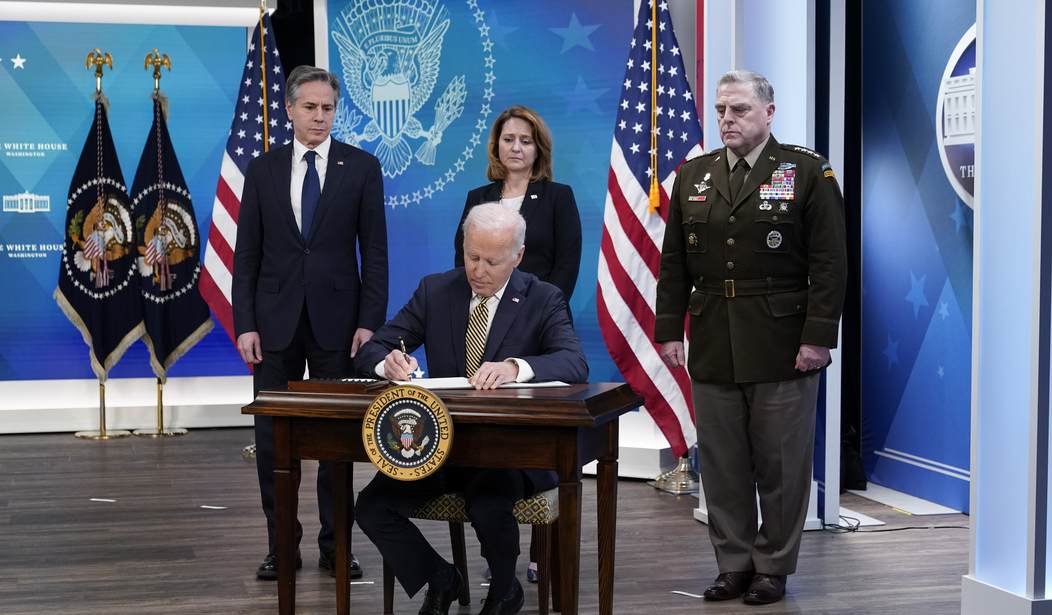
Both political parties accuse President Joe Biden of not doing more to help Ukraine, of not supplying the Ukrainians with fighter jets and of emphasizing "what he won't do" to help "rather than what he will do."
The criticism is warranted. But look at it from Biden's perspective or, more precisely, look at the politics from Biden's perspective.
President Barack Obama ordered all of the American troops out of Iraq. He did so over the objection of practically his entire defense and national security team including the secretary of state, secretary of defense, the national security adviser, the Joint Chiefs of Staff, the U.S. ambassador to Iraq and the CIA director. Outgoing President George W. Bush expected the new president to leave a stay-behind force. But Obama called Iraq "a dumb war" and ordered the troops home.
The pullout, as Bush predicted, created a vacuum. Enter the Islamic State group. In response, Obama gradually sent back to Iraq about the same number of troops that Bush considered necessary.
Some, mostly Republicans who were maligned as warmongering "neocons," criticized what they denounced as the Obama "bug-out." But, politically, Obama did not suffer. How many Iraqis died because of his reckless, premature pullout? Few ask, even fewer care.
In April 2003, according to Gallup, approval for the war in Iraq, which began less than two years after 9/11, reached 76%. Sens. Hillary Clinton and Joe Biden voted for the war. Even liberals like The New York Times columnist Thomas Friedman supported it.
But, over time, approval declined. Clinton apologized for her vote. Some Democrats and their media comrades believed "Bush lied; people died." Former Associated Press D.C. Bureau Chief Ron Fournier claimed that "Bush lied us into the war in Iraq." Even presidential candidate Donald Trump said: "They lied. They said there were weapons of mass destruction. There were none. And they knew there were none."
Never mind that Laurence Silberman of the bipartisan Robb-Silberman Commission, formed by Bush to examine the intelligence behind the Iraq war, wrote: "No one in Washington political circles offered significant disagreement with the intelligence community before the invasion. The National Intelligence Estimate was persuasive -- to the president, to Congress and to the media."
Americans forgot, or stopped caring, that Saddam Hussein, after the Gulf war of 1990-1991, promised -- but failed -- to declare what WMD he had. He threatened America; was stealing from the Oil-For-Food Program; was shooting at the British and American planes patrolling the no-fly zone over the Kurdish areas; had used chemical weapons on the Iranians and on his own people; had attempted to assassinate President George Herbert Walker Bush and had invaded Kuwait. Human Rights Watch estimates that more than 250,000 Iraqis were eliminated by Saddam.
The war in Afghanistan began with wide support. The Taliban allowed al-Qaida to use the country to plan the deadliest terror attack on American soil in history, a tragedy that cost nearly 3,000 lives. But public support waned -- even though, before President Trump withdrew more than 2,000 troops, our military commitment in Iraq dropped to 5,200 troops. Trump, and many Republicans and Democrats, complained about "endless wars," disregarding endless enemies who never get the memo. Even the bipartisan criticism of Biden's disastrous pullout from Afghanistan centers more on how he withdrew the troops, not that he did so.
In three weeks, Russia has reportedly lost more troops in Ukraine than America did in Iraq and Afghanistan combined in 20 years. Yet Iraq and Afghanistan are routinely called mistaken misadventures in "nation building" that we were goaded into by "neocons."
A 2021 AP-NORC poll found that 62% of Americans say the war in Afghanistan was "not worth fighting," and 63% say the same thing about the war in Iraq. American public opinion initially supports war, even the Vietnam War. But approval morphs into not only opposition, but into questioning the "true motive" for engaging in war.
Given this history, Biden's reluctance to "do more" for Ukraine becomes understandable.
Join the Conversation
VIP members get the ability to comment on articles.