





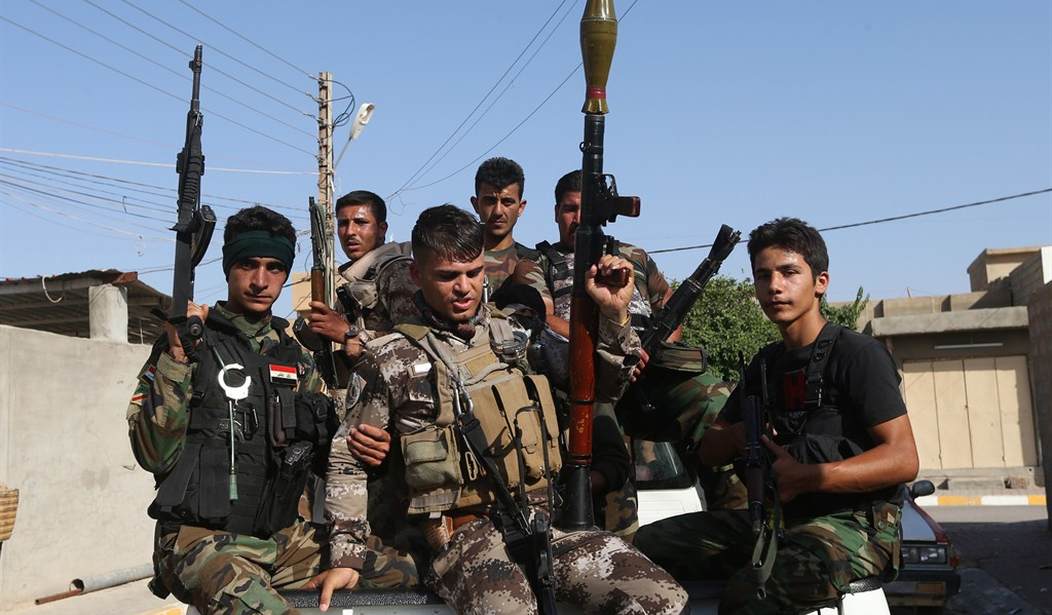
The ongoing conflict in Iraq has serious implications for vital U.S. interests, the extent of which are difficult to decipher at this early stage. Who ends up holding the keys to power within Iraqi territory? What happens to the regional balance of power? How will Iran’s pursuit of nuclear weapons—and our efforts to stop them—be affected?
One immediate effect of the turmoil, however, is painfully obvious: oil prices have already hit a nine-month high. Brent crude reached $115 per barrel this week, a level our country has not experienced since the height of U.S. tensions with Syria in September 2013. As a result, a number of market analysts now expect U.S. gasoline prices to surpass their highest levels for the month of June since 2008, rising from today’s level of $3.68 per gallon to as much as $3.80 per gallon by the end of the month.
If that were not troubling enough, Iraq’s vital importance to the global oil market could mean that today’s rising prices may be just the beginning. Markets are already reeling from a series of oil production outages in countries across the globe—from Nigeria, Libya, and South Sudan to Iraq, Iran, and Syria. Any additional loss of supplies from Iraq could stress the system to its limit and send oil prices to levels that many of America’s political leaders had hoped were a thing of the past.
A recent analysis by the Commission on Energy and Geopolitics, a group of former high-ranking military and civilian government officials, found that a partial disruption to Iraq’s oil supplies—1 mbd, or about a third of Iraq’s current production—would cause oil prices to rise by more than $30 per barrel, amounting to an approximate 50 cent per gallon increase at the pump for American consumers. With the United States consuming close to 20 million barrels of oil per day, it doesn’t take a trained economist to understand that we would take a serious economic hit.
At today’s oil price levels, the average U.S. family is already spending more than twice as much on gasoline as they were a decade ago—a total of $2,700 per household in 2012 compared to $1,200 in 2002 according to the Bureau of Labor Statistics. An oil price spike of the magnitude described by the Commission and other analysts would send spending on oil to record levels and have an immediate, damaging impact on economic growth.
We need to take back control of our economic fate. We shouldn’t accept as fact the idea that our overall prosperity and economic well-being are held hostage to the kinds of violence, extremism, corruption, and mismanagement that are endemic to the global oil market. We can do better, and we have options.
Part of the answer can be found in rising domestic oil production. The U.S. oil boom has provided significant benefits, including an improved balance of trade and hundreds of thousands of new American jobs. That should be embraced and supported. However, no matter how much we produce at home, oil will be priced in a global market, meaning that geopolitical events beyond our control will still have the ability to send our economy into a tailspin.
Energy security starts and ends with oil consumption, and that means we have to do something about transportation. About 70 percent of the oil America consumes is used in the transportation sector, and 92 percent of all fuel used to power that sector is derived from oil. Reducing oil dependence in the transportation sector is a tremendous opportunity to de-link the American economy from the global oil market and the various events—like the crisis in Iraq—that impact that market.
The solutions have already begun to be implemented. More than 200,000 electric vehicles and 140,000 vehicles powered by natural gas are currently on America’s roadways. Simply converting the nation’s fleet of heavy-duty, long-haul trucks to natural gas would save 2 million barrels of oil every day. The widespread adoption of passenger vehicles powered by electricity would have an even greater impact, and such vehicles are selling at a crisp pace and earning rave consumer reviews.
Still, more must be done to accelerate this progress. The country needs to increase its investment in oil-displacement transportation technologies so that we can more quickly sever our ties to the global oil market and shield our economy from its volatility. Doing so will also benefit our national security, as decreasing our economic exposure to oil price spikes will provide foreign and defense policymakers with expanded options.
Time and time again, we’ve learned the lesson that oil dependence makes us vulnerable to flare-ups in the Middle East and around the globe. Of all the serious fallout that will stem from the current crisis in Iraq, all we can predict with confidence is that any resultant high oil prices will harm our economy at a time when our families and businesses can hardly afford another setback. Let this latest lesson be the one that motivates us to embrace the solutions that are now at our fingertips.

Join the Conversation
VIP members get the ability to comment on articles.