





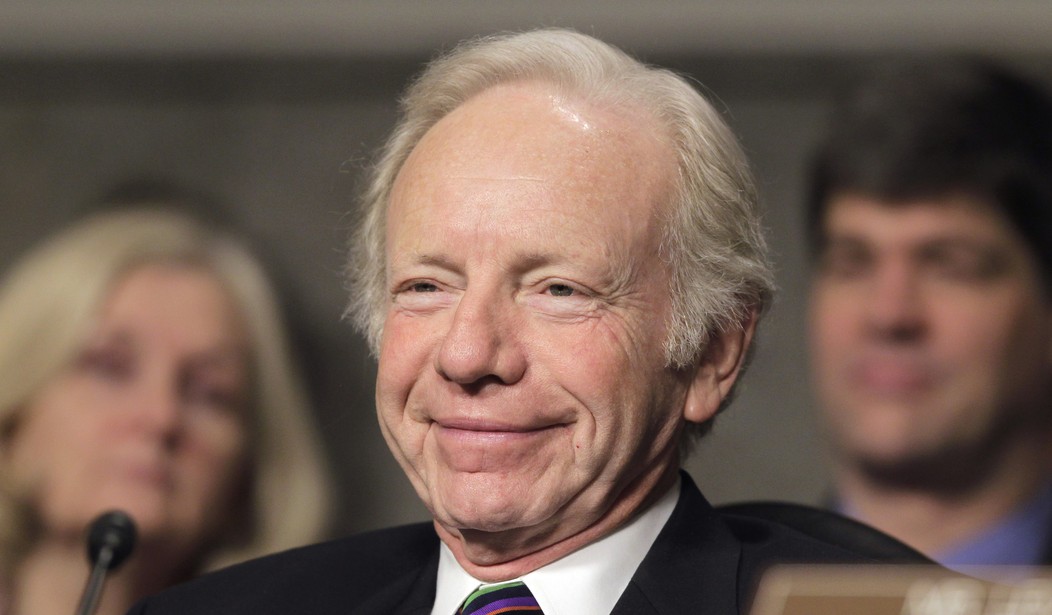
New York City -- "The light's gone from his eyes."
It was 2000, and Sen. Joseph Lieberman, a Democrat from Connecticut, was in full campaign mode. As Al Gore's vice-presidential nominee, Lieberman was preparing to debate Dick Cheney, but Lieberman's son, Matt, was worried about him. He said the words above to Lieberman's wife, Hadassah, who later used them as a wake-up call for her husband.
As Lieberman recounted in his 2011 book, "The Gift of Rest," Matt had been concerned that he was not sleeping, and maybe not praying, as he normally would. Matt had said, "His brain is all there, but his soul isn't coming through," Liberman wrote. "... It jolted me from my fatigue, and, I think, reconnected me to my soul."
Lieberman died on March 27. I find myself thinking about him late at night on Holy Thursday in a beautiful church, St. Vincent Ferrer, filled with Dominican friars at prayer. Rain and cold are not keeping pilgrims from stopping by in commemoration of the night before Jesus was crucified. Lieberman opened his book with a somewhat ridiculous story about shoes drenched by rain on a Friday night after a late budget vote at the Capitol. Capitol police offered him a ride -- which he couldn't take because it was after sundown, and he was an Orthodox Jew.
A small thing, perhaps. But the small things tend to direct the bigger things. That's why Lieberman wrote a book about the joy of keeping Sabbath -- to inspire people of all faiths, and even no faith, to pause on a regular basis.
Part of the beauty of Holy Week is that it reminds you that there are things more important than presidential elections. And in the rain, on Holy Thursday, I am thinking of Lieberman. Holy Thursday is about the Last Supper and the Eucharist, which started as a Passover meal. As a Christian, you'd have to be in denial not to feel a closeness to our elder brothers in faith on this occasion.
In "The Gift of Rest," Lieberman goes into detail about preparations for the weekly Sabbath. He explains, "We are preparing metaphorically and spiritually for the arrival of the most eminent guest in the world -- the King of Kings." He references the Song of Songs often, which is such a strong reminder of God's love for His people -- and something that unites the Abrahamic peoples, if we let it.
On the Sabbath, he writes, "we feel as if we are receiving God into our homes with gratitude and love. The intensity of our experience is proportional to, among other things, the intensity of our preparation. We prepare ourselves inwardly not just by praying or meditating but also by doing physical things. In general, this is the Torah's approach: The path to changing the inner you -- your feelings and attitudes -- is taking positive physical action."
From Christmas to Easter, the physical nature of the story of salvation is hard to miss. It's incarnation: God taking on human flesh, preaching and teaching among us, and dying for our sins. In many ways, every Sunday for Christians begins another Holy Week, yet we often take it for granted. These holiest days on the calendar can bring us back home.
Lieberman emphasized the transformational nature of staying with God throughout the week, and resting with Him weekly: "As the Sabbath ends each week, we pray for the promised redemption, knowing that our world remains broken, but fixable, and that we remain imperfect, but perfectible. The choices are ours. ... The Sabbath is a quiet, dark house where we suddenly notice things -- trends in the world around us and ideas that pop into our heads out of nowhere and would be overlooked during the week."
That's something of what I experienced on Holy Thursday. As we move toward Easter, I'm giving thanks for people who are not afraid to witness their love for God in public life, even when likely allies give them grief. For Christians, of course, we know Jesus suffered more than that.
Kathryn Jean Lopez is senior fellow at the National Review Institute, editor-at-large of National Review magazine and author of the new book "A Year With the Mystics: Visionary Wisdom for Daily Living." She is also chair of Cardinal Dolan's pro-life commission in New York, and is on the board of the University of Mary.



Join the Conversation
VIP members get the ability to comment on articles.