





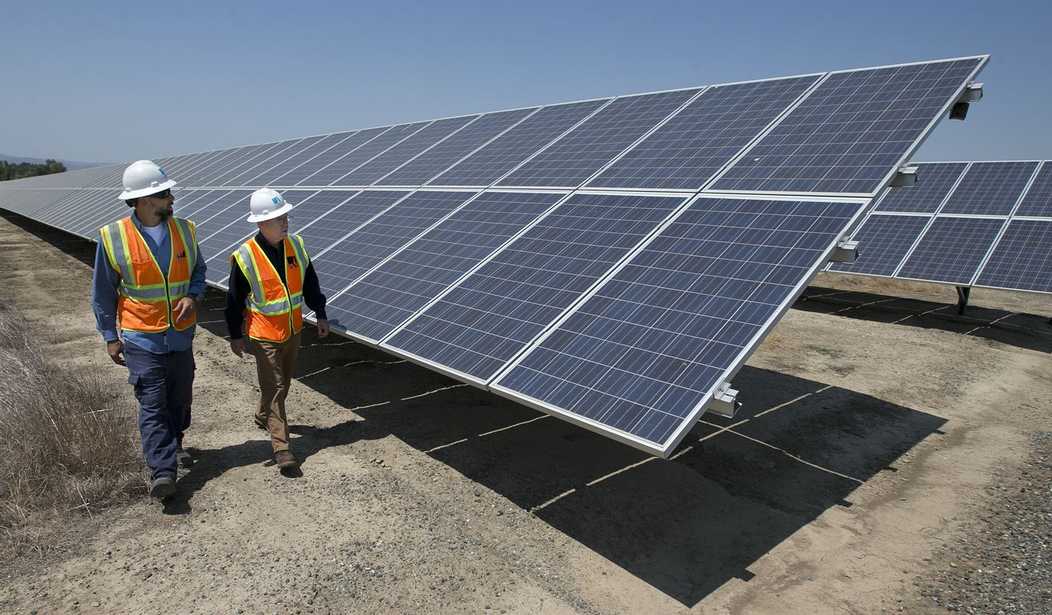
The political movement known as the “Green New Deal” aims to power the world by emissions-free energy sources, such as wind, solar, hydropower, batteries, and maybe (proponents are strangely squirrely about this one) nuclear. Their idea is based on a weaponized expansion of the theory of global climate change driven by carbon dioxide emissions. It has no basis in either affordability or reliability.
Their aim is the use of public policy to force “every aspect of American society and our economy to meet 100% clean and renewable energy.” Their counterparts in other nations share those goals.
Spain, for instance, has for many years been pursuing an aggressive policy of “decarbonizing” its energy generation, seeking “climate neutrality” by 2050. In April 2025, Spain announced to the world that it had achieved its “first weekday of 100% renewable power” on its national grid. Wind, solar, and hydropower provided enough power for electricity demand.
A few days after reaching this Green New Deal pinnacle, Spain suddenly and inexplicably suffered “one of the largest peacetime blackouts Europe has ever seen.” The Spanish power grid lost 60 percent of its generation capacity in mere seconds. The outage also took the interconnected grids of Portugal and southern France down with it, causing sheer chaos in a 21st-century economy. Reuters reported that, according to estimates from investment bank RBC, “the economic cost of the blackout could range between 2.25 billion and 4.5 billion euros.”
There had been warning signs. Two months prior, Redeia, which owns the Spanish grid operator, Red Eléctrica de España, warned in its annual report of the risk of “disconnections due to the high penetration of renewables without the technical capacities necessary for an adequate response in the face of disturbances.” Red Eléctrica has since acknowledge it’s “muy posible” (very likely) that “solar generation” was the culprit.
There are many inescapable realities about powering an electrical grid that Green New Deal visionaries have no answer for (and sometimes no idea of), including:
- Electricity must be consumed as it generated
- Power plants are not interchangeable
- The main renewable sources, solar and wind, are intermittent and unreliable
- Nuclear, natural gas, and coal are reliable enough to provide baseload (ever-present demand) power
- Natural gas and hydropower are dispatchable, quickly providing power to handle fluctuations
- Natural gas, hydro, and coal provide critical, natural inertia that protects the grid from sudden disturbances, but renewables can’t
For all those reasons, powering today’s economy absolutely needs baseload and dispatchable generation. As the North American Electric Reliability Corporation (NERC) stated in its “2021 Long-Term Energy Assessment,” “Natural gas is the reliability ‘fuel that keeps the lights on,’ and natural gas policy must reflect this reality.”
Spain’s grid did not reflect that reality, so the consequences did. Spain’s experience provides a lesson here in the U.S., where several states already have emissions-reduction policies and other states may be tempted to follow suit. One such state is my home state of North Carolina.
With its Carbon Plan requiring “carbon neutrality” by 2050, North Carolina policy threatens to abandon the “fuel that keeps the lights on.” State law has long required electricity to be least-cost and reliable, and even the Carbon Plan requires the path to carbon neutrality to be least-cost, reliable, and reasonable. Those goals are simply unachievable, however, without access to natural gas power plants.
Nevertheless — as shown in “Power Plays,” a new report from the John Locke Foundation’s Center for Food, Power, and Life — North Carolina has a long history of an activist executive branch acting to thwart natural gas pipeline projects and power plants. For example, Gov. Roy Cooper and the state Department of Environmental Quality held up permitting for the Atlantic Coast Pipeline and blocked permitting for the Mountain Valley Pipeline Southgate project, despite there being only one interstate natural gas pipeline serving North Carolina. The North Carolina Utilities Commission has prioritized the Carbon Plan’s interim goal of 70 percent reduction in emissions by 2030 over the principles of affordability and reliability — effectively creating an exorbitant carbon tax in its modeling and skewing its resource planning away from natural gas and nuclear in favor of overbuilding renewables.
This lack of natural gas infrastructure and overreliance on intermittent renewables could easily lead North Carolina down an expensive path of energy insecurity. Especially if the state’s only interstate pipeline, Transco, were to experience an unexpected disturbance like the Colonial pipeline ransomware attack.
The report recommends reforms that would keep the focus on affordability and reliability, including repealing the Carbon Plan or at least its interim goal. It also urges lawmakers to maintain vigilance over successful reforms. Society in the 21st century is far too reliant on electricity to give up affordable, reliable service for extremist political mandates.
Jon Sanders is the Director of the Center for Food, Power, and Life at the John Locke Foundation


Join the Conversation
VIP members get the ability to comment on articles.