





What day is it?"
"It's today," squeaked Piglet.
"My favorite day," said Pooh.
As a proud member of the "don't just do something, sit there" school of politics, I don't fret much about partisanship and gridlock. Partisanship and gridlock aren't bugs of our constitutional system, they're features. And while everyone likes to see their preferred policies sail through Congress, on the whole I think we've been well served by those features for two centuries.
That said, in the spirit of compromise so lacking in Washington, I would like to offer a suggestion for how to fix the alleged dysfunction in Washington: Let's have more partisanship about ideas and less about process.
You have to wonder if Harry Reid feels like an idiot yet. For years now, the Senate majority leader has been cynically protecting Democratic senators -- and President Obama -- from difficult votes. The rationale was pretty straightforward. He wanted to spare vulnerable Democrats named Mark -- Arkansas' Mark Pryor, Alaska's Mark Begich and Colorado's Mark Udall -- and a few others from having to take difficult votes on issues such as the Keystone XL pipeline, EPA rules and immigration reform.
The problem for the Marks and other red- or swing-state Democrats is that, having been spared the chance to take tough votes, they now have little to no evidence they'd be willing to stand up to a president who is very unpopular in their states.
Thanks to Reid's strategy of kicking the can down the road, GOP challengers now get to say, "My opponent voted with the president 97 percent of the time." Democrats are left screeching "war on women!" and "Koch brothers!"
For instance, Reid killed bipartisan legislation on energy efficiency in May by denying senators the right to offer amendments. This was a wildly partisan and nearly unprecedented move, blocking the Senate from debating important issues. He did so because he feared that GOP amendments -- on the Keystone pipeline, for instance -- would pass with Democratic support, angering the White House.
I'm sure Sen. Mary Landrieu, D-La., would love to be able to tout such a vote now. But she supported Reid's tactic, shooting herself in the foot in the process.
Of course, this assumes these allegedly independent Democrats would have broken with Obama. But whether they would have or not, wouldn't our politics be healthier if we had an answer to that question?
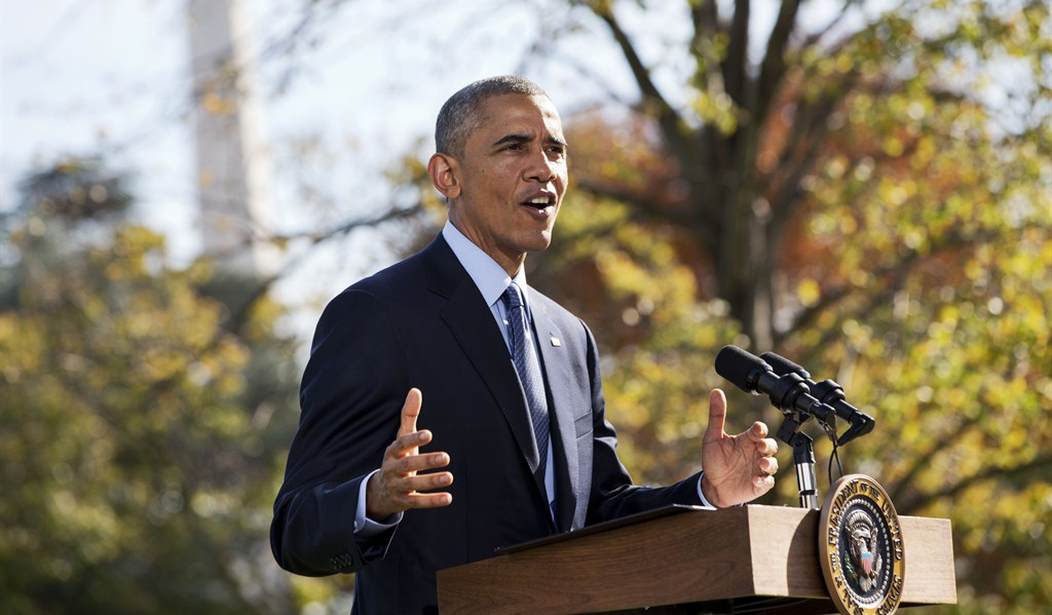
Indeed, so much of Obama's politically poisonous indecisiveness, whether on Syria, Ukraine, the Islamic State, immigration reform or the Keystone pipeline, seems driven by a powerful desire to kick the controversial decisions down the road and simply "win" the daily spin cycle. This tactic of protecting politicians from votes is a bipartisan practice that exacerbates the worst kind of partisanship.
Under former House Speaker Dennis Hastert, Republicans adopted the so-called Hastert Rule, which says no bill can be brought to the floor absent support of a majority of the majority -- i.e., a majority of Republicans in the GOP-controlled House.
In 2006, even though President George W. Bush supported a hike in the minimum wage (wrongly in my view), the House refused to take it up for a vote. It could have passed with a minority of Republicans joining the Democrats. Those Republicans mostly came from states where there were minimum wage hikes on the ballot. If they'd been allowed to vote in favor of a "clean" raising of the wage, some of them might well have kept their seats, and the GOP might have kept its majority. Instead, the Democrats were swept in that year, and they got the minimum wage hike anyway.
This live-for-today approach -- what GOP consultant Brad Blakeman calls "momentarianism" -- protects the short-term interests of political elites but harms the long-term interests of just about everyone. It prevents Republicans from forging creative strategies for winning over Democrats and vice versa. But it also denies letting voters know what politicians are really for by concealing their true positions in a fog of procedural nonsense.
Gridlock is great when it reflects principled disagreements between duly elected representatives of the people, not when it's used to protect politicians from their own constituents.

Join the Conversation
VIP members get the ability to comment on articles.