







In the early days of the American republic, newspapers were actually started by political parties, leading political figures and even presidents – to get their point of view across.
Alexander Hamilton, for example, helped establish The Gazette of the United States, "a paper of pure Toryism," according to Thomas Jefferson, "disseminating the doctrines of monarchy, aristocracy, and the exclusion of the people." To offset this influence, Jefferson and Madison helped establish the National Gazette, an outspoken critic of the administrations of Adams, Hamilton, and Washington, and an ardent advocate of the French Revolution.
It wasn’t until 1851 that Henry Raymond started the New York Times, ushering in a new era in journalism as a paper of “non-partisan, independent thought.”
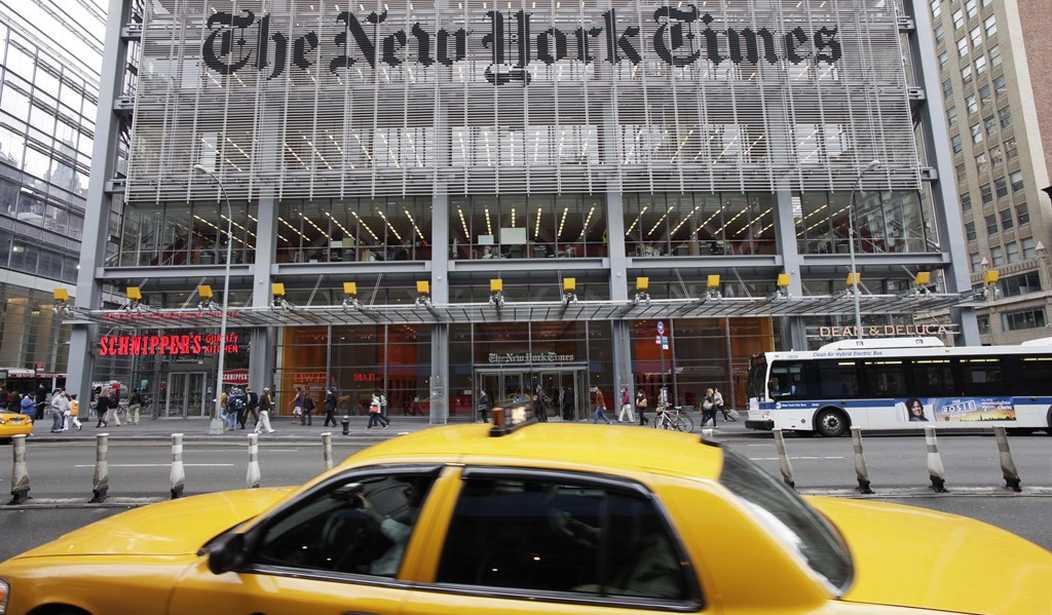
How times have changed. Although many newspapers still have the word “Democrat” in their titles and a few have the word “Republican” there really aren’t any newspapers today that could be regarded as organs of a political party – unless …. (strange as it may be) … you count The New York Times itself!
Even though the Times is still regarded by journalists as “the paper of record,” its unsigned editorials and the editorials of its flagship writer, Paul Krugman, are increasingly hard to distinguish from the party line of the Democratic National Committee (DNC).
Now if you are an honest liberal there are all kinds of interesting subjects to editorialize on these days – the sorry state of the public schools, the deplorable state of veterans’ health, the personal tragedies emerging in the Obamacare health insurance exchanges, the existence of inexplicable poverty amidst a bloated welfare state. But if you are shilling for the DNC, these subjects are potential minefields.
· You can’t criticize the public schools without risking offense to the teachers’ unions (the most important constituency in the Democratic coalition) and school board members who are almost always Democrats wherever the schools are bad.
· You can’t criticize veterans’ health care without addressing the right to see private doctors, and that means “privatization” and that is an anathema to public sector unions everywhere.
· You can’t discuss Obamacare without giving aid and comfort to Republican critics.
· You can’t criticize the welfare system because it’s almost completely run by Democrats in every city of any size.
Interestingly, the very best information in all of these areas comes from really good exposés written by New York Times reporters. Take Obamacare. The Times has published a series of heart wrenching stories about patients being effectively denied care because of narrow networks and ridiculously large deductibles. All this should be fertile territory for opining. Why are we having these problems? Where did Obamacare go wrong? These are questions editorial writers for the Times dare not ask.
Paul Krugman has probably written two or three dozen editorials on Obamacare, not one of which has any significant insight into Obamacare’s problems or why they are occurring. Instead, in column after column, Krugman serves up embarrassingly repetitious apologies for the program, coupled with mercilessly repetitious attacks on Republicans for predicting the problems would be even worse than they actually are. (Does he really get paid for that stuff?)
In general, the more interesting the subject, the harder it is to write an editorial that passes muster with the Democratic establishment. It’s even harder when the DNC has decided that Hillary Clinton is the candidate of choice.
For at least a decade, Krugman has been telling his readers that single payer health insurance is superior to our health care system, that public insurance is more efficient and equitable that private insurance, and that markets don’t work in health care. But now Bernie Sanders is saying those very same things, while Hilary Clinton is defending the Obamacare marketplaces, private insurance and the profit motive.
So what does Krugman do? Stick to what he’s always believed? Or, take one for the team, recant all his previous thoughts and defend Hillary? If you don’t already know,
Then there is the issue of money in politics. How do you write editorial after editorial on this subject (as both Krugman and the editors have done) without ever once mentioning that the worst offenders are Bill and Hillary? It’s even more of a challenge when Bernie Sanders hardly lets a day go by without mentioning $675,000 in speaking fees from Goldman Sachs and transcripts of speeches that Hillary refuses to make public. Then there are the periodic leaks from the State and Justice departments connecting the dots between contributions to the Clinton Foundation and official State Department business.
To be able to ignore all this and still keep the editorials lively and interesting is a rare skill, no doubt honed over many years of practice. It is a feat that is probably deserving of a Pulitzer in its own right.
Call it the Spin Zone award.


Join the Conversation
VIP members get the ability to comment on articles.