







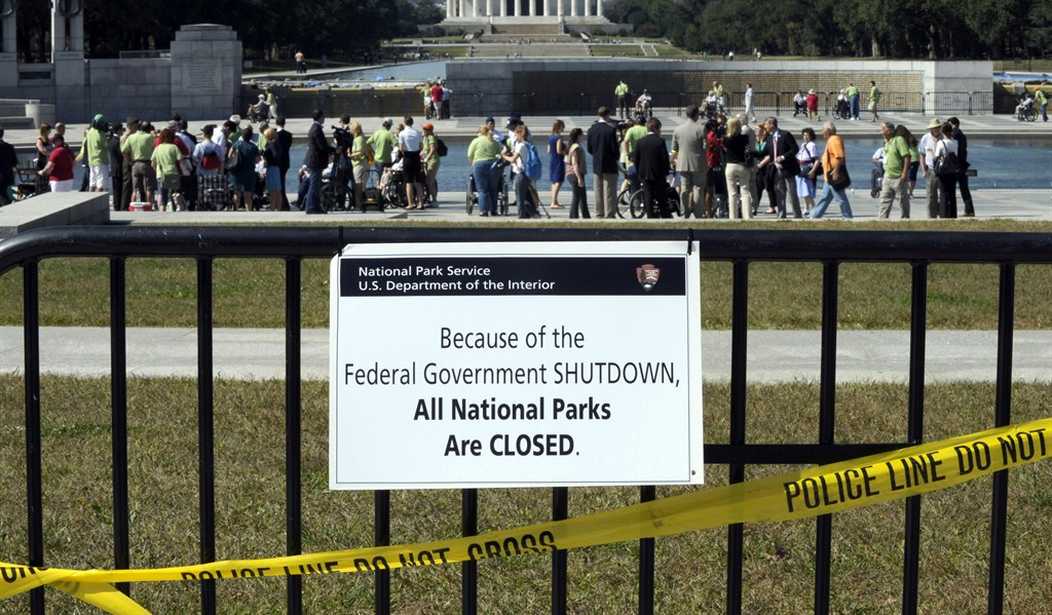
Last month, Americans were transfixed by the amateur theatrics undertaken by the Washington political establishment in connection with the debt ceiling crisis. The bad faith, poor tactics and wholesale avoidance of reality were offered by all players in very large doses. When the Republican leadership finally capitulated (thereby bringing down the curtain on the tawdry production), it soon became apparent that sound and fury had signified nothing except another exercise in can kicking. Public approval of Congress sank to the lowest level on record, and has only dissipated due to the unmitigated disaster of the Obamacare launch. But as bad as domestic approval has become, the behavior of the U.S. government has played far worse internationally.
A year before, European politicians faced what looked like the same situation of national default.But after fraught negotiations, they at least achieved the illusion of a political compromise. The narrative that emerged is that Europe was better able and more willing to compromise. Although this shallow conclusion overlooks key fundamental differences between the political structure of theU.S and the European Union (EU), it nevertheless has created the perception of lost American leadership. Since America owes its continued economic strength to its perceived political might, such changes could be dangerous in the extreme. However, the reality is that the European political machine is just as dysfunctional and completely insulated from the interests of its citizens.
In order to force political union and the creation of a European super state, often against democratic wishes, several EU nations created the Eurozone and issued their own single currency. However, unlike the United States, the EU is not yet a unified federal state, with a single treasury. Furthermore, many important EU nations, such as the UK, are not members of the Eurozone. Therefore, while the European Central Bank (ECB) may exert moral suasion, it has no executive power over non-Eurozone members of the somewhat politically disparate EU.
In the United States, Fannie Mae and Freddie Mac were rumored by Wall Street to have an implicit federal government guarantee. As such, they were enabled to over borrow at extremely low rates. A similar dynamic existed with smaller, so-called 'peripheral' nations within the Eurozone, including Greece, Portugal and Spain. These overly indebted, economically questionable nations were able to over borrow at low rates under the implicit guarantee of far stronger members of the Eurozone, such as Germany and the Netherlands.
When the over borrowing of the Eurozone periphery nations reached levels that caused concern within the bond markets, the gap in bond yields between the southern and northern tier of the Eurozone threatened extreme instability. To narrow the gap, Eurozone banks were 'persuaded' politically by Brussels to load up on the bonds of failing southern banks and national governments. In return the ECB treated these suspect holdings as prime deposits.
This mirage worked well until the recession of 2007/8. Bad loans then placed banks under strain that threatened survival. It exposed the inherent lack of explicit EU national support for Eurozone banks and even nations. It even threatened the existence of the euro, by then the world's second currency.
The ECB can and does create trillions of dollars of fiat euros. Also, it borrows hundreds of billions of dollars from the Fed by means of currency swaps. But unlike the U.S. dollar, the euro is not the international reserve currency. In addition, unlike the U.S. with its single Treasury, the EU has separate national treasuries. Therefore, international lenders have shown a far higher willingness to loan to the U.S. (There likely will be a limit for the U.S. Treasury as well, but that threshold has yet to be identified.)
But it is important to realize that it was the real and present danger of a bond collapse that finally spurred coordinated political actions in Europe, not any forward-thinking preemptive policy moves. Such a crisis has not hit the United States. Should it, the U.S. will be forced into action as well. The big difference of course is that the solvent Germans have been able to bail out the insolvent Greeks and Spaniards.Who will be there for the United States? It is unlikely that Canada has the resources.
The current U.S. political practices of irresponsible spending, a massive creation of fiat money and the covert debasement of the dollar may never succeed in eventually spurring real political action and meaningful policy changes. Instead the bond market will call the tune. When bond investors finally head for the exits, hard choices will have to be made that will likely include deep and politically agonizing spending curbs, similar and possibly worse than those exerted now in Europe.
Subscribe to Euro Pacific's Weekly Digest: Receive all commentaries by Peter Schiff, John Browne, and other Euro Pacific commentators delivered to your inbox every Monday!
Order a copy of Peter Schiff's new book, The Real Crash: America's Coming Bankruptcy - How to Save Yourself and Your Country, and save yourself 35%!
John Browne is a Senior Economic Consultant to Euro Pacific Capital. Opinions expressed are those of the writer, and may or may not reflect those held by Euro Pacific Capital, or its CEO, Peter Schiff.



Join the Conversation
VIP members get the ability to comment on articles.