







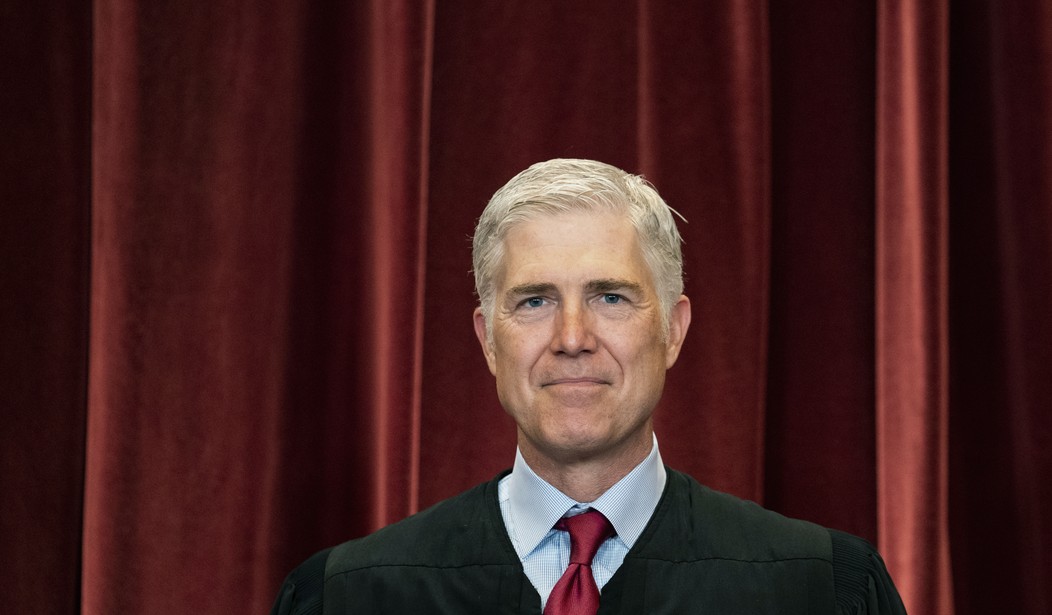
"Criminal laws have grown so exuberantly and come to cover so much previously innocent conduct that almost anyone can be arrested for something," Supreme Court Justice Neil Gorsuch observed in 2019. Gorsuch elaborates on that theme in a new book, showing how the proliferation of criminal penalties has given prosecutors enormous power to ruin people's lives, resulting in the nearly complete replacement of jury trials with plea bargains.
"Some scholars peg the number of federal statutory crimes at more than 5,000," Gorsuch and coauthor Janie Nitze note in Over Ruled: The Human Toll of Too Much Law, while "estimates suggest that at least 300,000 federal agency regulations carry criminal sanctions." The fact that neither figure is known with precision speaks volumes about the expansion of federal law.
Literally volumes. "By 2018, the U.S. Code encompassed 54 volumes and approximately 60,000 pages," Gorsuch writes, while "the Code of Federal Regulations spanned about 200 volumes and over 188,000 pages" as of 2021.
Since keeping up with all that law is a challenge even for experts, the rest of us cannot hope to know exactly which conduct is a crime, even though "fair notice" is a basic requirement of due process. The civil liberties lawyer Harvey Silverglate has suggested "the average busy professional in this country" may unwittingly commit "several federal crimes" every day.
And that's just federal law. Thanks to the vast trove of potential charges, Silverglate observes, quoting a warning from Justice Robert Jackson, "prosecutors can easily succumb to the temptation of first 'picking the man and then searching the law books, or putting investigators to work, to pin some offense on him.'"
Former President Donald Trump says that is what happened to him. His 34 felony convictions for paperwork violations stemming from his hush payment to a porn star provide evidence to support that complaint.
Because the same conduct can be construed as multiple violations of state or federal law, prosecutors can pressure defendants to plead guilty by threatening to throw the book at them. Although Special Counsel David Weiss initially was prepared to drop a federal gun charge against Hunter Biden under a diversion agreement, for example, he ultimately prosecuted the president's son for three felonies, all based on the same gun purchase, with combined maximum penalties of 25 years.
Why the change? After the diversion agreement and a plea agreement resolving tax charges fell apart, Biden decided to make the government prove its case in court. Exercising his Sixth Amendment right to trial by jury came with a stiff penalty.
Something similar happened to Aaron Swartz, a young computer programmer, entrepreneur and internet "hacktivist" who, apparently frustrated by limits on information he thought should be freely available, downloaded articles from JSTOR, an online academic library. When Swartz was caught, he returned the articles, and JSTOR considered the matter resolved.
Federal prosecutors nevertheless "charged Aaron with wire fraud and three counts under the Computer Fraud and Abuse Act of 1986," Gorsuch writes. And when Swartz declined to plead guilty, "prosecutors added another nine counts to their charges against him, exposing him now to decades in prison and millions in fines." Swartz committed suicide a few months before his trial was scheduled to begin.
As a result of such pressure, Gorsuch notes, about 97% of federal felony convictions and 94% of state felony convictions are based on plea agreements. Trial by jury, which the framers viewed as an essential bulwark against tyranny, plays only a marginal role in our current criminal justice system.
The more juries are needed as a check on prosecutorial power, in other words, the less likely they are to serve that role. "The framers really believed in juries," Gorsuch noted in an interview with New York Times columnist David French. "I mean, there it is in Article III. There it is in the Sixth Amendment. There it is in the Seventh Amendment. They really believed in juries, and we've lost that."



Join the Conversation
VIP members get the ability to comment on articles.