







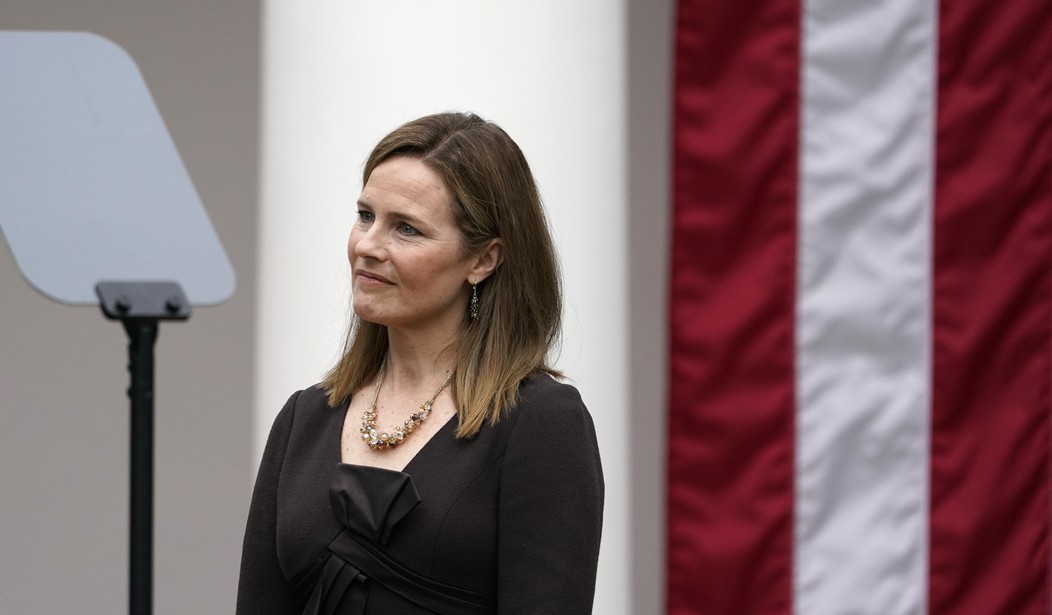
Democrats worry that Supreme Court nominee Amy Coney Barrett, an originalist and textualist who clerked for Justice Antonin Scalia in the late 1990s, will emulate him if she is confirmed by the Senate. We could do a lot worse.
Although progressives often portrayed Scalia as an authoritarian ogre, he was a more faithful defender of First, Fourth and Sixth Amendment rights that some of his purportedly "liberal" colleagues on the Court. Barrett's track record during three years on the U.S. Court of Appeals for the 7th Circuit suggests she also would frequently prove to be a friend of civil liberties.
In a 2018 opinion, Barrett concluded that an anonymous tip did not provide reasonable suspicion for police to stop a car in which they found a man with a felony record who illegally possessed a gun. "The anonymous tip did not justify an immediate stop because the caller's report was not sufficiently reliable," she wrote for a unanimous three-judge panel, noting that the report of gun possession by itself did not indicate criminal conduct.
In another Fourth Amendment case, decided in 2019, Barrett concluded that federal drug agents violated the Constitution when they searched a suspected heroin dealer's apartment based on the consent of a woman who answered the door but did not live there. Because the search was invalid, she said, the evidence it discovered should have been suppressed.
In a 2018 opinion for a unanimous 7th circuit panel, by contrast, Barrett said it did not matter whether the warrant authorizing tracking software that identified users of a child pornography website was valid. The evidence could be used anyway, she said, based on "the good-faith exception to the exclusionary rule."
Another Barrett opinion that may give pause to civil libertarians is her 2019 dissent from a decision in which the majority held that state and federal courts had erred by rejecting a defendant's claim that prosecutors improperly withheld exculpatory evidence when they tried him for attempted murder. While Barrett agreed that prosecutors should have revealed that the victim, whose testimony was crucial in obtaining a conviction, had undergone hypnosis prior to the trial, she thought the issue was not clear enough to override the determination of an Indiana appeals court.
Although that dissent might be cited as a reason to question Barrett's commitment to due process, her 2019 opinion in a case involving a Purdue University student who was suspended for a year based on uncorroborated sexual assault allegations points in another direction. She said the university's "fundamentally unfair" adjudication of those charges "fell short of what even a high school must provide to a student facing a days-long suspension."
When it comes to federal sentencing, an area where Scalia's Sixth Amendment views had a major impact, Barrett has repeatedly (although not always) sided with criminal defendants who argued that their punishment was more severe than the law allowed. And although her record on qualified immunity, a court-invented doctrine that shields police officers from federal civil rights claims when their alleged misconduct did not violate "clearly established" law, is also mixed, she wrote a reassuring 2019 opinion that demolished the argument of a detective who maintained that he could not be sued for lying in a probable cause statement that was used to charge a man with murder.
Barrett's critique of categorical bans on gun ownership by people with felony records, which she argues are inconsistent with the Second Amendment, will alarm gun control supporters. But her scholarly 2019 dissent in a case involving a man convicted of mail fraud shows how her originalist approach casts doubt on policies that permanently deprive people of the fundamental right to armed self-defense even when they have never demonstrated violent tendencies.
Barrett, in short, is not the sort of conservative who automatically defers to the government's position when its actions impinge on constitutional rights. The Supreme Court could use more skeptics like her.
Jacob Sullum is a senior editor at Reason magazine. Follow him on Twitter: @JacobSullum. To find out more about Jacob Sullum and read features by other Creators Syndicate writers and cartoonists, visit the Creators Syndicate webpage at www.creators.com.

Join the Conversation
VIP members get the ability to comment on articles.