





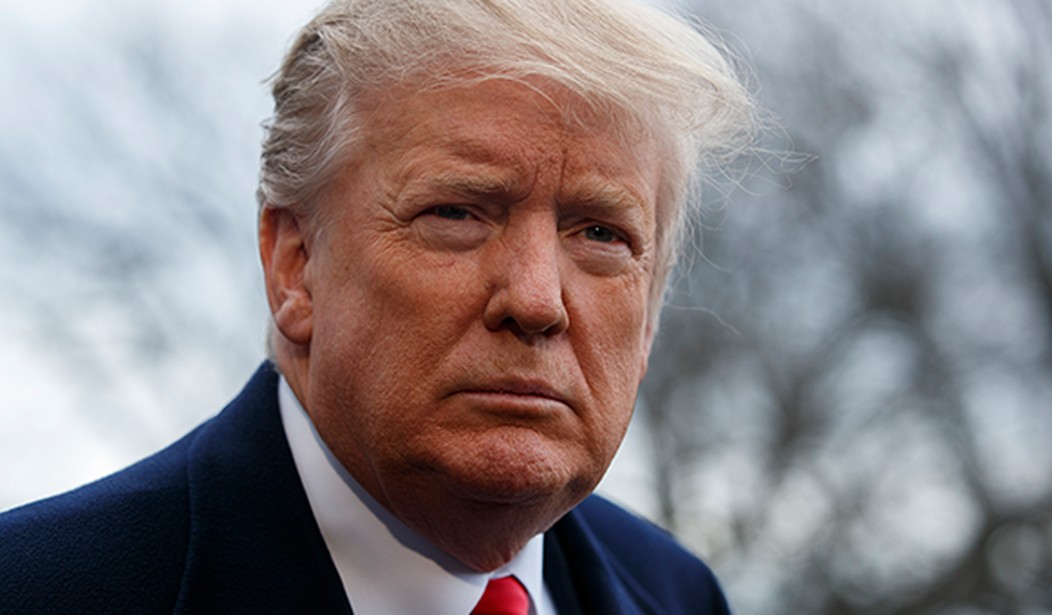
Donald Trump says what he thinks. Depending on your perspective, this quality is either refreshing or reckless. But it proved helpful in fending off charges that he obstructed justice or conspired with Russians to violate federal law.
Obstruction and conspiracy are supposed to happen in the shadows. Yet, as Attorney General William Barr noted on Sunday in his summary of special counsel Robert Mueller's report on Russian interference in the 2016 presidential election, many of the actions that Trump's critics have cited as evidence of his criminality happened in broad daylight.
While running for president against Hillary Clinton in July 2016, for example, Trump hoped aloud that Russian hackers would locate emails from the private server she used as secretary of state. "Russia, if you're listening, I hope you're able to find the 30,000 emails that are missing," Trump said at a press conference.
That comment can plausibly be described as a joke or a rhetorical stunt. But it is not the sort of thing a rational person would say if he were actually conspiring with Russian agents to influence the presidential election, whether through hacking or through online propaganda disguised as the political speech of Americans.
You might speculate that Trump is just really bad at conspiracy or that he is clever enough to understand that publicly inviting Russian hacking would make him look innocent. But after two years of investigation, according to Barr's summary, "the Special Counsel did not find that the Trump campaign, or anyone associated with it, conspired or coordinated with the Russian government in these efforts, despite multiple offers from Russian-affiliated individuals to assist the Trump campaign."
The obstruction issue is more complicated, not least because some legal scholars argue that the president cannot commit that crime by exercising his constitutional authority. According to this view, which Barr shares, Trump could have pre-emptively pardoned his cronies or ordered an end to the Russia investigation at any time for any reason, and the only consequences would have been political.
Leaving that issue aside, Trump made no attempt to hide most of the acts that his opponents portrayed as evidence of obstruction. He publicly fired FBI Director James Comey, publicly complained for a more than a year that Jeff Sessions had recused himself from the Russia investigation before finally sacking him, publicly described Mueller's probe as a "witch hunt" and publicly declared that he had "the absolute right" to pardon himself.
None of those actions stopped the Russia investigation, and firing Comey, which Deputy Attorney General Rod Rosenstein justified before turning around and appointing Mueller a week later, probably prolonged it. Trump's constant venting about the unfairness of the investigation and Sessions' failure to protect him from it aroused suspicion, making it look like Trump had something to hide.
While obstruction can be a crime even when it is unsuccessful, Trump's blatant ineptness and heedless flouting of political convention do raise questions about his motive, which is a crucial element of the offense. "While this report does not conclude that the President committed a crime," Mueller said regarding the obstruction question, "it also does not exonerate him."
Barr went further. "To obtain and sustain an obstruction conviction," he noted, "the government would need to prove beyond a reasonable doubt that a person, acting with corrupt intent, engaged in obstructive conduct with a sufficient nexus to a pending or contemplated proceeding." He and Rosenstein concluded that none of Trump's actions, "many of which took place in public," met all three criteria.
Strictly speaking, that conclusion is beside the point, as Justice Department policy precludes prosecution of a sitting president. But Mueller's report, combined with Barr and Rosenstein's gloss on it, gives ample cover to Republicans who would just as soon not try to remove a president of their party.
Trump will instead be judged by voters, and the case against him will hinge largely on the lack of self-restraint that helped save him from impeachment.
Jacob Sullum is a senior editor at Reason magazine. Follow him on Twitter: @JacobSullum.
Join the Conversation
VIP members get the ability to comment on articles.