





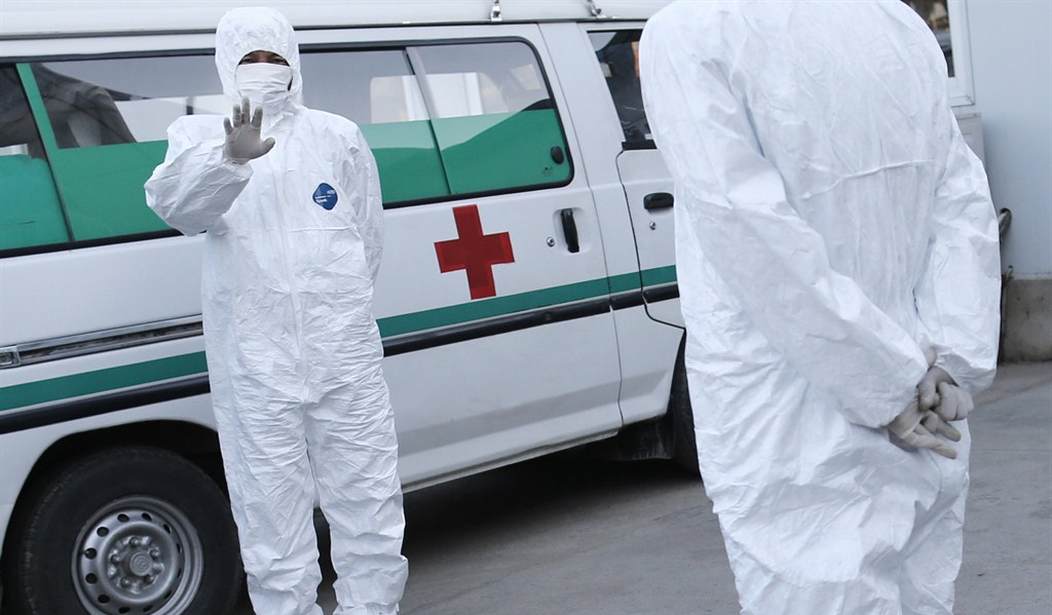
Last Friday, Charles LaVerdiere, chief judge of the Maine District Courts, ruled that any potential threat posed by Hickox, a nurse who returned to the U.S. on October 24 after treating Ebola patients in Sierra Leone, could be adequately addressed by "direct active monitoring" aimed at detecting the onset of symptoms should she become ill. Since Hickox "currently does not show any symptoms of Ebola and is therefore not infectious," LaVerdiere said, forcibly isolating her at her home in Fort Kent would not be justified.
To obtain the court order it sought, the state had to present "clear and convincing evidence" that Hickox posed a "public health threat" and that a 21-day quarantine was "the least restrictive measure" to deal with it. LaVerdiere concluded that "the state has not met its burden at this time to prove by clear and convincing evidence that limiting respondent's movements to the degree requested is 'necessary to protect other individuals from the dangers of infection.'"
Maine Attorney General Janet Mills welcomed the ruling. "The judge recognized the 'misconceptions, misinformation, bad science and bad information being spread from shore to shore ... with respect to Ebola,'" Mills said. "I believe we must do everything in our power not to fan the flames of fear but to encourage public health professionals such as Kaci Hickox to continue their brave humanitarian work."
Maine Gov. Paul LePage, by contrast, had some hot air ready to fan those flames of fear. "We don't know what we don't know about Ebola," LePage said while campaigning for re-election last Friday. "I don't trust (Hickox). And I don't trust that we know enough about this disease to be so callous."
Yet as LaVerdiere pointed out, the state's own testimony showed the quarantine demanded by LePage was unnecessary. In an affidavit, Dr. Sheila Pinette, director of Maine's Center for Disease Control and Prevention, observed that "Ebola Virus Disease is spread through direct contact with the blood, sweat, vomit, feces and other body fluids of a symptomatic person." She added that "individuals infected with Ebola Virus Disease who are not showing symptoms are not yet infectious."
In other words, as The New England Journal of Medicine explains, "an asymptomatic health care worker returning from treating patients with Ebola, even if he or she were infected, would not be contagious." The journal also notes that "fever precedes the contagious stage." Contrary to what LePage seemed to imagine, someone with a normal temperature who has tested negative for the virus will not suddenly start vomiting on fellow shoppers during a trip to the grocery store, setting off an epidemic.
Hickox, mindful of her neighbors' discomfort, nevertheless says she does not plan to go into town until after the incubation period ends on November 10, three weeks after she finished her work in Sierra Leone. If so, why did she bother challenging LePage's attempted quarantine?
"Sometimes we fight for our rights," Hickox told the Portland Press Herald, "but it doesn't mean we have to act on them." By showing that the routine quarantine of health care workers returning from West Africa does not satisfy the constitutional test typically applied in such cases, Hickox's case may help promote a more levelheaded approach in other states.
Like Hickox, The New England Journal of Medicine warns that the "unfair and unwise" quarantine policies adopted by states such as New York, New Jersey and Connecticut will "impede essential efforts to stop these awful outbreaks of Ebola disease" by deterring medical professionals from volunteering for work that is "stemming the epidemic at its source." Magnifying the Ebola threat in our imaginations could magnify it in real life.


Join the Conversation
VIP members get the ability to comment on articles.