





How do you know you don’t have a country?
Simply this:
Every single passive, non-aggressive act you take to repel people crossing your borders is considered de facto illegal, or inhumane, or in violation of international law, or in contraventions of some hidden clause in the U.S. Constitution.
So say the experts and their newly minted jurisprudence.
You may tell a toddler, “You can’t go there.” But you may not tell an illegal trespasser, “Hey, turn back. You can’t come into the U.S. at whim.”
Please understand that not giving someone something they demand or desire is a negative act. Or, more accurately, an inaction.
You are not actively doing anything to harm that person by denying them something.
Unless, of course, what you are denying them is their right to their life, their right to their liberty, their right to their property. Those are the only things you may not deny to innocent others. These interlopers do not have a right to, or a lien on, your liberty and property.
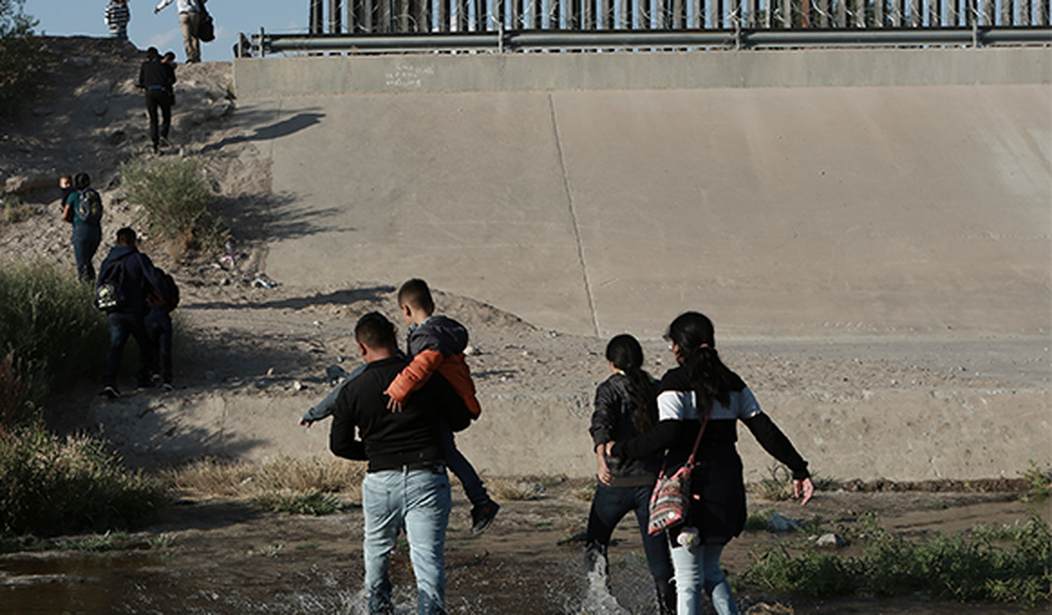
But if you cannot say to millions of people streaming across your border, into your turf, “Hey, you can’t go there.” Then it’s simple:
We don’t have a country.
Oh sure, we have a territory. America is a market place for goods and services. A mighty one at that. It’s a market place to which millions arrive each year to make a living and engage in acts of acquisitiveness.
America is a territory for trade. But is it a nation? Other than commerce and consumption, what is the glue that binds us together?
For to be a nation, citizens must, at the very least, be allowed to say to millions of strangers, “You can’t cross that threshold to enter my house.”
Individual citizens elect representatives so that they may speak on behalf of each one of us and say to strangers we have not vetted, “You can’t cross that threshold into the communities, institutions, and homes of the citizens we swore to protect.”
Individual citizens elect representatives so that these representatives can, collectively, protect their property, including their person, from harm.
According to the “night watchman state of classical liberal theory,” the protection of the integrity of property and person is the sole role of representatives. If you don’t get that small thing from those you elect; you don’t have representation.
Moreover, acts considered illegal and immoral when enacted by one individual against another’s person and property are still illegal and immoral when perpetrated by the many.
To wit, one hungry person may not break into another’s home in search of sustenance. By logical extension, millions of desperados cannot invade territories sustained by millions of others in search for their heart’s desire.
What each and every sane American is saying (even liberals), through his representatives, is this: “You can’t enter my home, unless I personally invite you to.”
And if your country and by extension your communities and homes are de facto open to everyone—we don’t have a country.



Join the Conversation
VIP members get the ability to comment on articles.