





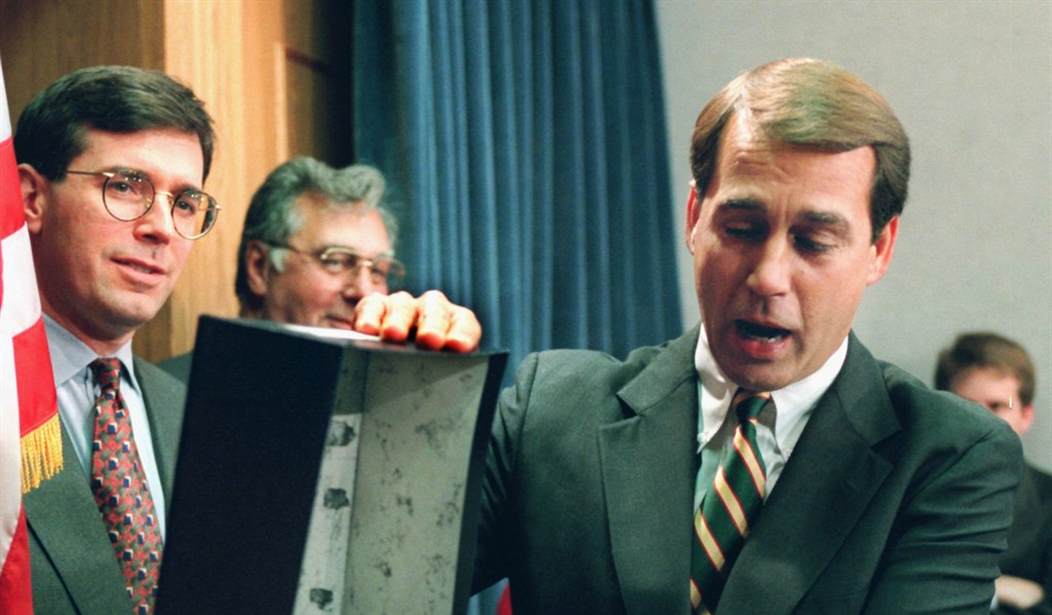
It is hard to believe that it was 25 years ago that we gathered on the west steps of the Capitol to announce our Contract with America. Perhaps prophetically, just before Newt began to speak, the clouds gave way to sunshine. The contract event had been months in the planning. While Newt Gingrich received much of the credit, it was actually the product of a collaboration that included Dick Armey and John Boehner.
Some of those assembled, like Randy Tate from Washington State, had not been born the last time the GOP controlled the U.S. House. Another candidate from Washington, George Nethercutt was running pretty strong against the sitting Speaker of the House. Michael Flanagan of Illinois was taking on the powerful Dan Rostenkowski. Since it was the first time we had all been together there were a lot of handshakes and introductions. A short guy from California worked his way through the assemblage. He had a warm smile and a friendly grip. Sonny Bono grinned even larger when he encountered a future colleague who had no idea who he was.
The Contract was brilliant on several fronts. It was a promise. In sales-speak, it was a conditional close. If the voters would give us the reigns of power, we would bring these 10 bills to the floor of the House for an up or down vote in the first 100 days of the next Congress. After the voters did their part and gave us the majority, it became a blueprint for us to follow. It gave us a solid message to talk about on the campaign trail and a clear agenda once we took office.
The ’94 freshman class of Republicans was one of the largest in history. It was a collection of some of the most interesting people I’d ever met. Few had any previous electoral experience. That was good. Like bumblebees, we didn’t know we weren’t supposed to fly. Perceived to be a redneck with the countenance of a southern gentleman, Roger Wicker from Mississippi was elected our class president.
We believed that we were elected to change Washington and wasted no time getting started. On the day we were sworn in we took up the first bill in the Contract, the Congressional Accountability Act. It formally required that Congress live by the same laws that we imposed on everyone else. I had been the Floor Leader in the Minnesota Legislature, so I was tabbed to lead the debate on the adoption of the rule, on the first bill, on my first day on the job. It was intoxicating.
Several of the planks in the Contract were about restricting abuses that had accumulated during the 40 years of uninterrupted Democratic Rule. Things like limiting Chairmanships to three terms, ending proxy voting and opening committee meetings to the public, all enjoyed widespread support.
Like an army, we marched through the bills and voted on all of them in the first 100 days. That meant long days. Chairman Henry Hyde quipped that it wasn’t so much the 100 days that wore him out, it was the 100 nights. We required an independent audit of the House and a three-fifths majority to raise taxes. Most items passed (the Constitutional amendment setting term limits came up short) and were sent to the president. President Clinton not only signed the bills, he took credit for them in his re-election campaign.
Led by fellow freshman Mark Neumann from Wisconsin, we forced some of the old bills on the Appropriations Committee to reduce the spending growth rate. They tried to get him removed from the Committee. We responded with a loud, "No You Won’t!" Mark was a math teacher turned real estate developer. He had a fairly simple formula that started with a question: Why should the federal budget grow at a faster rate than the average family budget? If we would limit the growth in federal spending, while allowing Americans to keep, spend and invest more of their money, we would balance the federal budget in less than seven years. He had charts and took them to the House floor for late-night special order speeches.
We accomplished some pretty amazing things. We reformed welfare, requiring work. We lowered taxes. The economy boomed. We cut the rate of growth in spending not only balancing the budget, we actually paid down over half a trillion dollars in publicly held debt. In fact, on the morning the plane was flying into the Pentagon, Republican Budget Committee members were meeting to discuss what to do with the growing surpluses.
The ensuing war changed everything. Spending restraint went out the window. Many of the reforms were papered over or tossed aside. But for seven shining years that began in September of 1994, history might indeed record that the Contract Class performed some things worthy of being remembered.
Gil Gutknecht was a Member of the freshman class of 1994 and served 12 years in the U.S. House of Representatives. He served on the Budget, Ag and Science Committees.


Join the Conversation
VIP members get the ability to comment on articles.