





Much has been written about conservatives in the United States over the past decade. Most of the studies and commentaries come with a healthy dose of bias against conservatism. Those that do the best still have a "Gorillas in the Mist" quality. Some things are vastly easier to understand than those studying them believe. So much of what has happened within the Republican Party since 2008 has been misunderstood and often intentionally spun on behalf of competing agendas. Many of the writers who have covered the GOP since 2008 lack any sense of history to put what is happening in proper perspective.
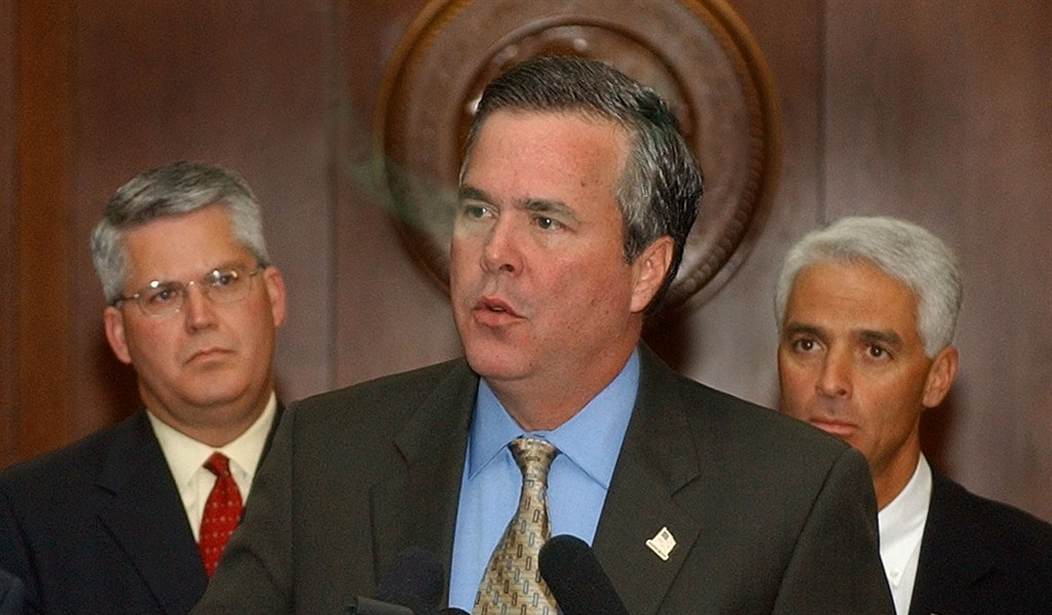
In 1994, conservatives rallied around a gubernatorial standard bearer named Jeb Bush. Young, from a family of Republicans and brimming with optimistic small-government rhetoric, he rode the Republican wave of 1994, but came up short in his quest for the governorship of Florida. His brother, on the other hand, won his own governor's mansion in Texas.
Had Jeb Bush won in 1994 instead of 1998, he would more likely than not have become president in 2000. His brother, claiming to be a "compassionate conservative," ran for president against John McCain and several single-constituency Republican alternatives. Conservatives rallied to that Bush instead, securing his nomination and election.
Given the war, conservatives remained loyal to George W. Bush even as he began an expansion of the federal government. Letting the late Sen. Ted Kennedy (D-MA) write his education plan, Bush expanded federal oversight of education. He also created a new, massive entitlement program under Medicare Part D, among other things.
On Aug. 15, 2003, conservative commentator Fred Barnes penned an op-ed in the Wall Street Journal defending President Bush's conservative credentials. "The case for Bush's conservatism is strong," wrote Barnes. Then, providing further license for President Bush's redefinition of conservatism, Barnes continued, "(Bush) is a big government conservative. This isn't a description he or other prominent conservatives willingly embrace. It makes them sound as if they aren't conservatives at all. But they are. They simply believe in using what would normally be seen as liberal means -- activist government -- for conservative ends. And they're willing to spend more and increase the size of government in the process."
Many conservatives privately bristled under this redefinition of conservatism. But the war, the closeness of the 2000 election and Bush's own personable nature had drawn much of the conservative movement to his administration. The movement and many of its leading voices had become appendages of and proxies for the Republican Party, surrendering intellectual integrity in the name of stopping terrorism and John Kerry by any means. They kept silent.
Two years later, on Oct. 3, 2005, the break up of the conservative movement with George W. Bush began. After defending him for so long and saying "big government conservative" with a straight face, the movement watched him nominate Harriet Miers for the Supreme Court. Then came immigration reform, the General Motors bailout and the Troubled Assets Relief Program.
The 2008 election should have given conservatives a cathartic moment. Bush's successor would have been forced to defend the Bush legacy, reject it or alter it. Conservatives would then have been able to use support or opposition of Bush's successor as a proxy for the Bush legacy.
But Bush's vice president did not run. Conservatives found themselves re-fighting John McCain, who they thought they'd dispatched in 2000. They rallied around Mitt Romney only to lose and then see Romney return as a more moderate and malleable candidate. The fight within the movement so many focus on now is a fight most often between those conservatives who stayed appendages of and proxies for the Republican Party after Bush against those who sought to reclaim their territorial and intellectual independence.
With 2016 approaching, Jeb Bush's run will finally give conservatives the moment they have wanted. They will be able to use Jeb as a proxy for George's legacy. It is not fair to Jeb Bush to view him as a proxy for his brother, but his candidacy will force the conservative movement to finally find peace over the role of conservatives using government as a means to an end.



Join the Conversation
VIP members get the ability to comment on articles.