





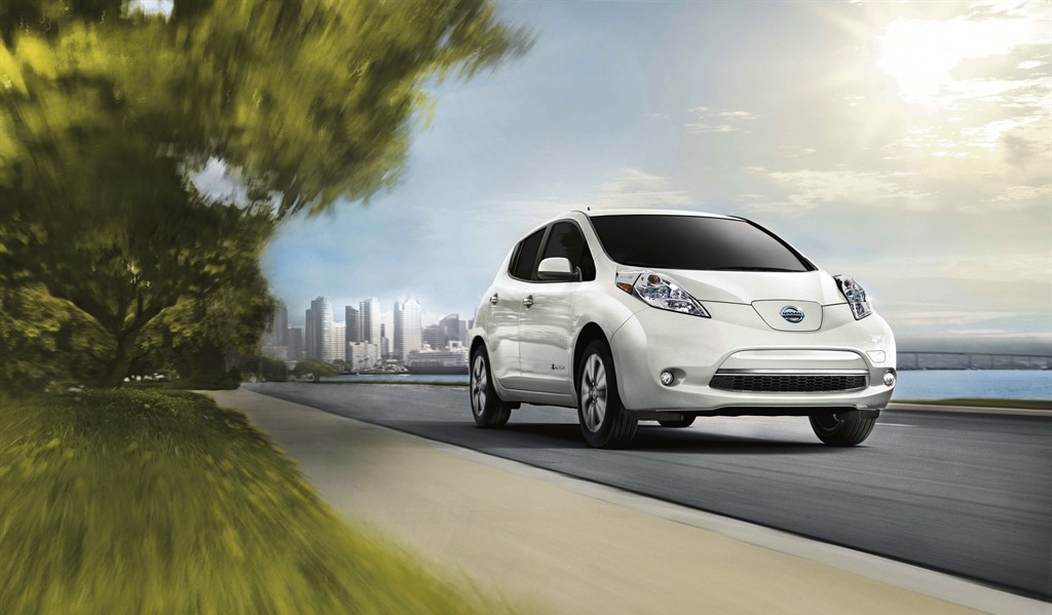
The left likes to treat skeptics of electrical cars as if they were Luddites. Truth is, making an existing product less efficient but more expensive doesn't really meet the definition of innovation.
Even the purported amenities and technological advances EV makers like to brag about in their ads have been a regular feature of gas-powered vehicles going back generations. At best, EVs, if they fulfill their promise, are a lateral technology.
This is why there is no real "emerging market" for EVs in the United States as much as there's an industrial policy in place that props up EVs with government purchases, propaganda, state subsidies, cronyism, taxpayer-backed loans, and edicts. The green "revolution" is an elite-driven, top-down technocratic project.
And it's increasingly clear that the only reason giant rent-seeking carmakers are so heavily invested in EV development is that the government is promising to limit the production of gas-powered cars artificially.
In August 2021, President Joe Biden signed an executive order to set a target for half of all new vehicles sold in 2030 to be zero-emission. California claims to ban combustion engines in all new cars in about ten years. So, carmakers adopt business models to deal with these distorted incentives and contrived theoretical markets of the future.
In today's real-world economy, Ford projects it will lose $3 billion on electric vehicles in 2023, bringing its EV losses to $5.1 billion over two years. In 2021, Ford reportedly lost $34,000 on every EV it made. This year, it was losing more than $58,000 on every EV. In a normal world, Ford would be dramatically scaling back EV production, not expanding it. Remember that next time; we need to bail out Detroit.
Then again, we're already bailing them out, I suppose. Last week, the U.S. Energy Department lent Ford -- again, a company that loses tens of thousands of dollars on every EV it sells -- another $9.2 billion in taxpayer dollars for a South Korean battery project. One imagines no sane bank would do it. The cost of EV batteries has gone up, not down, over the past few years.
Ford says these upfront losses are part of a "start-up mentality." We're still pretending EVs are a new idea rather than an inferior one. But scaremongering about climate and a misplaced romanticizing of "manufacturing" jobs have softened up the public for this kind of waste.
In the real world, there is Lordstown. In 2019, after General Motors -- which also loses money on every EV sold -- shut down a plant in Lordstown, Ohio, then-President Donald Trump made a big deal of publicly pressuring the auto giant to rectify the situation. CEO Mary Barra lent Lordstown Motors, a new EV outfit, $40 million to retrofit the plant. Ohio also gave GM another $60 million.
You may remember the widespread glowing coverage of Lordstown. After Biden signed his "Buy American" executive order, promising to replace the entire U.S. federal fleet with EVs, Lordstown's stock shot up.
By the start of this year, Lordstown had manufactured 31 vehicles in total. Six had been sold to actual consumers. (Most of them would be recalled.) The stock was trading at barely a dollar. Tech-funding giant Foxconn was pulling its $170 million. And this week, the company filed for bankruptcy.
Without massive state help, EVs are a niche market for rich virtue signalers. And, come to think of it, that's sort of what they are now, even with the help. A recent University of California at Berkeley study found that 90% of tax credits for EVs go to people in the top income strata. Most EVs are bought by high earners who like the look and feel of a Tesla. And that's fine. I don't want to stop anyone from owning the car they prefer. I just don't want to help pay for it.
Really, why would a middle-class family shun a perfectly good gas-powered car that can be fueled (most of the time) cheaply and driven virtually any distance, in any environment, and any time of the year? We don't need lithium. We have the most efficient, affordable, portable, and useful form of energy. We have centuries' worth of it waiting in the ground.
Climate alarmists might believe EVs are necessary to save the planet. That's fine. Using their standard, however, a bike is an innovation. Because even on their terms, the usefulness of EVs is highly debatable. Most of the energy that powers them is derived from fossil fuels. The manufacturing of an EV has a negligible positive benefit for the environment, if any.
And the fact is that if EVs were more efficient and saved us money, as enviros and politicians claim, consumers wouldn't have to be compelled into using them, and companies wouldn't have to be bribed into producing them.
David Harsanyi is a senior editor at The Federalist. Harsanyi is a nationally syndicated columnist and author of five books - the most recent, "Eurotrash: Why America Must Reject the Failed Ideas of a Dying Continent." His work has appeared in National Review, the Wall Street Journal, Washington Post, Reason, New York Post, and numerous other publications. Follow him on Twitter @davidharsanyi.


Join the Conversation
VIP members get the ability to comment on articles.