





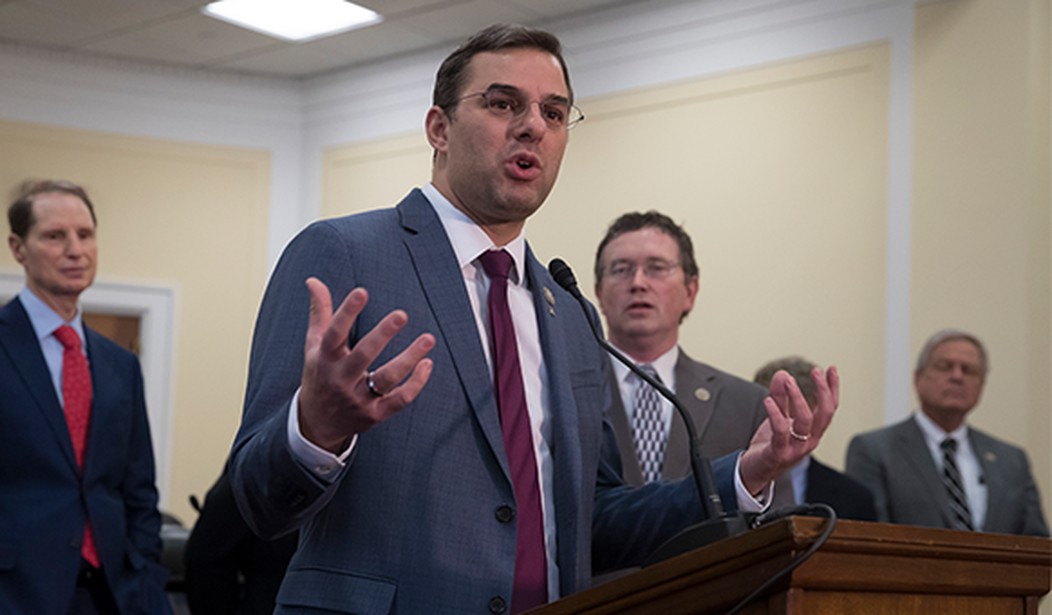
Rep. Justin Amash has left the Republican Party and will now represent Michigan's third congressional district as an Independent. In a Washington Post op-ed, he wrote: "I've become disenchanted with party politics and frightened by what I see from it. The two-party system has evolved into an existential threat to American principles and institutions."
Responding to Amash's announcement, President Trump called him "a total loser" who was unlikely to win a primary election next year against a Republican challenger.
No one is a total loser and some of Amash's concerns ought to be of interest to more of us. The parties are as divided as ever. Re-election seems to be the primary goal of many in Congress, along with nonstop fundraising.
The Founders never intended politics to become a career. They were farmers, lawyers, businesspeople, and average citizens who saw service to their country as a duty and a privilege, not a lifestyle. Most returned home to their real jobs after serving the nation for a brief time. Many of today's politicians serve for decades with no real connection to the people they were elected to serve.
Instead of clashes between parties whose interests do not promote the general welfare but instead appear mostly self-serving, candidates should debate which ideas have a proven track record of working, no matter their party of origin.
Our 30th president, Calvin Coolidge, who was born in a tiny hamlet in Plymouth Notch, Vermont on July 4, 1872, had abundant wisdom on numerous subjects. Horse, or common sense, they called it.
About taxes, which today's Democratic presidential candidates believe are not high enough, Coolidge said, "I want taxes to be less, that the people might have more," and "The collection of any taxes which are not absolutely required, which do not beyond reasonable doubt contribute to the public welfare, is only a species of legalized larceny" and "The wise and correct course to follow in taxation is not to destroy those who have already secured success, but to create conditions under which everyone will have a better chance to be successful." Copy to Bernie Sanders and Elizabeth Warren.
Coolidge also said you don't help build up the weak by tearing down the strong. Copy to all Democrats.
In his op-ed, Amash writes of partisanship: "These are consequences of a mindset among the political class that loyalty to party is more important than serving the American people or protecting our governing institutions. The parties value winning for its own sake, and at whatever cost. ... In this hyper-partisan environment, congressional leaders use every tool to compel party members to stick with the team, dangling chairmanships, committee assignments, bill sponsorships, endorsements and campaign resources. As donors recognize the growing power of party leaders, they supply these officials with ever-increasing funds, which, in turn, further tightens their grip on power."
He is right, but who is most at fault? Isn't it the people who vote for and allow them to stay beyond their "sell-by" date, corrupted by money and power? Too many voters are also compromised by what they get from the government.
Coolidge said, "The aim of our government is to protect the weak -- to aid them to become strong." That last part is key. Too many politicians want to subsidize the weak in their weakness, addicting them to government programs and the Democratic Party. Where in the recent debate among Democratic presidential candidates did you hear anything about government helping people to become less dependent on it and more independent of it?
Amash may not win re-election, but his critique of the dangers of extreme partisanship, where no idea from "the other side" should be considered valid, ought to be taken seriously. We have a history of ideas that worked and failed. We should reconsider the ones that worked and reject the ones that didn't.
Winning the battle of ideas ought to be paramount, not just beating members of the other party. Coolidge, a total winner, would approve.



Join the Conversation
VIP members get the ability to comment on articles.