





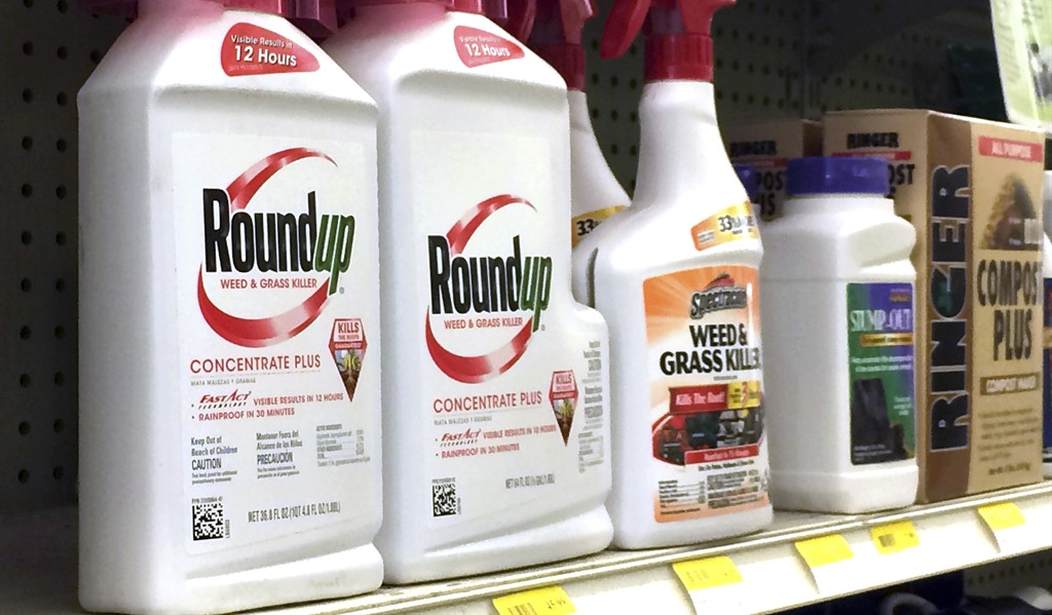
For over two years now, environmental activists and anti-industry groups have been raging against the U.S. government, the European Union, and practically anybody else that would listen about the herbicide glyphosate.
Glyphosate is a weed killer and the main ingredient in RoundUp. Weed killers are obviously a critical tool for American farmers and farmers around the world. The left-wingers are attacking weed killers despite the chemical receiving a clean bill of health from both the EPA and Europe’s main food safety and chemical authorities.
PRI.org reported late last year that “in November 2015, the European Food Safety Authority, or EFSA, found that glyphosate was ‘unlikely’ to cause cancer in humans. In the US, the EPA released a report that also said glyphosate was unlikely to cause cancer. That report was posted online in late April, but disappeared three days later. The EPA says that, although the report was labeled ‘final’ on every page, it was prematurely released.” Yet the left wingers are protesting from California to France and have been marching in the streets and testing their own urine to get it banned or restricted.
The impact to consumers of the anti-weed killer mafia would be to ban glyphosate, the most widely-used agricultural chemical of all time. U.S. farmers use 300 million pounds of the stuff each year. While anti-glyphosate activists argue that all that use is a threat to public health, they now have a major problem in trying to make their story stick.
Reuters reported on June 14, 2017 in a bombshell article titled “The WHO's cancer agency left in the dark over glyphosate evidence,” that “When Aaron Blair sat down to chair a week-long meeting of 17 specialists at the International Agency for Research on Cancer in France in March 2015, there was something he wasn’t telling them. The epidemiologist from the U.S. National Cancer Institute had seen important unpublished scientific data relating directly to a key question the IARC specialists were about to consider: Whether research shows that the weedkiller glyphosate, a key ingredient in Monsanto’s best-selling RoundUp brand, causes cancer.” It appears that the one study that drives their entire campaign has been exposed as bogus.
The International Agency for Research on Cancer (IARC) found that the weed killer was “probably carcinogenic,” yet the review’s chairman ignored some evidence that contradicted that conclusion. In fact, and according to EcoWatch, Blair himself worked on the decades-long Agricultural Health Study (AHS), which debunked allegations of a link between glyophosphate exposure and cases of cancer. The scientist was part of a team that looked at health data from 89,000 U.S. farm workers and family members that dated back to the 1990s on. Earlier data from that study had already found no link between the two, and the latest findings only strengthened that case. And Blair testified that the data would have changed the IARC’s whole analysis.
For some reason, this report was never published. Results oriented scientific research has no place in this type of important analysis. This cuts the legs out of the protesters who are relying on this IARC “study” to work over governments to ban the popular weed killer. According to the Reuters story, one of Blair’s researchers emailed him before a 2015 meeting that “it would be irresponsible if we didn't seek publication of our NHL manuscript in time to influence IARCs decision." Three years later, that data has yet to be published because as Blair states, “you couldn’t put all that in one paper.”
One reason why Americans should be angry with results oriented scientific research is that they pay for it. American taxpayers’ money pays for IARC’s work through the World Health Organization and the United Nations, in addition to direct grants from the U.S. government.
In Europe, the head of the European Food Safety Authority (EFSA) came under attack by green campaigners because his researchers dared contradict IARC’s conclusion. For mild-mannered scientists, EFSA raised eyebrows for coming out swinging against what it called “Facebook science.”
The federal government and the states rely on IARC to make determinations of what substances can be linked to cancer. Sept. 11 first responders relied on the IARC to determine that 15 of the compounds present at the World Trade Center were known carcinogens. Yet, in this case the new revelations have spurred talk of withdrawing the IARC glyphosate monograph that is the underpinning of a pending case against RoundUp in California right now. The IARC needs to fix the deliberative process and stop suppressing scientific evidence that contradicts the finding they want to conclude. The public deserves an organization to produce an accurate judge of potential cancer hazards – the IARC has called into question whether they deserve to be that source for reliable scientific analysis.
Join the Conversation
VIP members get the ability to comment on articles.