







Imagine this. An automobile manufacturer adds a turbocharger to the engine of a passenger car as a way to increase the vehicle’s acceleration. Nanny State bureaucrats at the National Highway Traffic Safety Administration decide that the turbocharger makes a vehicle to which it is attached go too fast, which renders it “unsafe.” The agency decides that the simplest way to address its concern is to include within the definition of an “automobile” a “turbocharger,” which the agency then can outlaw as an “unsafe motor vehicle.”
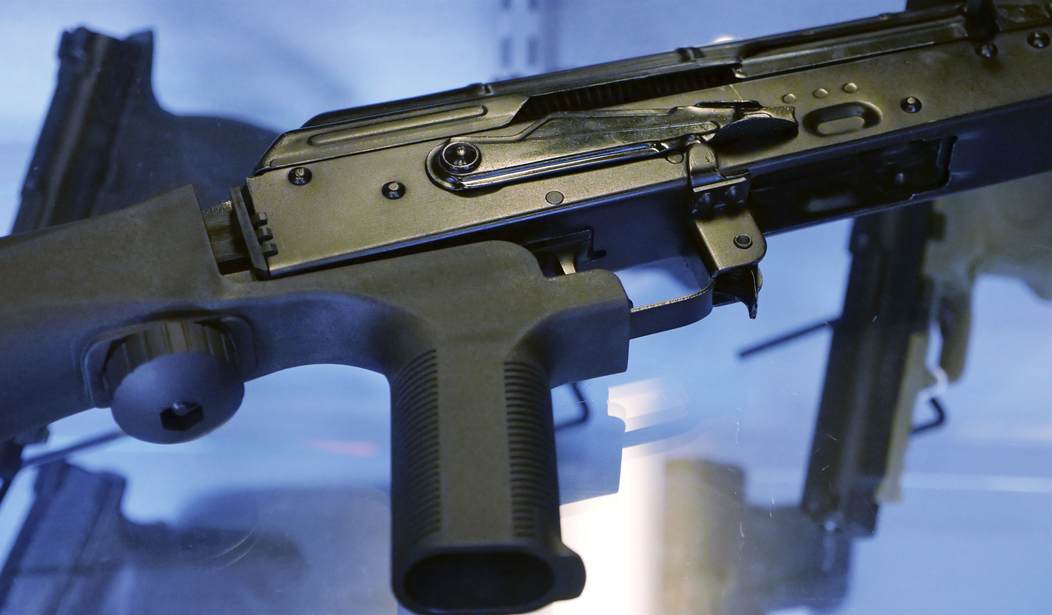
“Nonsense,” you say – a car “part” is not a “car,” right? Correct, yet that is precisely what the United States Department of Justice did in 2018 when it deemed by regulatory re-write, that an accessory that could be attached to a rifle to make it fire faster – a “bump stock” – was in fact and by law, a “machine gun” and therefore unlawful to be owned or possessed by individuals.
Thus, by regulatory fiat a piece of plastic, which is all a bump stock is, becomes a “machine gun” for purposes of federal law.
Despite the absurdity of this regulatory maneuver, the Supreme Court on Monday once again declined to hear arguments in cases challenging the constitutionality of the government’s bump stock redefinition.
The Court should have heard arguments in the case, to enable a majority of justices a way to declare such regulatory legerdemain is a constitutionally impermissible exercise of legislative power by the Executive Branch (aside from it being an example of absurd legal reasoning that no president should get away with).
While gun control advocates, including the Biden administration which had urged the Court not to hear the cases, characterize the issue as a “Second Amendment” case, it truly is not. At its core, the legal issues center on regulatory law, not Second Amendment law, and the repercussions extend far beyond firearms.
Like many of Uncle Sam’s bad decisions in recent decades, this one outlawing bump stocks was a knee-jerk reaction to a specific incident – the 2017 mass shooting by a crazed gunman from a hotel window in Las Vegas, Nevada. A number of bump stock-modified rifles were found in the murderer’s hotel room after police breached his barricaded door.
The publicity surrounding the Las Vegas shooting led to calls to change the law and ban the theretofore little-known, but legal, firearm accessory. Congress could not make a decision, so the responsibility fell to President Trump to show the American people he was “doing something.” That “something” was to order his then-Attorney General, Jeff Sessions, to take executive action against the devices.
It eventually fell to Sessions’ successor, Acting Attorney General Matthew Whitaker, in late 2018 to actually amend the long-standing definition of a machine gun so as to include a bump stock within its terms. It is this presidential action – changing federal law by the “stroke of a [regulatory] pen” – that has set a dangerous precedent that should concern liberals and conservatives.
Allowed to stand, this precedent permits extensive presidential mischief that can be wrought by Republican and Democrat administrations alike, targeting all manner of activities and products regulated by the federal government, without having to go through the often messy and time-consuming congressional legislative process.
Thanks to this Trump-proposed regulatory maneuver, virtually any federal regulation – including those involving such wide-ranging issues as the environment, health care, banking, firearms, and even abortion, among hundreds more – can serve as the vehicle for a president to unilaterally enact substantive changes to federal laws.
Regardless of why the Supreme Court declined to accept this challenge to what is by every reasoned analysis an abuse of Executive Branch regulatory power, Big Government advocates will be left extremely happy by the decision. It leaves wide open a side door by which this and future administrations can run roughshod over the system of checks and balances so carefully crafted by our Founders, but which has been so often undermined by successive administrations of both major parties.
Bob Barr represented Georgia’s Seventh District in the U.S. House of Representatives from 1995 to 2003. He served as the United States Attorney in Atlanta from 1986 to 1990 and was an official with the CIA in the 1970s. He now practices law in Atlanta, Georgia and serves as head of Liberty Guard.

Join the Conversation
VIP members get the ability to comment on articles.