





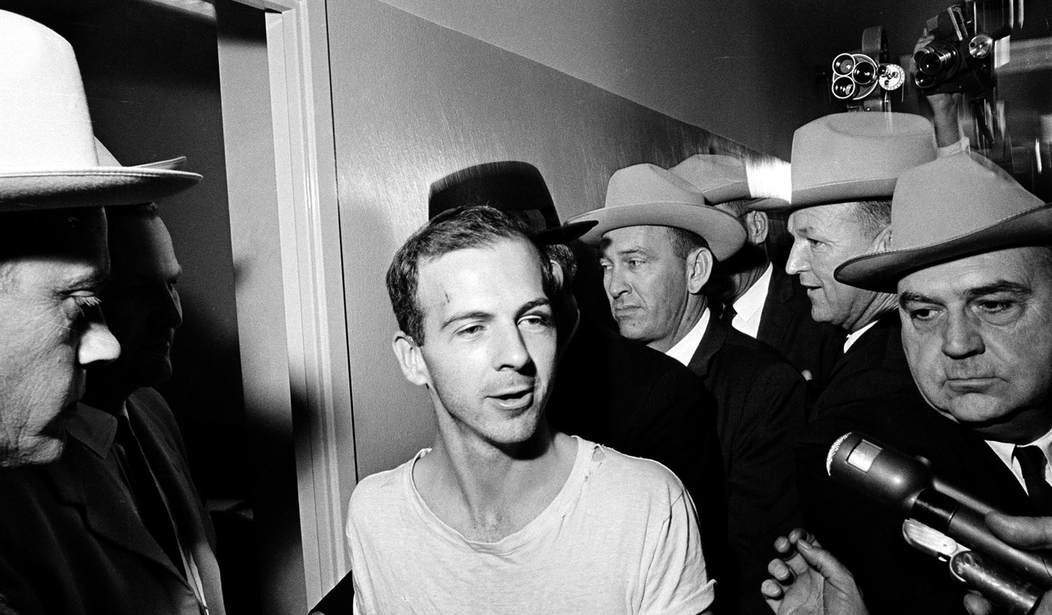
This week, the Trump administration released tens of thousands of documents regarding the assassination of President John F. Kennedy. Speculation about the "real explanation" for JFK's assassination has been an enormous cottage industry for decades; as of November 2023, a Gallup poll showed that 65% of Americans believe that people other than Lee Harvey Oswald were involved in the murder. At no point since the assassination have a majority of Americans believed the truth: that Oswald was a lone gunman.
Perhaps that's because the idea of a lone gunman achieving such a high-profile assassination on camera in the modern age seems so unthinkable. But, of course, it isn't: William McKinley was assassinated by a lone gunman in 1901; Teddy Roosevelt was shot in the chest in 1912 while campaigning for president; in 1933, FDR narrowly escaped assassination when Giuseppe Zangara fired five shots at him, killing the mayor of Chicago; Gerald Ford was nearly assassinated twice in a three week stretch in 1975; John Hinckley Jr. shot Ronald Reagan just a few weeks into Reagan's presidency in 1981; and, of course, Donald Trump was nearly assassinated during a campaign speech last year. In other words, presidential assassinations are shockingly common.
So why are so many Americans convinced, despite all available evidence, that others were involved in the JFK assassination? Much of it has to do with the rapidly declining levels of trust in the American government since the 1960s. While only 52% of Americans believed in a JFK conspiracy theory in 1963 -- an idea fostered by legacy media, which claimed that he had been killed by right-wing "hate" -- by 1976, that number had skyrocketed to 81%. That trend correlates with a radical increase in distrust in government generally: In 1964, some 77% of Americans said that they trusted the government to do the right thing always or most of the time; by 1976, that number had dropped to 35%. (As of 2024, by the way, that number is 22%.)
Now, distrust of government is a perfectly normal and even admirable feature of American political life dating back to the founding. The founders distrusted government not to abuse the rights of individuals, and thus sought checks and balances to prevent it from occurring. But since the 1960s, American distrust of government has been matched by a massive expansion of governmental intrusion. All of which suggests that our modern distrust of government carries with it a different flavor: a flavor of the conspiratorial. The founders believed that ambition was common to all men, and that ambition thus had to counteract ambition; today's Americans instead believe that the problem is that our government is staffed by uniquely bad men.
The founders were right: the corruption of government is innately connected to its scope. But today's Americans instead believe that the corruption of government is simply a question of the wrong people controlling the government. The problem isn't a government with too much power, but a government controlled by enemies.
Now, undoubtedly, there are awful people in government. And certainly there have been conspiracies of such awful people within government (see, for example, the Anthony Fauci-led attacks by career staffers on those who opposed Covid-19 lockdowns). But if we misattribute broad and endemic problems of government to such conspiracies despite all available evidence, we miss the point: We maintain the size and scope of government while hunting shadows, and training ourselves to distrust our own eyes in the process.
Conspiracies exist. But they require evidence. Otherwise, they're conspiracy theories. And a country that falls for conspiracy theories without any supporting evidence is a country ripe for the plucking by demagogues on all sides.

Join the Conversation
VIP members get the ability to comment on articles.