





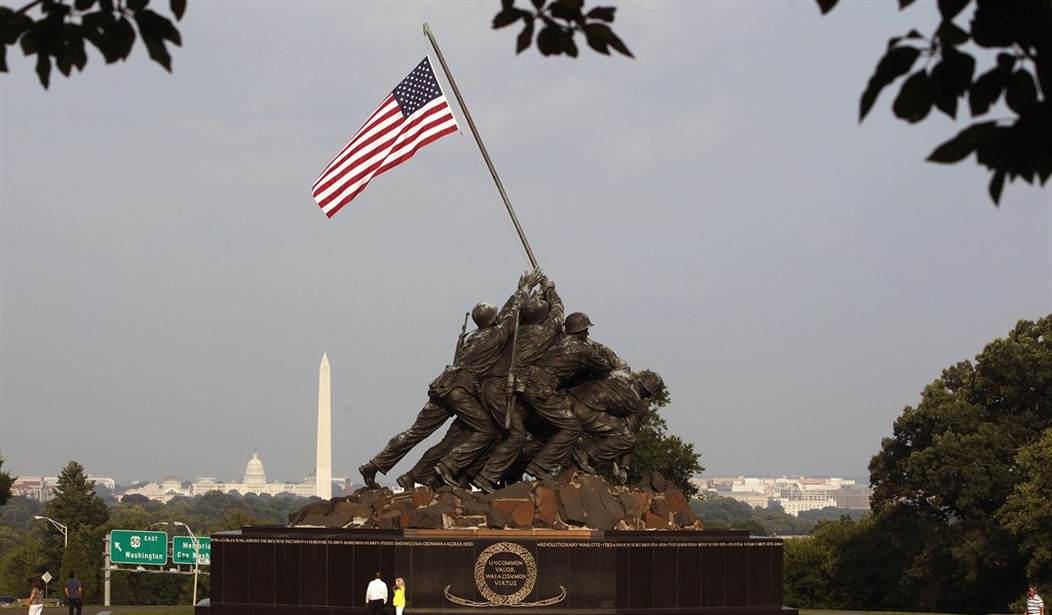
From Feb. 19, 1945 (when U.S. Marines assaulted its beaches) to March 27 of that year (the day combat officially ceased), the island of Iwo Jima was hell on earth.
In 2009 I began writing occasional columns commemorating the 70th anniversary of key WW2 battles and events. I dedicated them to the WW2 generation. Twenty-year-old Marine vets of February 1945 are now 90, if they are still among us.
Iwo Jima was on my list of must-cover subjects. By sheer coincidence, my wife and I spent this past weekend in Dallas, Texas, with the sister of a Marine F4U Corsair pilot who was shot down near the island in late February 1945. He survived WW2, but is now dead. I thanked her for her brother's service. She said she believed her brother was supporting Marines fighting on Iwo. Then -- eyes tearing -- she added that she wished he was still alive.
Iwo Jima is one of WW2's more memorable battles. Popular culture certainly treats it as an iconic clash. John Wayne's epic Sands of Iwo Jima is one of many Hollywood fictional treatments of Iwo Jima's terrible reality that inform the collective memory of 21st-century audiences.
Nonfiction reporters and film crews thoroughly documented that terrible reality. The savagery on Iwo Jima's eight square miles of beaches, ridges and volcanic rubble produced a trove of combat film and photos. Wartime censors often clamped down on footage they thought too ghastly to include in public theater newsreels. However, the image of Iwo Jima's relentless close battle of infantry and flame-throwing tanks was difficult to cleanse.
On Feb. 23, 1945 photographer Joe Rosenthal followed Marines up Mount Suribachi and snapped his Pulitzer Prize-winning picture of Marines (and a Navy corpsman) raising the U.S. flag on its heights. We later learned Rosenthal photographed the second Suribachi flag-raising, but the dangerous gallantry he recorded was authentic. Three of the men who raised the flag would die on the island.
Which leads to the fundamental reasons Americans should remember the battle: its price in blood and the strategic value of seizing it.
Between Feb. 19 and March 27, the U.S. suffered 25,000 casualties; approximately 6,800 Marines and U.S. Navy personnel killed, another 18,000 wounded.
Pre-invasion, U.S. intelligence estimated the Japanese garrison had 22,000 soldiers. By March 27, the Marines had taken 216 Japanese prisoners. Many Japanese prisoners did not surrender. Marines found them amid volcanic rubble, wounded and unconscious. U.S. commanders believed their forces had killed the other 21,800.
Note this column's first sentence identifies March 27 as the official date the battle concluded. Over subsequent weeks and months, several hundred more survivors emerged. Japan had 25,000 troops on the island. Some of the 3,000 holdouts committed ritual suicide rather than surrender.
The holdouts hid in the island's extensive defensive system, which included machine gun bunkers and concealed artillery positions, concrete-reinforced tunnels connecting underground barracks (some branches extended beneath Mount Suribachi) and hundreds of caves with bunkered or camouflaged entrances. The tunnels and caves were stocked with food and ammunition.
The system was designed to do two things: withstand the hellacious bombardment U.S. air and naval forces always delivered, and then force American infantry to spill blood and die for every inch of the island rock.
Beginning with Peleliu (September 1944), Japan pursued a strategy of strategic attrition. Fanatic resistance on heavily fortified outlying islands would bleed U.S. forces. Rather than suffer horrendous casualties, America would negotiate a ceasefire.
Iwo Jima was, in many respects, a super-Peleliu, a strategic trap.
This is why, among military historians and military planners, Iwo Jima has become one of the war's more controversial operations. The island was supposed to serve as a staging area for invading Japan; it didn't. Some senior officers argued that seizing the island gave B-29 bombers attacking Japan's home islands a safe landing strip. But at the price of 6,800 dead Marines?
At a dinner party in 1998, a Marine vet told me that in 1968, Iwo Jima was still a touchy subject in the Corps. His comment paraphrased: We paid such a steep price, you just didn't raise the issue of utility. I said, as a guy still pulling duty on joint planning staffs, the decision to invade Iwo Jima troubled me. And maybe it should. But that's hindsight. There were several vets at the dinner. We poured another round of drinks and toasted the Marines, every damn brave one of them.
Join the Conversation
VIP members get the ability to comment on articles.