





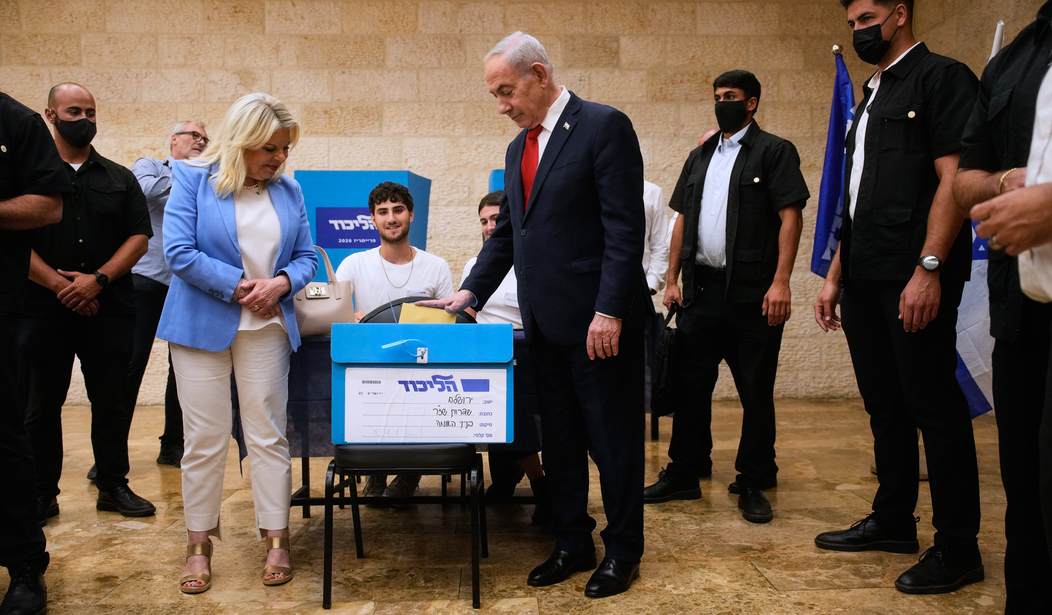
Israelis head to the polls, and they really head to the political poles.
For many years I lived in Israel on work visas. My wife working at the appropriate ministry for such things definitely helped my doing so for over a decade. Then one day, against the law of the country, the folks at the Interior Ministry said no more visas. It was time to put up or shut up. So I asked what flavors of ice cream were available, and there were two: citizenship or permanent residency. Both would give me an ID card and require me to pay Israeli (along with U.S.) taxes. The only noticeable difference was that I could not vote in national elections as a permanent resident. I chose to become a permanent resident. I vote in Jerusalem for mayor and city council, but I don’t vote for the Knesset. I am and remain a proud citizen of the United States of America.
Israelis go to the polls in late October. Israeli politics are like a car crash played out over the course of several months. There are around two dozen political parties, the bigger ones being Likud and various rotating parties now that Labor has all but disappeared from the political map. Then there are many smaller parties, some swearing that they will never sit with certain other parties due to ideological differences. Some keep to their word while others find some magical dispensation to sit with the sworn enemy, usually in the form of ministries and hundreds of millions of shekels for favored projects. Amazing how that works. The last time there were elections, it took multiple rounds before a stable government could be formed. The problem is that Israel is facing its own challenges of a growing Arab population.
All Israeli citizens enjoy equal rights. That’s true for Jews, Christians, and Arabs. Not all enjoy equal obligations. Very few Israeli Muslims serve in the IDF, and one of the arguments of the ultraorthodox when being told to join up is to say that the same should apply to all Arabs, which includes about two million of Israel’s 10 million citizens. The problem faced in the last election, and that may occur again in a few months, is one of simple math. To have a legitimate and stable government, the prime minister should have at least 61 seats in the 120-person Knesset. The days of the Mapai Party (precursor to Labor) having large majorities on its own are long gone. Every government for the past few decades has involved active coalition-making and oftentimes unseemly horse-trading. “Bring your seven seats, and I’ll give you three ministries and 100 million shekels for your favorite subject.” If the ultraorthodox refuse to sit with parties that want to send their young men to the army and the religious Zionist parties refuse to sit with the more dovish parties that fantasize about peace with the Palestinians, then the left once again has no way to get to 61 seats without turning to Arab/Islamist parties. Arabs, supposedly suffering from some form of apartheid according to the smart set in the West, hold between 12-15 seats in Israel’s Knesset. The only non-Bibi government in the last 20 years had to include an Islamist party to reach the magic number of 61. Any government with an Arab party will be seen by most Israelis as illegitimate. How do you have sensitive security discussions when you suspect that somebody in the room is sending WhatsApp messages to Hamas in real time? Israel has no solution for absolute Arab-Muslim fidelity to the state, and the left no longer has the attraction to win elections as it used to do (think prime ministers like Ehud Barak, Ehud Olmert, Ariel Sharon, and Yitzhak Rabin).
And the problem described above is the ultimate conundrum of the modern state of Israel. It is generally described in the press by two monikers: “the Jewish state” and “the only democracy in the Middle East.” And both are correct. A person who can confirm his Jewish identity may receive citizenship immediately, whereas someone else would have to go through some type of extended process to receive the same. This is the idea behind having a Jewish state: every Jew in the world should have a place to go to live, be safe, and thrive. This was the promise of those who declared the state and fought for its founding. But a democracy implies that everyone is equal and has exactly one vote. And this is true in Israel. Arabs — Christians and Muslims — are NOT 3/5 people; no, their vote is exactly the same and equal to that of any Jew in the land. And thus, the Arab parties take 10-plus percent of the seats in the Knesset. I always find it somewhat amusing and quite annoying when some Arab Knesset member trashes the state of Israel while collecting over $10,000/month from the same. When the left was strong, it could still form governments with Labor-Meretz, the ultraorthodox, and other groups. Since the second intifada and the bloodletting under the guise of “peace,” Israelis have soured on the political doves. They want security and a strong economy. Also, the more religious parties will not sit with the more anti-religious parties. So the political left is dead — unless it is willing to join forces with that sliver of Arab representation to get over the 61-person threshold.
I can’t predict what will happen in the upcoming elections. On the one hand, many feel that Bibi Netanyahu was ultimately responsible for the pogrom on October 7, 2023. On the other hand, his government has led the thrashing of Hamas, Hezbollah, and Iran. I don’t know if the people are finished with him. Additionally, the generally monolithic ultraorthodox parties are finding that their younger members want jobs, and some are interested in joining the IDF. Unlike in previous generations, they are looking at parties other than the ones that the rabbis tell them to vote for. The parties on the right enjoy support from younger “charedim” (ultraorthodox), and in the recent Likud primaries, many ultraorthodox seemed to be found at the polling sites. The more left of the political spectrum also wants Hamas and Iran neutered, so I don’t hear anyone bleating on like Shimon Peres did about “peace partner” and “two states for two people.” Every day gives a different poll — Bibi is in the lead, no, it’s Bennet, oh, Eizenkot is the man. I don’t believe any of it, because much of the outcome depends on turnout. Israelis can only vote if they are in the country, and when Bibi beat Shimon Peres, a lot of Israelis flew home specifically in order to vote. I don’t know if we will see the same again this time around.
The outcome of the elections will involve parties receiving between four (the minimum for entry into the Knesset) and probably 30 seats. The president (Isaac Herzog) will task somebody to put together a government. Generally, the head of the party with the most seats, or the one with the greatest likelihood of getting 61 members, will get the first nod. Then the deal-making starts. Whoever ends up being prime minister will most likely keep much of the status quo. Everybody wants a good relationship with Washington. Nobody wants Hamas or Iran to return to their former positions of strength. So even if there is some change in the government, there probably will be very little change in policies. Nobody will kill the startup culture or upset Donald Trump. Hang on for a wild ride. We were in the U.S. in November 2024. My Israeli wife could not believe how calm Election Day was there. Israeli politics are crazy, and there are still two months to go.
Editor's Note: Do you enjoy Townhall's conservative reporting exposing the radical Left and woke media? Support our work so we can keep bringing you the truth.
Join Townhall VIP and use promo code FIGHT to receive 60% off your membership.

Join the Conversation
VIP members get the ability to comment on articles.