





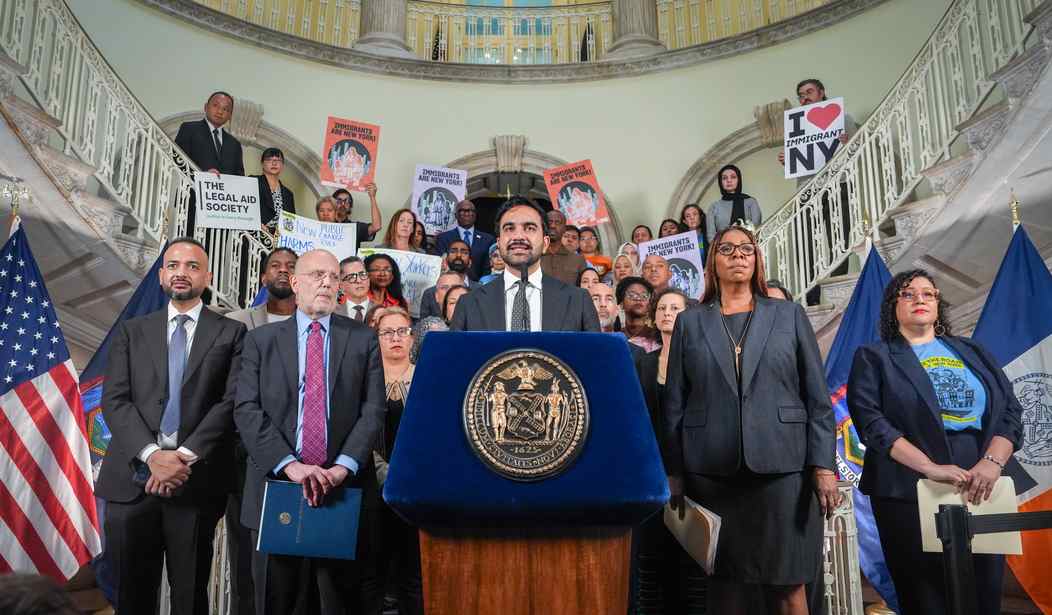
“Reparations is a legitimate domestic and international demand for compensation and repair for the damages associated with slavery, genocide, and colonialism,” proclaims a prominent DSA blog. The sentiment is also frequently aired by current DSA political candidates.
Those who advocate reparations argue that, seven or eight generations after slavery was abolished in the U.S., descendants of enslaved people remain disadvantaged and are still unable to participate fully in the nation's economic life because of slavery and of Jim Crow’s lingering effects. Even if one accepts such a highly faulty premise, a fundamental question remains: Who owes what to whom?
Who Should Pay Me?
Only a small percentage of American households in the 1860s owned slaves. The overwhelming majority of white Americans, the South included, did not own slaves, could not afford to own them, and had no direct involvement in the institution of slavery.
At the same time, the current descendants of those who did own slaves almost certainly rejected and condemned slavery. Should they bear financial responsibility for the actions of ancestors who lived more than 160 years ago? Should Americans whose families had no connection to slavery bear that responsibility as well?
Even if it were possible to identify every living descendant of slave owners and every living descendant of enslaved people, how should financial responsibility be determined? And, should Americans whose ancestors played no role in slavery or Jim Crow, regardless of race, be expected to pay anything?
Payment to Whom?
Here is a historical consideration that DSA advocates do not address. The U.S. fought a bloody, four-year Civil War to end the Confederacy, with hundreds of thousands of soldiers killed and many more wounded. Should the descendants of Union soldiers who fought to preserve the nation and ultimately abolish slavery bear the same financial responsibility as descendants of slave owners? What about the greatly diminished earning power of white Union families who lost their chief breadwinner in the Civil War?
What of the black Americans who did not descend from enslaved people? Millions immigrated to this country long after slavery ended in 1865. Many have no ancestral connection to American slavery and, it needs to be emphasized, no interest in receiving reparations. If such Americans suffered financially under Jim Crow laws, or other forms of discrimination, would ‘equitable’ distribution of reparation funds somehow become any clearer?
Slavery in America, as well as discrimination, also affected more than one group. Native Americans were enslaved in certain regions during various periods of American history. Some Chinese laborers and other immigrant groups endured working conditions so exploitative that critics have likened them to forms of involuntary servitude.
Pendants for Descendants?
Determining eligibility presents untold challenges. Would eligibility depend solely on ancestry? If someone has one black grandparent descended from enslaved people but three grandparents with no such ancestry, how would compensation be calculated? Where would eligibility begin and end?
After seven or eight generations, it is extraordinarily difficult to measure present-day economic differences that can be attributed directly to slavery, likewise three or four generations after the end of legalized discrimination.
Many immigrants with darker skin who arrived in the U.S. within the past few decades have achieved remarkable economic success, often surpassing national median incomes within one or two generations. Their experiences raise questions about whether present-day disparities can reasonably be attributed solely to slavery that ended more than 160 years ago or to other forms of discrimination before LBJ’s Great Society legislation in 1965.
All Aboard the Success Train
En masse, recent immigrant groups have prospered economically. Americans of Indian, Filipino, Pakistani, Sri Lankan, and several other Asian backgrounds, for example, have median household incomes that exceed the national average, including that of white Americans. Any proposal for reparations would have to explain how such outcomes can even occur. Could it be that these newly arrived, non-white immigrants focus on the vast opportunities that our nation provides and not on perpetual victimhood?
Do reparations advocates account, as well, for the extensive efforts undertaken by federal, state, and local governments during the past six decades? Affirmative action programs, equal employment laws, anti-discrimination enforcement, educational initiatives, and numerous other public policies have involved more than $22 trillion in government spending.
One can argue that these efforts were intended to address the enduring effects of historical discrimination and cannot be ignored when focusing on reparations. Curiously, never addressed in any reparations discussion are the decades-long disproportionate numbers of black-on-white murders and assaults. The cost of which are virtually incalculable.
A Comparison of the Ages
Last, if reparations are intended to compensate black Americans for the economic opportunities their ancestors lost, as espoused by Ta-Nehisi Coates in "The Case for Reparations" and backed by prominent DSA members, one might compare average incomes in the U.S. with average incomes in the regions of West Africa from which many individuals were taken, most often sold by fellow Africans.
Average annual incomes in parts of West Africa today are only a fraction of average incomes earned by black Americans. Taken literally, such a comparison could produce the conclusion that black Americans owe the U.S. government for the economic advantages of living here — to which no one would make such an argument.
The notion above merely illustrates the difficulty of reducing a historical issue to a simple financial calculation. If it is unreasonable to demand that black Americans surrender part of the wealth they have earned through their own talent and hard work, it is unreasonable as well to require contemporary Americans to compensate them for actions committed by Americans who died long before 1964.
Editor’s Note: Do you enjoy Townhall’s conservative reporting that takes on the radical Left and woke media? Support our work so that we can continue to bring you the truth.
Join Townhall VIP and use promo code FIGHT to receive 60% off your membership.



Join the Conversation
VIP members get the ability to comment on articles.