





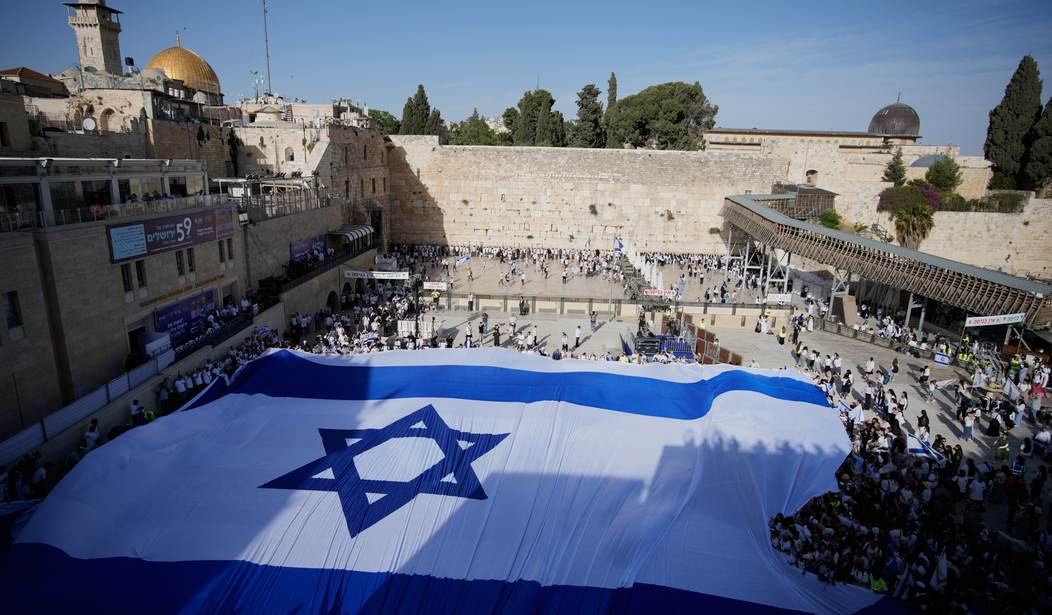
There are some amazing things to see in the Holy City.
Jerusalem, in many ways, is like cities of similar size throughout the world. It has an expanding light-rail line, and its heavy train service has cut the time to get to Ben Gurion Airport from nearly an hour to 22 minutes. It has awful traffic jams, not infrequent protests by some group that is unhappy, expensive housing, and a wide range of restaurants from which to choose. But if one goes to the Old City and to the City of David, he can enter a world of the distant past.
I have always had an attachment to Jerusalem, even when growing up in Chicago. I used to scan the Chicago Tribune for articles about the city or Israel in general. For years, I had a brass JERUSALEM key chain, which went with me everywhere. If Jerusalem is a magnet, then the Western Wall is an electromagnet. It draws a person, and I have seen many a visitor talk to God there and begin to cry. There are very few places where one feels that he is leaving our modern society and transporting back to an earlier time. The Museum of Science & Industry in Chicago had a 19th-century street, and there are still places in Europe and in the Middle East where time seems to have stopped for at least a couple of hundred years. But in Jerusalem, one is transported back 3,000 years. As the Bauers did not make a big vacation this year, we at least made our way to the new City of David exhibit: the Pilgrimage Road. The first time I heard about it, I read about Secretary of State Marco Rubio and U.S. Ambassador to Israel Mike Huckabee visiting the new exhibit.
The tour took two hours and covered primarily the period of the Second Temple. Before we hit the main part, we walked by an earthen retaining wall built by the prophet Nehemiah, after the Persian king gave him permission to return to the Land of Israel and made him his local governor. The tour starts at the southern approach to the Temple Mount. Over 600 meters, one walks up toward the retaining walls built around the site of the Temple. Jerusalem is well-known to be multi-layered, as each group that conquered and ran the city plowed over what was there and built on top of it. Thus, we found ourselves walking on a Roman street that headed up from the Siloam Pool toward the main city. The pavement stones were massive and reflected Rome’s attempt to honor the city and keep the activities of the locals going. According to the guide, the street was built in the year 30, less than 40 years before the Jewish revolt and the destruction of the city and the Second Temple at the hands of Titus and his Tenth Roman Legion. The Romans built holes in the street that allowed rainwater to flow into a sewer system below. In the sewer, coins were found. On one side, they said, “Redemption for Zion,” and on the other, “In the Second Year of the Revolt.” Also found in the sewer system were coins from all of the surrounding lands. And the big find was a golden bell, identical to that described as being at the base of the clothing worn by the High Priest.
There is no question that the sights we saw, including First Temple artifacts that clearly had “Jerusalem” either written or stamped on them, tie the Jewish people to the ancient city. But such connections, while historically accurate and technically important, would never be enough to reestablish a Jewish presence in Israel or Jerusalem. I can show that I lived in a certain house in a suburb of Chicago. The current owners would certainly not let me move in or give over the house because long ago I used to live there. The Jews who fought 80 years ago against local and neighboring Arab armies won — an outcome never accepted by the Arabs and their Jew-hating supporters. The fools behind the “Two-State Solution” always pretended that the Arabs were okay with 1948 and only had a problem with 1967. If Israel gives back what it took in the Six-Day War, peace will reign eternal. The Arabs never accepted 1948, and even though Egypt and Jordan signed pieces of paper with Israel, they still hate the Jews and only begrudgingly interact with the Jewish state.
Walking through the various exhibits and climbing the road to the plaza in front of the Temple Mount gave a strong feeling of having turned back the clock a few thousand years. The Roman road ended, and the archaeologists don’t know if the locals used the missing stones for building homes or if the road went off in a different direction. The road was 25 feet wide in order to accommodate the throngs that came three times a year for the Torah festivals. Further up, a Byzantine floor pattern emerges before one stands before piles of massive stones that apparently fell during the destruction and burning of the Second Temple. A soot-blackened tree was found in the sewer system, one of several reminders of the fires that raged as the city was sacked and the Temple destroyed. One can close his eyes and try to imagine the throngs of people filling the road with family, food, and animals. It took them over a decade to prepare the area we saw, as it sits under an existing neighborhood. All digging had to have immediate supports built in order to prevent a collapse of the buildings above and currently occupied.
People have often noted the uniqueness of Jerusalem by what it wasn’t. It was not a city with a port on the sea, like Jaffa. That would have made a great location for a capital city, as ships could come and go to strengthen foreign relations and trade. Jerusalem also does not sit on a major trade route, which again would have made more sense as it would have been wealthier. Instead, Jerusalem is surrounded by mountains, and even today, one feels that he is going up and up as he approaches the city by car. The site of the Temples is, according to Jewish tradition, the same location where Abraham offered up his son Isaac to God. The southern boundary of the city was defined by two rivers that met near the Siloam Pool, and the Temples stood between several mountains, including the Mount of the Olives and Mount Zion. The dictator Mahmud Abbas can claim that the Temples were in Yemen; every piece of historical and archaeological evidence puts them right there above and behind the Western Wall.
When the Jordanians took the Old City of Jerusalem, they — in typical Arab fashion — destroyed every suggestion of Jewish life. They blew up synagogues and seminaries. They ejected all Jews, including my wife’s mother and her family. They used Jewish headstones to pave roads. Israel, on the other hand, does not erase any part of the very Arab history of the city. Street names and structures built by various Arab rulers remain as they were, and obviously the two big mosques sit on the top of the Temple Mount. On the one hand, it is a testimony to Israeli (and Western) tolerance; on the other hand, it is one more sign of weakness in the eyes of Jew-hating Muslims. They only appreciate power, and wiping out all traces of Islamic influence in Jerusalem would show them who’s running the show.
Jerusalem is a unique and amazing city. Should you come visit, try to get to David’s City for an afternoon. Three hours will give you 3,000 years of history.
Editor's Note: Do you enjoy Townhall's conservative reporting that takes on the radical Left and woke media? Support our work so that we can continue to bring you the truth.
Join Townhall VIP and use promo code FIGHT to receive 60% off your membership.


Join the Conversation
VIP members get the ability to comment on articles.