





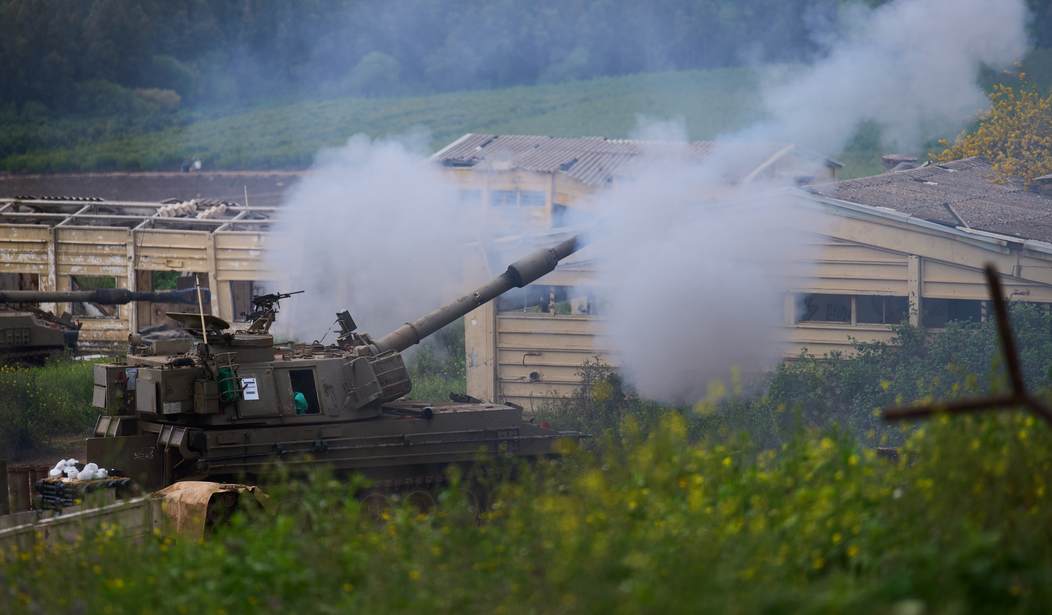
On paper, Israel could destroy Hamas and Hezbollah. Wars, unfortunately, are not fought on paper.
A friend sent me a Hezbollah video. The first thing I can say is that they need a new music director for their social media propaganda. The video is clearly a drone’s eye view of its approach toward an Israeli tractor, where it detonates to the side and toward the bottom of the tracks. Thank God, the soldier driver was unharmed. This is the second such video he sent me, as he previously sent one filmed by Hamas of an RPG hitting the antenna in front of the cab of a different armored tractor and thus exploding outside of the personnel area. For many, war is not some abstraction but is quite real.
The reality is that Israel could wipe out both Hamas and Hezbollah. If she could drop 18,000 munitions on Iran in only a couple of weeks, she could do the same on its more local enemies. The problem is not one of firepower or military capability. The problem is one of perception. If Israel really wanted to destroy Hamas, it could bomb Gaza in a Dresden-level attack. Thousands upon thousands would be killed, civilians and terrorists. That would be the only way to militarily defeat Hamas and its ancillary terror associates. Ditto for Lebanon. If you are okay with southern Lebanon looking like Berlin in May of 1945 or Tokyo a few months later, then Israel could get the job done. But in reality, she cannot even suggest doing the job as it needs to be accomplished.
Since World War II, the overriding rule in international conflicts has been hygiene. General Curtis LeMay burned 60 mostly wooden Japanese cities to the ground. He joined General Leslie Groves in dropping two atomic bombs. In one night in March 1945, LeMay’s B-29s burned a quarter of Tokyo and killed 100,000 Japanese. Even with all the destruction, it was only the public announcement by the Japanese emperor, Hirohito, that led to the end of the war. Not the destroyed cities, the glowing atomic radiation, nor even the Russians gobbling up islands that they had lost 40 years earlier. No, only Hirohito telling the people—and for most it was the first time that they had ever heard his voice—that the war was over and that they had lost could bring an end to the mass destruction of World War II. Iran and its proxies are no less militant or ideologically extreme than the Japanese of yore. They don’t care how much damage they have absorbed or how many are dead: their religious/ideological bent will keep them fighting until they’re all dead. The problem is that the world will not let Israel give them their wish of “martyrdom.”
If Israel were to attack Hamas and Hezbollah with all of its firepower and force, the U.N. would condemn the Jewish state. So would the Democrats and the European sleazeballs. The press would increase its attacks against Israel. Israelis would find it hard to travel outside of the country and business relations would frazzle. Half of Israel would use its Soros credit cards to make violent protests that would paralyze Jerusalem and Tel Aviv. The International Court of Stupidity would line up war crime cases against everyone from Bibi Netanyahu down to the company cook. Like sports that can play to a tie, wars for the past 50 years have involved mass killing and then ending while nothing has been properly settled. War is meant to end political disagreements, but the amount of violence required to do so was acceptable back then, but not any longer. Israel, in my mind, has only exacerbated the situation by sending SMS and phone messages to tell people—including terrorists and their grandmothers—to get out of buildings soon to be attacked. They have set a new standard, and there is no going back—for Israel. No other country will do the same, but should Israel fight again, it will be a war crime if it does not warn the terrorists prior to bombing or does not send in endless tons of food to its enemies. Some firsts are best left for last.
Successful wars, namely those that led to some level of peace between the belligerents, required one side winning in an undisputed manner. Germany and Japan have been great allies and friends of the U.S. precisely because their total destruction allowed for Allied-approved reconstruction. There will be no new and friendly Iran as long as the mullahs and the IRGC run the show. Obama and Co. tried that approach and got played for literally pallets of cash and a direct route to a nuclear weapon and a delivery vehicle for it. War is not pleasant and is to be avoided as best as possible. But our wars for the past 50 years have been inconclusive and have led to either more wars or lousy “peacetime” outcomes. Choking Iran’s income via the present blockade of the Straits of Hormuz may be enough to destroy the Iranian economy and lead to the internal revolution that alone can make for a new day in Iran. It’s a great approach, but I can see that the U.S. is not ruling out a possible return to fighting. Dozens of U.S. tankers are parked at Israeli airports, and some number always seems to be in the air in case the war goes hot again.
Nobody likes war, but nobody benefits from half-wars. Israel and Lebanon are beginning to talk, but their problem is not the exact position of the border fence between them, but rather the Iranian satellite—Hezbollah—that hijacked Lebanese politics and resources and continues to attack northern Israel during the ersatz ceasefire. If we still lived in an age where Westerners valued and appreciated their culture, then the fight would be for the complete destruction of anti-Christian Iran and its proxies. While Israel is the jihadis’ first course, dinner is the U.S. and Western Europe.
So should Israel go full Rambo on its immediate threats? My feeling is that the answer is no. It’s like a successful operation that leaves the patient a vegetable. Israel could kill ‘em all, but would suffer economically and politically to the point of no return. In Gaza, more efforts need to be made to find a voluntary landing place for around 500,000 people. If enough Gazans exit—and they want to leave—then Hamas’ power goes down significantly. In Lebanon, the local government, Israel, and the post-Assad Syrian leadership need to strangle Hezbollah so that they cannot get money or war material with ease. The Syrians actually seem to be helping on that score. It will take time, but the group might just be put out of business for good. One fights the war he can and not the war he would like to fight. After two weeks of the recent Iran fighting, the head of the Israel Air Force said that their airframes had already taken a year’s worth of use in just those 14 days. Someone recently asked Donald Trump if he would drop an atomic bomb on Iran. That would certainly end their nuclear and ballistic dreams. He said absolutely not. He went on to say that a nuclear weapon should never be used, and thus thousands of sorties of bombers and fighters, along with drones, tankers, and cruise missiles, are needed to make a war within the confines acceptable to the U.S. leadership. I understand it, and I agree, however much harder it is to make war this way. The alternative is worse—much worse, especially if you are still hoping to have a new Iran with leadership from the people and not the mullahs and their thugocracy.



Join the Conversation
VIP members get the ability to comment on articles.