




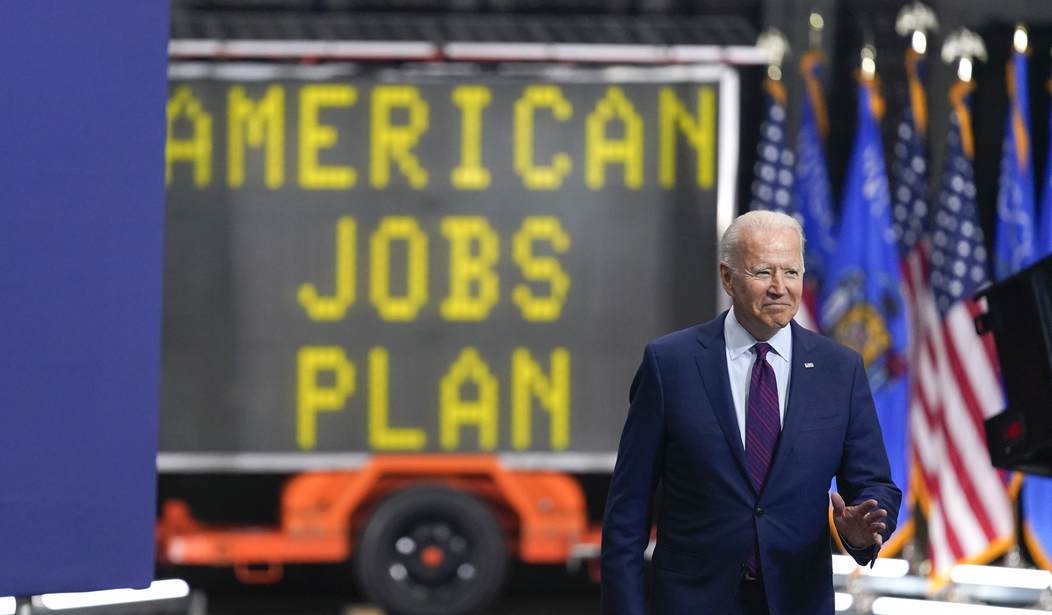
The nonpartisan Congressional Budget Office released its score of the $1+ trillion bipartisan infrastructure bill Thursday after months of fraught negotiations. As it turns out, those concerned about how the plan would be funded were justified in their skepticism.
According to the CBO, the Infrastructure Investment and Jobs Act would "decrease direct spending by $110 billion, increase revenues by $50 billion, and increase discretionary spending by $415 billion" in the next decade. "On net, the legislation would add $256 billion to projected deficits over that period."
Senate Amendment 2137 to H.R. 3684, the Infrastructure Investment and Jobs Act https://t.co/ozXhOuRQnf
— CBO Cost Estimates (@USCBOcostest) August 5, 2021
A $256 billion gap doesn't sound like the "pay for itself" promises that were made by everyone from Transportation Secretary Pete Buttigieg to the bipartisan senators who made up the bill's negotiating team.
The CBO's score was concerning enough to slow its progress through the Senate Thursday evening, pushing the next vote for infrastructure into the weekend as proponents seek to explain away the quarter-trillion-dollar funding shortfall.
My statement on what happened tonight in the #Senate around the infrastructure bill: pic.twitter.com/tutkJXmdT8
— Senator Bill Hagerty (@SenatorHagerty) August 6, 2021
Some Republican senators, such as Indiana's Todd Young, say the CBO's report is "an artificial score" that doesn't tell the whole story. Utah's Mitt Romney also sought to debunk concerns over the $256 billion funding gap by saying there are "real dollars" not being counted by the CBO.

As expected, CBO confirms half the bill is paid for with new revenue that “scores.” The other half is paid for with savings and other revenue (unused UI, unused COVID $) that don’t score under their rules, but they are real dollars.
— Senator Mitt Romney (@SenatorRomney) August 5, 2021
Meanwhile, Mike Lee of Utah bluntly evaluated the infrastructure plan's funding saying "the pay-fors are fake" and Senator Mike Braun (R-IN), ahead of the CBO score, shared a thread on Twitter explaining the issues with the supposedly paid-for infrastructure plan.
Even if these rosy CBO estimates are accurate, that still leaves us a day late and several hundred billion dollars short.
— Senator Mike Braun (@SenatorBraun) July 29, 2021
The bipartisan infrastructure bill is NOT paid for.
Within the 2,702 pages of allegedly vital infrastructure spending, Katie found plenty of funding lines for woke spending to appease Democrats but that has little to do with roads and bridges.
Talk of "gender identity" and "digital equity," $2.5 billion for green energy subsidies, $5 billion for no/low emission school buses, $250 million for electric ferries, and much more are part of the plan that would add more than $250 billion to the U.S. deficit.
A final vote is now expected to come in the second half of Saturday or Sunday, depending on how things go in the chamber when the Senate returns.
Senate adjourned early this morning. Is out today. Today serves as the “intervening day” (required by the cloture rule) before the Senate can vote to break a filibuster on the bipartisan infrastructure bill. That means final passage likely comes later in the day Sat or even Sun
— Chad Pergram (@ChadPergram) August 6, 2021









Join the conversation as a VIP Member