


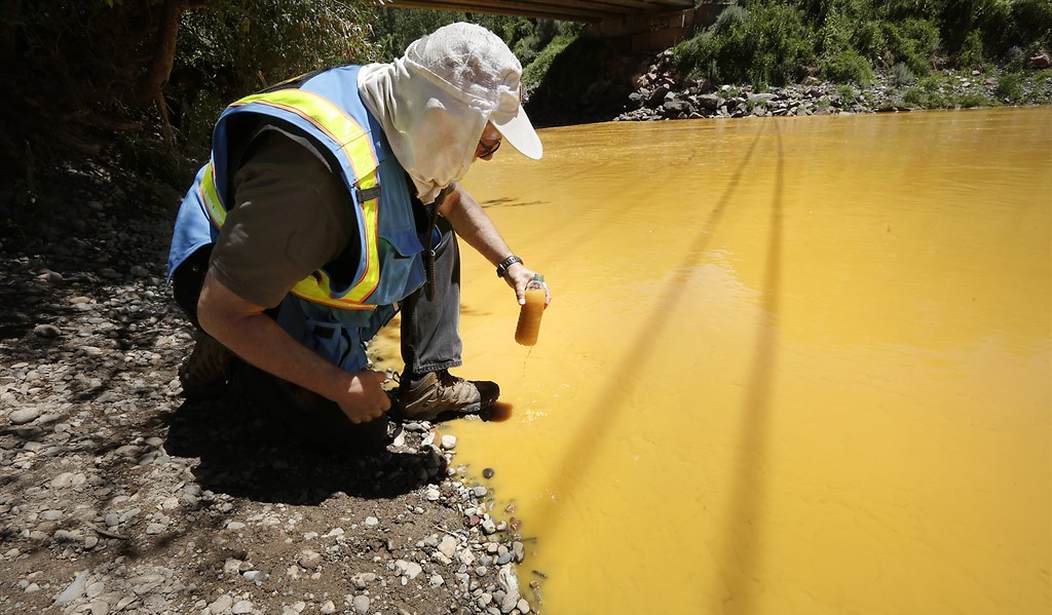
In August, the Environmental Protection Agency royally screwed up when they released 3 million gallons of toxic water from an abandoned mine in Colorado. The waste from the Gold King Mine, which had been abandoned for nearly ten years, was so great that it turned the Animas River orange. That river connects with the San Juan River, which leads into the greater Colorado River. The spill has impacted Colorado, Arizona, and New Mexico. Now, investigators have found the EPA could have avoided this environmental fiasco (via AP):
The Colorado spill would have been avoided had the EPA team checked on water levels inside the inactive Gold King Mine before digging into its collapsed and leaking entrance, a team of engineers from Interior's Bureau of Reclamation concluded in a 132-page report released Thursday.Abandoned hard-rock underground mines are not subject to the same federal and state safety requirements other mining operations must follow, and "experience indicates that they should be," the report concluded.
"A collapsed flooded mine is in effect a dam, and failure must be prevented by routine monitoring, maintenance, and in some cases remediation," the engineers wrote. "However, there appears to be a general absence of knowledge of the risks associated with these facilities."
The findings have implications across the United States: Similar disasters could lurk among the many abandoned mines that have yet to be cleaned up.
The total cost of containing this mining industry mess could top $50 billion, according to government estimates.
Recommended

The initial clean up cost estimate by American Action Forum had a wide range of $338 million to $27 billion. Moreover, the EPA knew about the blowout risks with the mine. The Navajo Nation,whose livelihoods were threatened by the spill, were furious over the government inaction as well.
Earlier this month, the EPA had a soft repeat of Gold King at Standard Mine near Crested Butte, Colorado, where 2,000 gallons of toxic water leeched into a creek that connects to the town’s water supply, according to the Denver Post.
The spill happened at 1:30 p.m. Tuesday [October 6], and the EPA said it immediately informed public works officials. Residents weren't notified. Crested Butte Mayor Aaron Huckstep said he wasn't notified until Thursday.EPA officials on Wednesday, responding to Denver Post queries about the mine, didn't reveal the spill. On Thursday afternoon, the agency issued a prepared statement saying that, based on neutral acidity and creek flow levels, Crested Butte didn't close its water intakes.
"Subsequent investigation found no visible plume or signs of significant impacts in downstream locations," the EPA said.
At the cleanup site, acidic wastewater laced with cancer-causing cadmium and other toxic heavy metals leaches out of the mine into Elk Creek, which flows into Coal Creek — a primary source of water for Crested Butte. The Colorado Department of Public Health and Environment has determined that the levels of arsenic, cadmium and zinc in Coal Creek exceed state standards.













Join the conversation as a VIP Member