




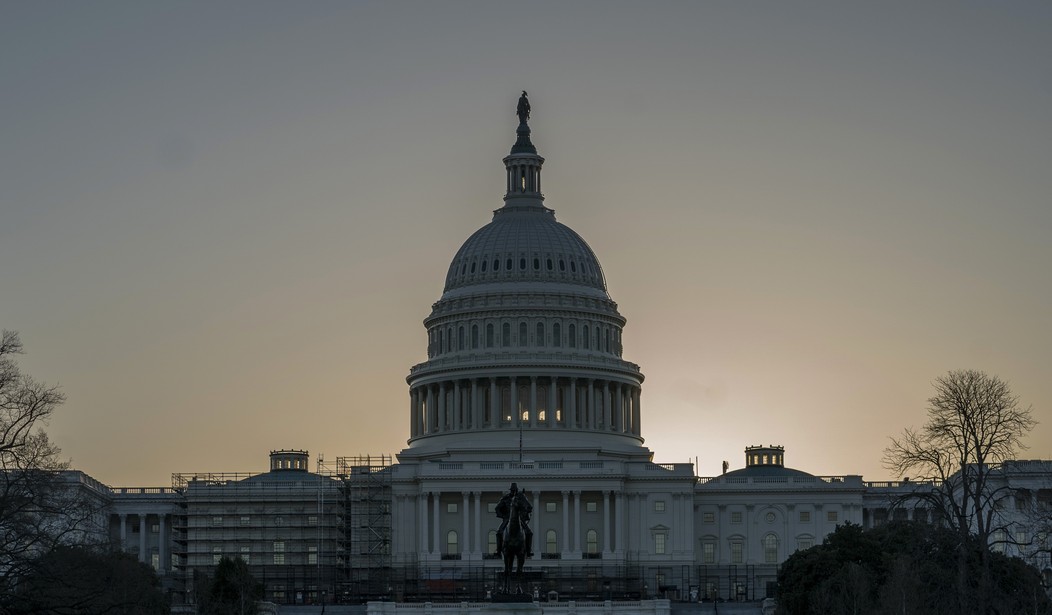
For the first time in U.S. history, the national debt topped $33 trillion at a time when Washington is on edge over a potential government shutdown at the end of the month due to a battle over federal spending.
The figure—$33,044,858,730,468.04—which is what the U.S. owes its creditors, was published Monday afternoon in new data released by the Treasury Department.
"The United States has hit a new milestone that no one will be proud of: our gross national debt just surpassed $33 trillion," said Maya MacGuineas, the president of the Committee for a Responsible Federal Budget. "Debt held by the public, meanwhile, recently surpassed $26 trillion. We are becoming numb to these huge numbers, but it doesn’t make them any less dangerous."
Total US Debt surpasses $33 trillion for the first time.
— zerohedge (@zerohedge) September 18, 2023
For those keeping tabs, the US added $1 trillion in debt in three (3) months. pic.twitter.com/9eJVnX1YnZ
$1 trillion more debt… SINCE JUNE! Now $33 trillion. Your family’s share is over $260,000.
— Rep. Dan Bishop (@RepDanBishop) September 18, 2023
The swamp’s answer: let’s do another CR. pic.twitter.com/pgtN3KNjjF
US national debt in 1950: $260 billion
— End Wokeness (@EndWokeness) September 18, 2023
US national debt in 1960: $286 billion
US national debt today: $33 TRILLION
Are we really better off today? Are our roads better? Schools? Public safety?
Then what the hell did our government do with that $33,000,000,000,000?
Recommended

Treasury Secretary Janet Yellen said she's not worried yet, though plenty of others are concerned.
“The statistic or metric that I look at most often to judge our fiscal course is net interest as a share of GDP,” she told CNBC Monday, referring to the net payments the federal government makes on its debt relative to U.S. gross domestic product. “And even with the rise we have seen in interest rates that remains at a very reasonable level.”
To Yellen’s point, the federal government’s interest payments represented 1.86% of GDP in 2022, according to Federal Reserve data. That’s in line with the historical average since 1960 of just under 2%.
Yellen said she is still “not really concerned about the impact” that recent federal spending programs—including the CHIPS and Science Act that subsidizes semiconductor production and research and the Infrastructure Investment and Jobs Act that authorizes spending on roads, bridges, and other infrastructure projects—will have on the national deficit, arguing the federal government just needs “to make sure that we stay on a sustainable course.”
Still, the Congressional Budget Office warned in a June report that higher interest rates and the mounting national debt could lead the federal government’s net interest payments to spike to 6.7% of GDP by 2053. [...]
Some critics have gone a step further in their warnings about the potential impact of an increasingly indebted U.S. government. Mark Spitznagel, founder of the hedge fund Universa Investments, told Fortune in August that we’re living through the “greatest credit bubble in human history.”
“We’ve never seen anything like this level of total debt and leverage in the system. It’s an experiment,” he said. “But we know that credit bubbles have to pop. We don’t know when, but we know they have to.”
Sen. Mike Lee explained how it's gotten to this point.
We're $33 trillion in debt.
— Mike Lee (@SenMikeLee) September 12, 2023
It's time for the American people to expect more. pic.twitter.com/8qUV5dLFFM











Join the conversation as a VIP Member