





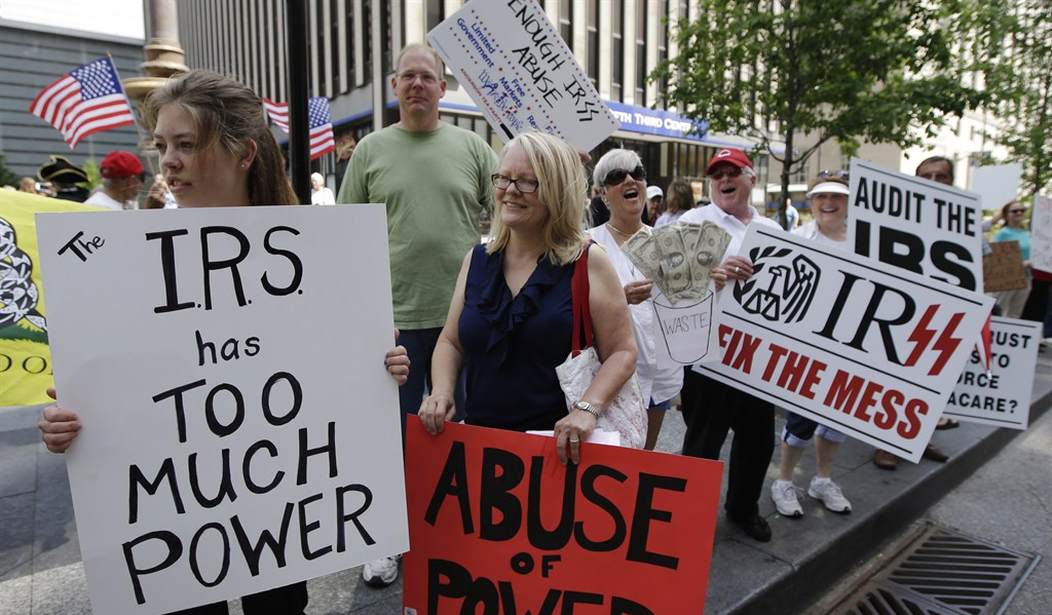
A report by Jonathan Weisman at the New York Times purports to show that the IRS 'targeting' scandal went well beyond merely conservative groups. Be-on-the-lookout (BOLO) lists that were created, Weisman reported, were found to instruct employees to pay strict attention to nonpolitical groups like "open source developers" and "occupied territory" groups:
Organizations approached by The New York Times based on specific “lookout list” warnings, like advocates for people in “occupied territories” and “open source software developers,” told similar stories of long waits, intrusive inquiries and bureaucratic hassles that pointed to no particular bias but rather to a process that became too rigid and too broad. The lists often did point to legitimate issues: partisan political campaign organizations seeking tax-exempt status, or commercial businesses hoping to cloak themselves as nonprofit groups. But even I.R.S. officials say lookout list warnings were often pursued in a ham-handed or overly rigid way.
This has led Alex Seitz-Wald of Salon to see "another nail in the IRS scandal's coffin," claiming that this, coupled with reports from last month that BOLO lists existed to target progressive groups, means there's no scandal here: just typical IRS scrutiny run amok.
BOLO lists are inappropriate for any group, but there's still reason to see a troubling bureaucratic pattern that specifically targeted conservative organizations. The BOLO lists for progressive and non-political organizations have so far been shown only to apply to groups that applied for 501(c)3 non-profit status - whereas the vast majority of the conservative groups targeted by the IRS were applying for 501(c)4 status.
501(c)4s are allowed to engage in political activities to a limited extent. 501(c)3s are strictly prohibited from political activity. It would be perfectly legitimate for an expressly political conservative group to be applying for 501(c)4 status, but the same doesn't go for a progressive group applying for 501(c)3 status. This was, and continues to be, important point that progressives have not acknowledged: The same standards did not apply across the political spectrum for groups applying for 501(c)4 status, a status that allows nonprofit groups to engage in political activity.
As Guy pointed out last month:
Zero Tea Party conservative groups' applications were approved for more than two years, as dozens of lefty groups were rubber-stamped. Yes, it seems as though the word "progressive" appeared on some of those 'BOLO' lists (see update below), but the screening and approval process went on as usual for those groups. Not so for the other side, against whom Beltway managers directed added scrutiny, onerous follow-up questionnaires, and interminable delays.
What Weisman's reporting confirms is that IRS agents have been lazy and sought out shortcuts in performing their jobs. What Weisman's (and previous) reporting doesn't show is that other groups were targeted as conservative groups were. Acting IRS commissioner Daniel Werfel has been on a PR campaign to try to clear his agency's name by revealing that much inappropriate behavior went on and making it seem as though there was no political motive. So far, it's been unconvincing - the bureaucratic scrutiny given to conservative groups was unprecedented and unlike anything that anyone else suffered.

Join the Conversation
VIP members get the ability to comment on articles.