





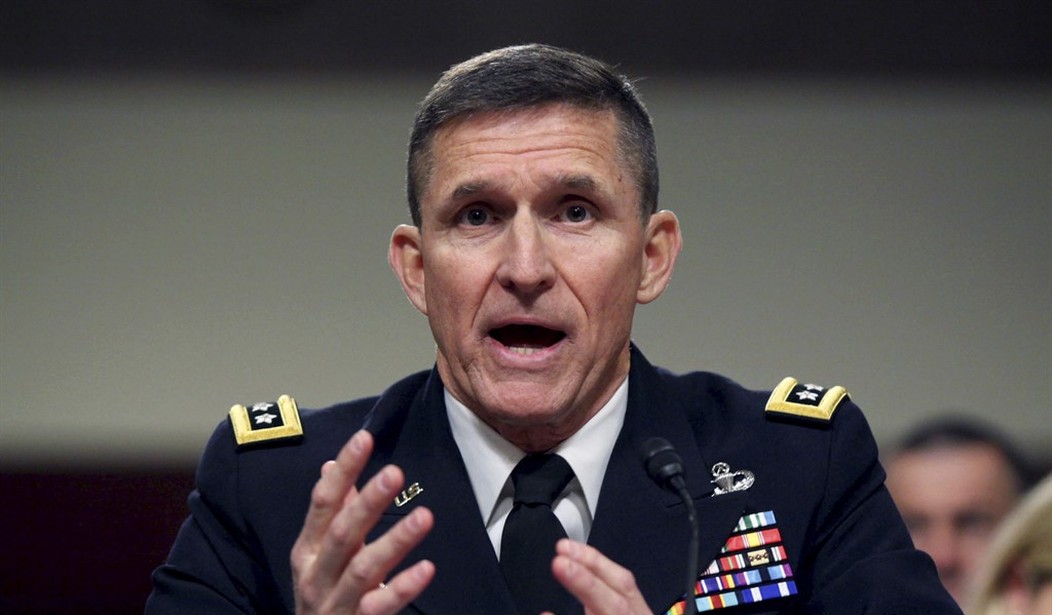
Speaking to reporters from the White House Tuesday, Press Secretary Sean Spicer said the late-night resignation of National Security Advisor General Michael Flynn came after an erosion of trust with President Trump and Vice President Pence.
"We got to a point not based on a legal issue, but based on a trust issue with a level of trust between the president and General Flynn had eroded to the point where he felt he had to make a change. The president was very concerned that General Flynn had misled the vice president and others," Spicer said (bolding is mine). "The evolving and eroding level of trust as a result of this situation in a series of other questionable instances is what led the president to ask for General Flynn's resignation."
The situation in question revolves around phone calls Flynn had with the Russian ambassador in December. During the phone calls Flynn discussed sanctions relief, but told Vice President Mike Pence they weren't discussed. Pence then publicly defended Flynn and the phone calls with false information.
"He was also very concerned in light of he sensitive subjects dealt with by that position of national security advisor like China, North Korea and the Middle East, that the President must have complete and unwavering trust for the person in that position," Spicer continued. "The evolving and eroding level of trust as a result of this situation in a series of other questionable instances is what led the president to ask for General Flynn's resignation."
When pressed on whether the White House was confident Flynn hadn't misled the President, Vice President and others on matters outside of Flynn's phone calls with the Russian ambassador, Spicer argued national security briefings are given to the President by a number of people.
Pavlich: On the trust issue and eroding of trust, last night in General Flynn's resignation letter he said he inadvertently briefed the Vice President-elect and others with incomplete information. Considering his role in advising the President on national security matters, is the White House concerned that he maybe briefed the President-elect, Vice President-elect with incomplete information on other matters of national security in addition to his phone calls with the Russian Ambassador?
Spicer: If you look at the team, it's not one person in isolation, it's several. You've got General Kelly on the Homeland Security front, you've got Mattis on the DOD front, he's got an entire national security staff apparatus that briefs him, Director Pompeo at the CIA and others from the DNI's office that come brief him on a whole host of issues. It's not a single position [briefing the president].
Pavlich: So this was an isolated incident of Flynn giving bad information?
Spicer: Regardess of whether it is or isn't a single situation, it's not as though there's one person briefing him. The President synthesizes a lot of information both written and stuff that is briefed to him and ultimately it is he who makes a decision based a lot on what he already knows, what he is presented with, so the president gets information from a lot of people.
Spicer also said there was "exhaustive and extensive questioning of General Flynn" to find the truth about his phone calls with the Russian ambassador.
Join the Conversation
VIP members get the ability to comment on articles.