


According to The New York Times, a case the Supreme Court heard on Tuesday, involving a challenge to Obamacare's requirement that businesses pay for their employees' contraceptives, "pits religious liberty against women's rights." Similarly, last month's controversy over an Arizona bill aimed at protecting business owners from being forced to treat homosexual and heterosexual couples alike was widely perceived as a conflict between religious liberty and gay rights.
Both of these debates are more accurately described as clashes between real rights and fake rights. To put it more politely, they pit negative liberty, which requires freedom from external restraint, against positive liberty, which imposes demands on other people's resources. Under the latter vision, giving freedom to one person requires taking it away from another.
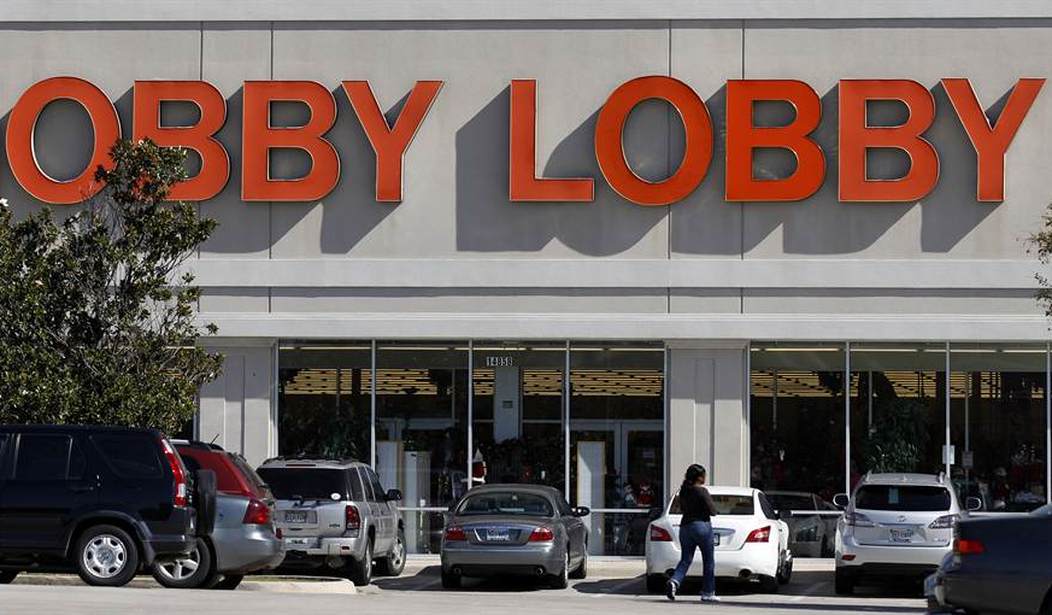
In the Supreme Court case, two family-owned businesses, the craft store chain Hobby Lobby and Conestoga Wood Specialties, a Pennsylvania cabinet manufacturer, argue that forcing them to provide health insurance that covers birth control methods they view as tantamount to abortion violates the Religious Freedom Restoration Act (RFRA). Under that law, "government may substantially burden a person's exercise of religion" only if it is "the least restrictive means" of serving a "compelling governmental interest."
That was the test the Supreme Court applied under the First Amendment until 1990, when it reversed course and decided any burden was acceptable as long as it was imposed by a neutral, generally applicable statute. The decision triggered outrage across the political spectrum, and three years later, a nearly unanimous Congress responded by passing RFRA.
Arizona has its own version of RFRA. S.B. 1062, the bill that Gov. Jan Brewer vetoed last month in response to nationwide criticism, would have clarified that it protects businesses (one of the issues raised by the Hobby Lobby case) and that it applies to legal actions brought by private citizens. Its chief sponsor said he was reacting to a discrimination complaint against a New Mexico photographer who declined to take pictures of a gay wedding; there have been similar cases involving a Colorado bakery and a Washington florist.

Arizona currently recognizes no such cause of action, so S.B. 1062 would have had no immediate effect on interactions between businesses and gay couples. And if Arizona's legislature one day decided to ban discrimination based on sexual orientation, the law could still be upheld as "the least restrictive means of furthering (a) compelling governmental interest."
But does the government have a compelling interest in forcing people to accept behavior that violates their deeply held beliefs? There is an important difference between requiring the government to treat gay and straight couples the same and requiring private citizens to do so. One is a matter of equal treatment under the law, while the other is intolerance disguised as its opposite: intolerance of intolerance, to put it charitably.
Similarly, there is an important difference between demanding that the government refrain from interfering with people's reproductive choices and demanding that business owners subsidize them. Just as no one has a right to pictures taken by an unwilling photographer, no one has a right to an IUD or a Plan B pill purchased with the money of people who do not want to pay for it.
The American Civil Liberties Union (ACLU) disagrees. "We don't allow religious beliefs to be used to discriminate against others," says Brigitte Amiri, a senior attorney with the ACLU's Reproductive Freedom Project, explaining why the Supreme Court should uphold the contraceptive mandate. ''Religious freedom is a fundamental right," says Daniel Mach, director of the ACLU's Program on Freedom of Religion and Belief, "but it's not a blank check to harm others or impose our faith on our neighbors."
That is why, according to Mach, bakers, photographers and florists must be conscripted for gay weddings. Exactly who is imposing on whom in that situation? By choosing positive liberty over negative liberty, the ACLU is forsaking the freedoms it claims to defend.








Join the conversation as a VIP Member