







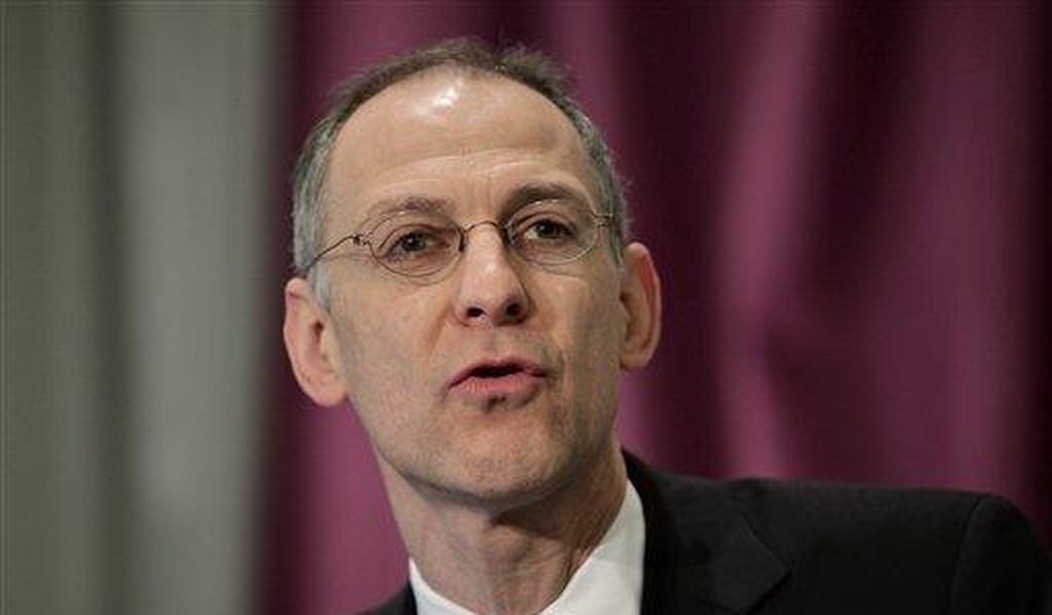
Dr. Ezekiel Emanuel is an architect of Obamacare -- and the brother of former White House Chief of Staff Rahm Emanuel -- whose recent apologetics on behalf of the law he helped design have grown increasingly desperate. On Fox News Sunday, host Chris Wallace quizzed him about the accuracy of one of President Obama's most prominent healthcare vows: “If you like your doctor, you will be able to keep your doctor. Period." Is that actually true? Emanuel wasn't fond of the question, ultimately conceding that Obamacare's doctor networks will be limited. But that doesn't mean consumers can't keep their preferred doctors -- if they're prepared to shell out, that is (via the Weekly Standard):
WALLACE: 'If you like your doctor, you can keep your doctor.' Did he not say that, sir?"
EMANUEL: "He didn't say you could have unlimited choice."
WALLACE: "It's a simple yes or no question. Did he say if you like your doctor, you can keep your doctor?"
EMANUEL: "Yes. But look, if you want to pay more for an insurance company that covers your doctor, you can do that. This is a matter of choice. We know in all sorts of places you pay more for certain -- for a wider range of choices or wider range of benefits.The issue isn't the selective networks. People keep saying, Oh, the problem is you're going to have a selective network--"
WALLACE: "Well, if you lose your doctor or lose your hospital--"
EMANUEL: "Let me just say something," said Emanuel. "People are going to have a choice as to whether they want to pay a certain amount for a selective network or pay more for a broader network."
WALLACE: "Which will mean your premiums will probably go up."
EMANUEL: "They get that choice. That's a choice they always made."
WALLACE: "Which means your premium may go up over what you were paying so that, in other words"
EMANUEL: "No one guaranteed you that your premium wouldn't increase. Premiums have been going up."
WALLACE "The president guaranteed me I could keep my doctor..."
EMANUEL: "And if you want to, you can pay for it."
Within an 88-second clip, another lie unravels, buttressed by an additional lie. The law's defenders have once again resorted to the tortured parsing of an unambiguous promise. When Obama and Democrats said, "you can keep your plan and your doctor -- period," the message was crystal clear. Americans were told that if they were satisfied with their existing healthcare arrangement, the new law would not affect them. This was intentional. Polls showed deep public skepticism over the proposed overhaul in 2009 and 2010, so Democrats had a strong incentive to tell as many people as possible that they would suffer zero effects under the new regime. This goes back to the fundamental Obamacare lie -- that the law was bereft of trade-offs and losers. The way things were presented for public consumption, the "Affordable" Care Act was a legislative panacea that would improve everyone's lot. Now that these distortions are being laid bare by reality, people like Zeke Emanuel are spinning their wheels, trying to explain to irate citizens why Team O never technically promised what everyone remembers them promising. How would people have reacted if the sales pitch had been, "if you like your doctor, you might be able to keep her, if you're willing to fork over a lot more money?" I'd guess the same way people are taking to preposterous spin from Congressional Democrats over other shattered pledges. And don't overlook Emanuel's revisionism about "no one" ever guaranteeing lower premiums. Sure. Lower premiums was merely a central selling point of Obamacare. Candidate Obama talked endlessly about the average family saving $2,500 per year in premiums:
President Obama offered this assurance:
"And that will lower rates, it’s estimated, by up to 14 to 20 percent over what you’re currently getting. That’s money out of pocket."
Just for good measure, Nancy Pelosi asserted, "everybody will have lower rates" as recently as last year. Emanuel and company are welcome to insist that lower premiums were not part of the Obamacare sales package. And the American people are welcome to laugh in their faces. Conservative columnists, centrist wonks and mainstream media reports are all projecting the coming wave of "doc shock." That NBC story notes that in addition for average people not being prepared for what's coming, the healthcare industry is largely unprepared for the massive influx of patients: "Now comes the equal challenge of turning all that coverage into care. Is our health care system ready for the influx of newly insured patients? Not yet. 'If you do the math, it just doesn’t work,' says Matt Salo, executive director of the National Association of Medicaid Directors. 'There is no way we can meet all this new demand with the existing workforce unless we radically change the way we deliver health care.'" The New York Times quotes a North Carolina-based insurance broker who describes a toxic evolution among consumers. They've shifted from confusion and frustration over Obamacare's technical problems (which are far from over) to outright anger over sticker and access shock:
“They are confused before they call,” she said. “After they call, they’re not confused anymore. They’re angry.”
This lone sentence flays Democrats' dangerous delusion that fixing the various websites will put an end to their Obamacare problem. Not even close.


Join the Conversation
VIP members get the ability to comment on articles.