


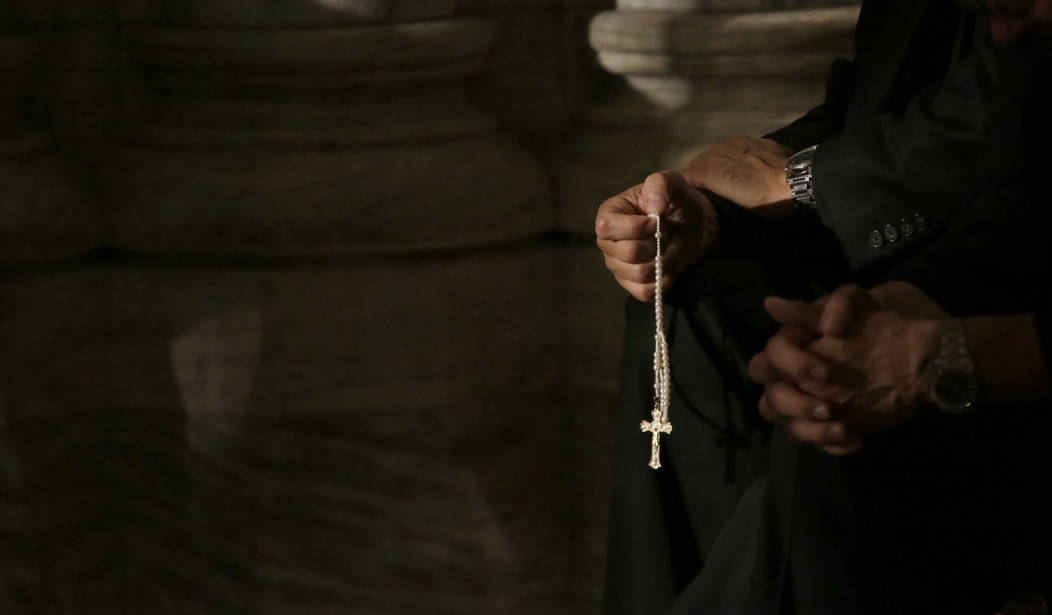
For those of us who grew up in a church environment, complete with weighty sermons, Sunday school, and catechism, there is something curious about Diversity, Equity, and Inclusion (DEI). The doctrine occupies a special space in one’s mental architecture, in that institutions need the equivalent of priests who instruct their flocks with reverential earnestness. This sacralization of Christian concepts is nothing new. Modern political ideologies, such as socialism and fascism, have been understood as secularized versions of Christianity for a long time, at least since the French Revolution. The question is, do DEI statements clothe Christian concepts in secular garb?
The short answer is yes, but plowing through DEI statements is a task of paralyzing tedium, until readers finally succumb to the sermonizing by letting their attention wander; even Jeremiah had his limits. DEI statements read like secular creeds that launch pilgrims on a journey, which progresses from least involved to full commitment, a pattern similar to Christian outreach efforts. We’ll use the least complex approach, which any Christian could produce by heart:
Stage One: Unbelief, indifference to the truth.
Stage Two: Awareness, recognition. The Heidelberg Catechism comes in handy here in part one’s answer to Q&A—2: Sinners must acknowledge how great their sins and misery are.
Stage Three: Fulfillment, which embraces enthusiastic participation to life-time commitment to spread the Word.
This template works for the Berkeley Office for Faculty Equity & Welfare, whose DEIB (B—Belonging) policy provides an elaborate example. Its sample rubric has three parts: Knowledge, Track Record, and Plans. These are divided into three stages, each of which has one or two points for scoring purposes. Thus, in Stage One of the Knowledge Part, a person scores a point or two for showing “little to no evidence of awareness of DEIB issues in higher education or their field.” A point is earned in the middle stage by a candidate who demonstrates “some level of awareness.” Not exactly a Come to Jesus Moment, but this is DEI, after all. In Stage Three, four to five points knocks it out of the park: “Clear and deep understanding of dimensions of DEIB in higher education.” The examples portion for this stage reads: “Discusses diversity, equity, inclusion, and belonging as core values that every faculty member should actively contribute to.” In short, knowledge triggers enthusiasm.

A person’s Track Record of Advancing DEIB shows points in Stage One for doing little or nothing; three points in Stage Two for displaying paltry attempts, and four or five points in Stage Three for sustained “efforts to promote DEIB in teaching, research, or service.” Examples include “multiple activities in depth…,” where the subject “organized or spoke(n) at workshops or other events …aimed at increasing others' understanding of diversity, equity, inclusion…” We are approaching a missionary level of proselytization.
This is achieved at the Plans for Advancing DEIB Part. A pair of points for having no plans is followed by three points for thinking about it, before being awarded four or five points in Stage Three: “Clear and detailed plans for advancing DEIB.” Examples gush with efflorescence, suggesting perhaps that reaching this stage should earn one a Ph.DEIB degree, if such exists.
Structural parallels to Christian creeds are not perfect, of course, but the resemblance is remarkable. Certainly, DEI has spread like wildfire. Indeed, Bari Weiss speaks for many when she states that in the past two decades, she saw “this inverted worldview swallow all of the crucial sense-making institutions of American life.”
How does one explain this? Answers include the nihilism of American elites who seek something to fill the spiritual void in their lives. Peer pressure always plays a role, along with the influence of academia throughout American institutions. But DEI’s religious appeal is unmistakable. The doctrine’s call for commitment to its demanding profession of faith, its trinitarian, creedal structure, along with its endless virtue signaling compel devotion and often fanaticism. In short, DEI is a religious movement.
I think Christians have some grasp of what’s been going on, and with most citizens react not merely with concern, but with apprehension. After all, DEI is The Doctrine That Ate America. If it is not stopped, DEI will supplant the country’s Judeo-Christian value system and push America farther down the road of decline.









Join the conversation as a VIP Member