





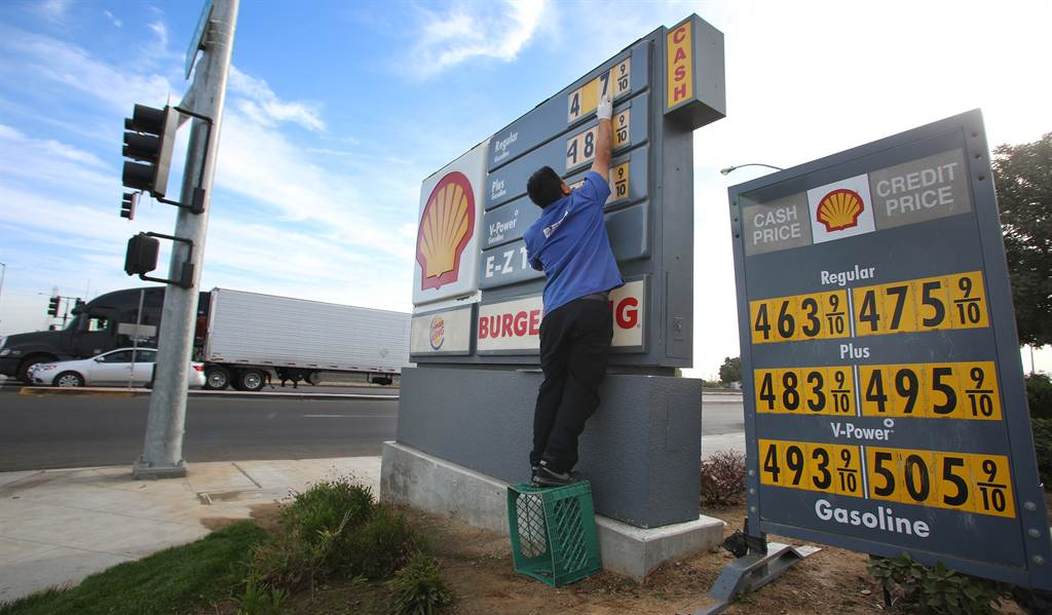
We’re all paying more at the pump. It’s hurting consumers and dangerous for the fragile economy. And, it’s because of a Washington handout to corn farmers and big Wall Street banks – all disguised as a measure to promote renewable energy and clean-burning fuels.
The Renewable Fuel Standards (RFS) mandates an ever-increasing floor of ethanol be mixed with gasoline. The bill, which was expanded under President Obama, ensures a baseline level of demand for ethanol, distorting the market and sending the price of corn substantially higher. That’s because gasoline refiners have to purchase ethanol, regardless of the price.
So, corn prices tripled, which has factored its way into the prices of other agriculture products. In fact, the Congressional Budget Office estimates that the impact of the RFS is so broad that ethanol subsidies account for 10-15 percent of the rise in overall food prices. In terms of the overall economy, the RFS is expected to cause a decline of $770 billion in GDP in 2015 alone. That’s real economic activity, which translates to real jobs and incomes for Americans throughout the country.
And, hardly anyone in Congress or the Obama administration thinks the current law is working. TheEnvironmental Protection Agency, which is run by leftist environmentalists, said that it does not “foresee a scenario in which the market could consume enough ethanol […] and/or produce sufficient volumes of non-ethanol biofuels to meet the volumes of total renewable fuel and advanced biofuel as required by statute for 2014.” So, in other words – Washington has once again imposed unachievable burdens on the private sector.
Recommended

But what may be worse than this indirect subsidy to corn farmers is the way that big Wall Street banks are exploiting it at the expense of consumers. That’s because if a gasoline refiner cannot meet the demands of the RFS, it can purchase credits, called renewable identification numbers (RINs), in a “marketplace.” But unlike transparent marketplaces like Amazon, the market for RINs is opaque and dominated by speculators with no interest except driving the price higher.
The New York Times recently reported that, “the price of the ethanol credits skyrocketed 20-fold in just six months.” A credit that went for 7 cents at the start of the year traded for $1.43 in July, according to Bloomberg. And that price is simply passed along to consumers at the pump – a large factor keeping gas prices above $3 per gallon nationwide for 1,000 consecutive days.
But Congress has approached the RFS from a weak position, intimidated by powerful lobby groups who like these handouts. Though the Chairman of the House Energy and Commerce Committee, Fred Upton (MI), has assigned four members to find a solution, just one – Rep. Steve Scalise (LA) – has called for full repeal. The others – Reps. John Shimkus (IL), Lee Terry (NE) and Cory Gardner (CO) – are calling for “reform.” Such reform could even get attached to the must-pass bill that will raise the debt ceiling. According to recent reports, that could even include a one-year delay to the RFS mandates.
While a one-year delay will certainly help the stagnant economy, it does little but push the can down the road. As long as the RFS exists, it will damage the economy. Congress is just debating the degree to which they will let that happen. Conservatives in Congress need to stop trying to save the RFS – and repeal it in its entirety. Doing that will relieve some of the pain at the pump, stop the increase in food prices and save Americans $770 million in economic activity in 2015.









Join the conversation as a VIP Member