





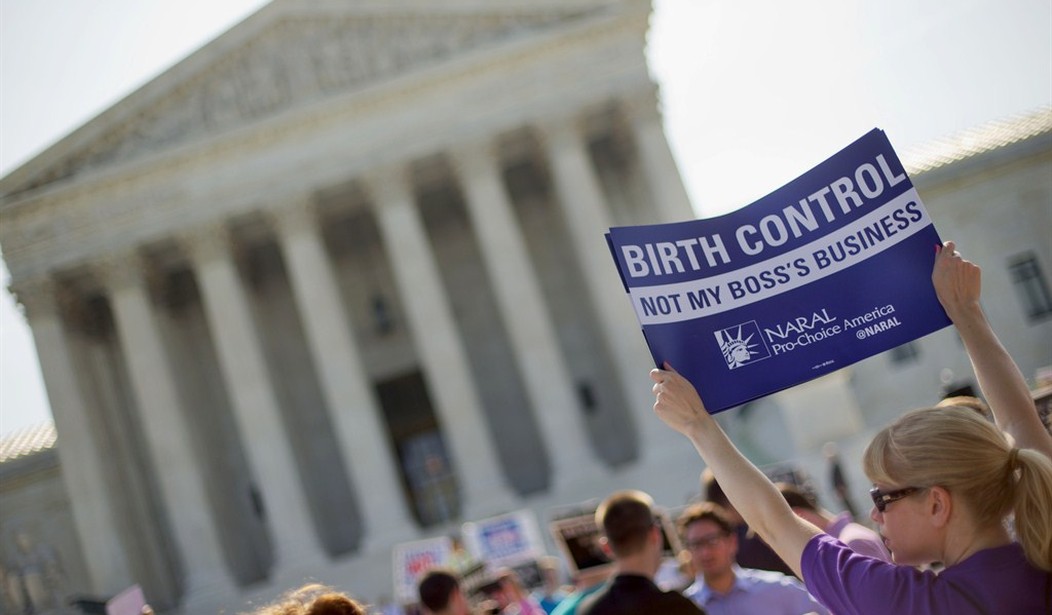
Abortion-rights protesters gathered outside the Supreme Court building on Monday holding signs that read "Birth Control: Not My Boss's Business."
Much to their chagrin, Supreme Court Justice Samuel Alito agreed in his ruling in the Hobby Lobby case.
Of course, that's not how supporters of the government's contraception mandate see it. They actually believe that birth control is their boss' business, and they want the federal government to force employers to agree.
More on that later, but it's first worth noting how we got here.
First, contrary to a lot of lazy punditry, there is no Obamacare contraception mandate. As my National Review colleague Ramesh Ponnuru notes, even President Obama's liberal rubber-stamp Congress of 2009-10 never addressed -- or even debated -- the question of whether companies can be forced to provide contraceptive coverage. Department of Health and Human Services bureaucrats simply asserted that they could impose such a requirement. Indeed, "several pro-life Democrats," Ponnuru adds, "who provided the law's narrow margin of victory in the House have said they would have voted against the law had it included the mandate."
Moreover, Hobby Lobby never objected to covering birth control per se. It already covers 16 kinds of birth control for its employees. But it objected to paying for what it considers to be abortifacients, which don't prevent a pregnancy but terminate one. The pro-abortion-rights lobby can argue that "abortion" and "birth control" are synonymous terms, but that doesn't make it true.
One lesson here is that overreaching can have unintended consequences. We saw that last week when the Supreme Court ruled unanimously that the White House had overplayed its hand when it comes to the president's ability to make recess appointments. By abusing a presidential prerogative, Obama invited the court to address the issue. As a result, presidential power -- at least in this regard -- is now more curtailed.
Similarly, the Hobby Lobby decision opens the door for closely held companies to deny coverage of all forms of birth control, if they can plausibly argue that doing so would violate their conscience. The decision doesn't apply to large, publicly held corporations, but even if it did, it is unlikely that many companies would go down that path. And even if they did, birth control would not be "banned"; employees simply would have to pay for it themselves. The notion that denying a subsidy for a product is equivalent to banning that product is one of the odder tenets of contemporary liberalism.
This gets us to why I think the ruling's majority essentially agreed with the protesters. If I like to dress up as a character from "Game of Thrones" on weekends, pretending to fight snow zombies and treating my mutt like it's a mystical direwolf, that's none of my employer's business. But if I ask my employer to pay for my trip to a "Game of Thrones" fan convention, I am asking him to make it his business. If my employer refuses, that may or may not be unfair, but it's his right. If, in response, I go to the convention and have the government force my employer to pay for my travel, that only makes things worse. It not only makes my private pursuits my boss' business, it makes them the business of taxpayers and a bunch of bureaucrats in Washington.
At the heart of this, and so many other recent controversies, is an honest disagreement about how society should be organized. For liberals (and far too many Republicans), businesses should be de facto, if not de jure, extensions of government. If something is desirable, businesses should be forced to impose it. The fact that the owner disagrees or that it is not in the business' economic interest is immaterial. And it's not just businesses. Recall that the Obama administration has tried to force explicitly religious groups to betray their beliefs as well.
Obviously, there's room for nuance here. Few people think that we should scrap minimal workplace safety rules, for instance. No one thinks the Church of Satan should be permitted ritual human sacrifice. But when in doubt, the government should err on the side of laissez faire et laissez passer, le monde va de lui meme.
Not everything is your boss' business, or anybody else's.



Join the Conversation
VIP members get the ability to comment on articles.