







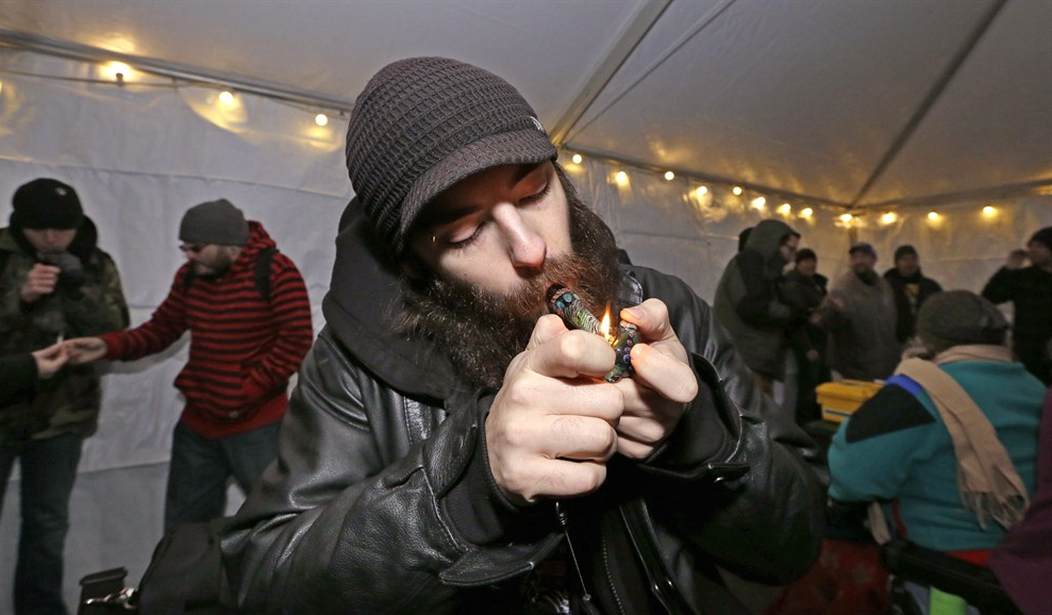
On Jan. 1, the Centennial State (it hasn't yet changed its nickname to "The Rocky Mountain High State") became the first place in the country to legalize marijuana sales for recreational purposes.
And Brandon Harris is stoked.
The 24-year-old Harris drove 20 hours from Cincinnati, along with a smoking buddy, to be the first Ohioans to buy legal pot in Colorado.
"It's such a big day in history," Harris, told the Washington Times. "The fact that we don't have to be criminals and can just smoke, and not be looked down on, or have to mess with the local police."
Well, he's mostly right. Americans are still free -- for now, at least -- to look down on people for whatever reason we want. Simply because an activity is legal doesn't mean I am barred from judging you negatively for engaging in it.
Decorating your room from floor to ceiling with Justin Bieber posters is perfectly legal -- so long as you keep the paper a safe distance from the votive candles on your Bieber shrine. But if I walked into my doctor's office and saw such a display, I would search for a new doctor pretty quickly. The same goes if I found out he was a big pot smoker.
Whether you find that analogy insulting probably depends on whether you smoke a lot of pot (or if you're a "Belieber").
But that's OK with me. As non-judgmentalism becomes part of the secular catechism, people lose sight of the fact that the freedom to do what you want must include the freedom to form your own opinions about how other people use their freedom.
Which brings us back to Mr. Harris. He and his pal were so jazzed by the ability to buy pot legally, they decided to remain in Colorado permanently.
"We're staying," he told the Denver Post. "We're going to become residents."
Now, if I were an employer interviewing young Mr. Harris, I might ask him, "What brought you to Colorado?" If he answered, "The legal weed," it'd be a pretty major strike against him. Personally, I think letting dope become so important that you're willing to uproot your whole life just so you can have it legally all the time doesn't speak well of you.
But that's me. Others feel differently. And, if I'm going to be honest, I can't swear that if Washington, D.C., banned alcohol or caffeine, I wouldn't pull a Harris and ditch the District.
This is the way it's supposed to work. People who want to live one way vote with their feet and move to places where they can live the way they want to live. It's way too soon to know if Colorado's collective experiment will prove to be a mistake. It's also too soon to know if some Colorado residents will move to states where weed is illegal as a result. But it's an experiment worth conducting.
Pot legalization advocates are fond of casting themselves as the avant-garde of a new libertarian revolution sweeping the nation. I generally hope they're right. But I also hope we don't lose sight of the collective right of states and other legally recognized communities and institutions to have the freedom to organize their lives the way they want.
I love America's love of individual liberty. But no good thing comes without a downside. Particularly since the "rights explosion" of the 1960s and 1970s, public-policy debates are too often framed as the individual versus the government. Presented with that choice, Americans are going to err on the side of individual rights. And that's usually a good thing. The problem is that the rights of a community -- a town, a county, a state, a religious organization, etc. -- are left out of that formulation. And they matter.
Man is a social animal and wants to live in a community. Hippies want raw milk, evangelicals want codes of decency, Amish want to reject modern technology, the Sisters of the Poor don't want to pay for birth control under Obamacare. What's wrong with that?
My objection to both the progressive vision of one-size-fits-all government and some extreme notions of individual liberty is that they both lack the imaginative sympathy required to let groups of people organize their lives in the ways that will let the majority live the way they want to live.
Why not let a thousand flowers bloom? If Colorado wants to legalize weed, fine. If Alabama doesn't, that's fine too. Alabamians who disagree can fight it out democratically, or they can follow Harris' lead and move.
Will States' Rights Go to Pot?
Opinion
The opinions expressed by columnists are their own and do not necessarily represent the views of Townhall.com.
Advertisement
Advertisement


Join the Conversation
VIP members get the ability to comment on articles.