







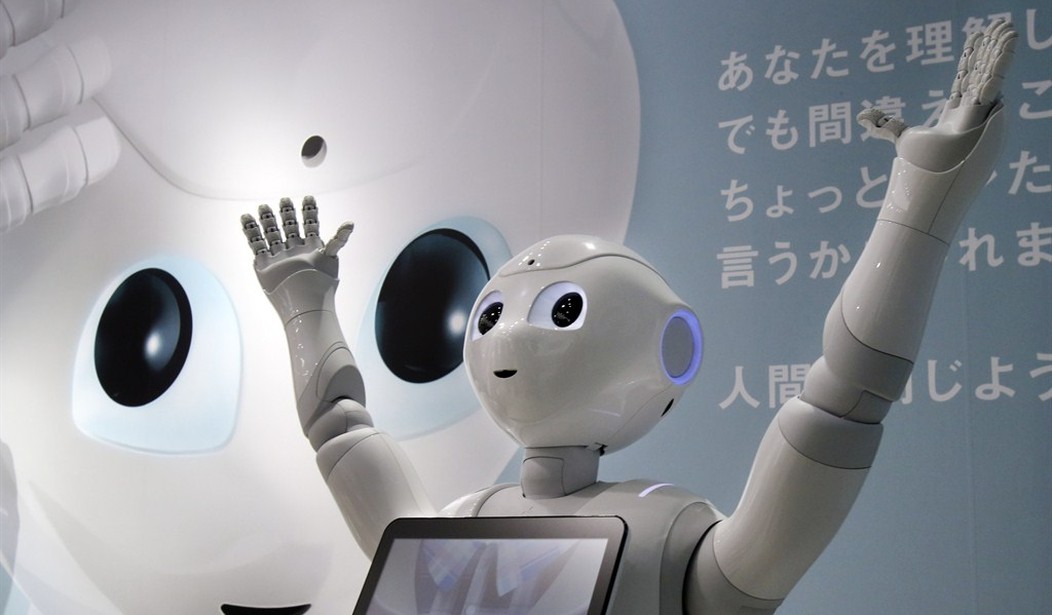
At that point, maybe we no longer talk about "human history." It will be "machine progress," with us along for the ride -- if machines keep us around. Maybe they'll keep us in a zoo, like we do with our monkey ancestors.
Scientists and ethicists are beginning to wrestle with the question of how to make sure artificial intelligence, when it arrives, is nice to us.
Make sure the robots are strict libertarians? That way, they'll be forbidden to commit assault, theft or fraud -- the three legal restrictions in which libertarians believe.
Unfortunately, computer programmers won't listen to my suggestion. Those who work for video-game companies and the military make machines that kill people.
All this is scary because scientists say that soon machines will be too smart and self-motivated for us to predict.
"Robots absolutely can become much more dangerous," says Patrick Tucker, of The Futurist magazine. "And they become more dangerous as we ask them to do more."
Our best hope may be a future where instead of trying to control intelligent machines, we blend with them.
In some ways, that's already happening.
Erik Brynjolfsson, author of "The Second Machine Age," says today's machines augment our minds the way that the industrial revolution's machines augmented muscles. This creates progress that government statistics don't measure.
"It used to be you could just count physical objects -- tons of steel, bushels of wheat," says Brynjolfsson on my TV show this week. "As we have more of an idea economy, it's harder to measure the value of those ideas.
"Wikipedia created enormous value," he adds, "but it's free, and that means that it doesn't show up in GDP statistics, which measure the value of goods and services."
Outsourcing parts of our thinking with tools like Wikipedia and Google may be how we'll keep improving our lives -- cooperating with machines instead of fighting them. In science-fiction terms, the future may be "cyborg": part machine, part human.
Instead of parents deciding where to send their kids to school, they may puzzle over which machine enhancements to give them. Already clinics offer "designer babies" by selecting embryos based on genetic quality. Soon parents will select by height, intelligence, beauty and so on.
This future sounds unsettling, but it's not much use just hoping machines stay dumber than we. The IBM computer "Watson" lost to humans on "Jeopardy" but beat the quiz show's champion a few years later.
Leftists tell us that such computers will take our jobs, requiring welfare programs for unemployable humans. President Barack Obama expressed this static thinking when he told an interviewer that ATMs and airport ticket kiosks kill jobs.
But this is childish thinking. In the 1800s, nearly all Americans worked on farms. Now 1 percent do. Farm workers found other jobs, often better jobs. So did horseshoers, phone operators and secretaries. (Today's high unemployment is caused by suffocating regulation, not computerization.)
James Miller, author of "Singularity Rising," says that a future with little hard work left for humans sounds like "an economic utopia." He says that trying to prevent progress by machines would be as destructive as if we'd outlawed the rise of cars, buses and modern trains. But Miller does fear the computer revolution will be different: "The analogy would be: 100 years ago, we breed super intelligent horses. That would have permanently destroyed a lot of jobs."
I'm more optimistic. As with so many innovations in the past, I'll bet that handing off tasks to machines will make our lives better by freeing us up to focus on activities that we enjoy more. Robots will make our future better.
If they don't kill us.


Join the Conversation
VIP members get the ability to comment on articles.