


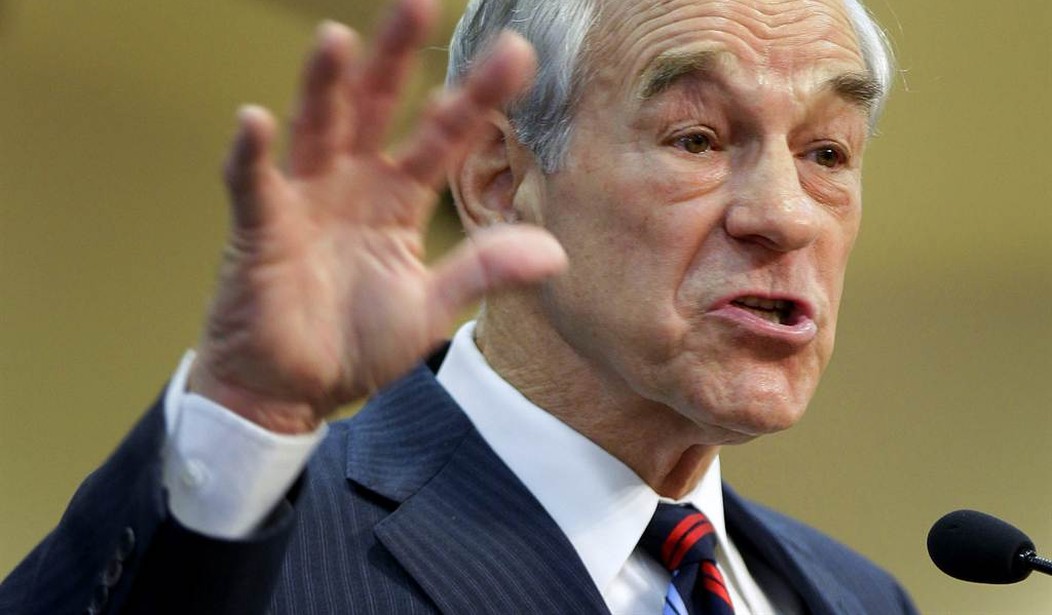
From at least the time of the 1980’s, the Republican Party and the “conservative movement” have been dominated by, not conservatives, but neoconservatives. The so-called “libertarian” influence in the party is growing—and neoconservatives are none too pleased by it.
Libertarians, neoconservatives assert, are “isolationists,” “naïve,” even sophomoric, idealists whose detachment from reality borders on being “unpatriotic,” for libertarians threaten to compromise national security, making citizen and soldier alike unsafe.
After all, when his own country is in the midst of a protracted, bloody war, a person who uses his considerable influence to convince large numbers of Americans that their country is “the greatest purveyor of violence in the world today” must surely be deemed a threat of a sort to national security.
A person who cautions people against being fooled into thinking that “God chose America as his divine, messianic force to be a sort of policeman of the whole world,” who claims to “hear God saying to America, ‘You’re too arrogant!’” and promising to “break the backbone of your power,” must be an “isolationist,” an opponent of “American Exceptionalism.”
How can libertarians not be said to weaken America’s resolve during times of war, how can they not be said to, in effect, provide “aid and comfort” to the enemy, when they use their public platform to decry the war as “unjust, evil, and futile,” a “demonic, destructive suction tube” and “enemy of the poor?” Do not libertarians exhibit, at best, an astonishing degree of naivety, and, at worst, something bordering on anti-Americanism, when they accuse America of being self-delusional, of indulging “rationalizations” and embarking on an “incessant search for scapegoats” that “blind” her to her own “sins”?
Recommended
David Frum, writing for National Review, must’ve been on to something when he accused those on the right that opposed the Iraq War of being “unpatriotic.” After all, can an American who refers to the enemy in terms of “the hundreds of thousands trembling under our violence,” and who claims to speak for the “little brown…children” who now “languish under our bombs” be anything but unpatriotic?
No one who charges America at any time, but particularly when she is at war, with suffering from a “deadly arrogance that has poisoned the international situation for years” and that has actually “sought, in a real sense, to sabotage the Geneva Accord,” can be good for either the Republican Party or, more importantly, national security.
No one who says of the children of America’s enemy that they have been “degraded by our soldiers as they beg for food,” or, in order to survive, they’ve had to busy themselves with “selling their sisters” and “soliciting for their mothers” to our soldiers can ever be thought to support the troops. No one who describes the “business” of our troops as “burning human beings” and “of filling our nation’s homes with orphans and widows, of injecting poisonous drugs of hate into the veins of peoples normally humane,” can possibly be said to be supporting them, right?
Now for the punch line: None of the foregoing quotations from high profile libertarians are actually from any libertarian. They derive, rather, from a single speech—“Why I Am Opposed to the War in Vietnam”—delivered on April 30, 1967, from none other than Martin Luther King, Jr.
Was King an “isolationist,” naïve, unpatriotic, and unconscionably nonchalant regarding matters of national security? Was he the “traitor” that neoconservatives accuse Edward Snowden of being? Did he provide “aid and comfort” to America’s enemies?
Maybe he was or wasn’t any of these things. The point, though, is that consistency demands of neoconservatives that they answer these questions in the affirmative, for not only did King use his tremendous influence on the world scene—an influence not a fraction of which any libertarian today can claim to have—to call for an end to the Vietnam War; this winner of the Nobel Peace Prize made the harshest of charges, certainly harsher than any that Ron Paul ever would’ve considered making, against his own country.
Yet this MLK Day, like every other, neoconservatives on talk radio, Fox News, and beyond lavished unadulterated praise upon this man of the hard left, a man, mind you, who was upset, not that America was expending astronomical resources in Vietnam, but that it wasn’t spending these resources waging “war” on poverty at home.
Meanwhile, libertarians who, rightly or wrongly, really do stand for the “limited government” that neoconservatives claim to prize as well, continue to arouse the ire of the latter.
It is time for those of us in “the conservative movement” to take seriously the identity issues of our party.







Join the conversation as a VIP Member