





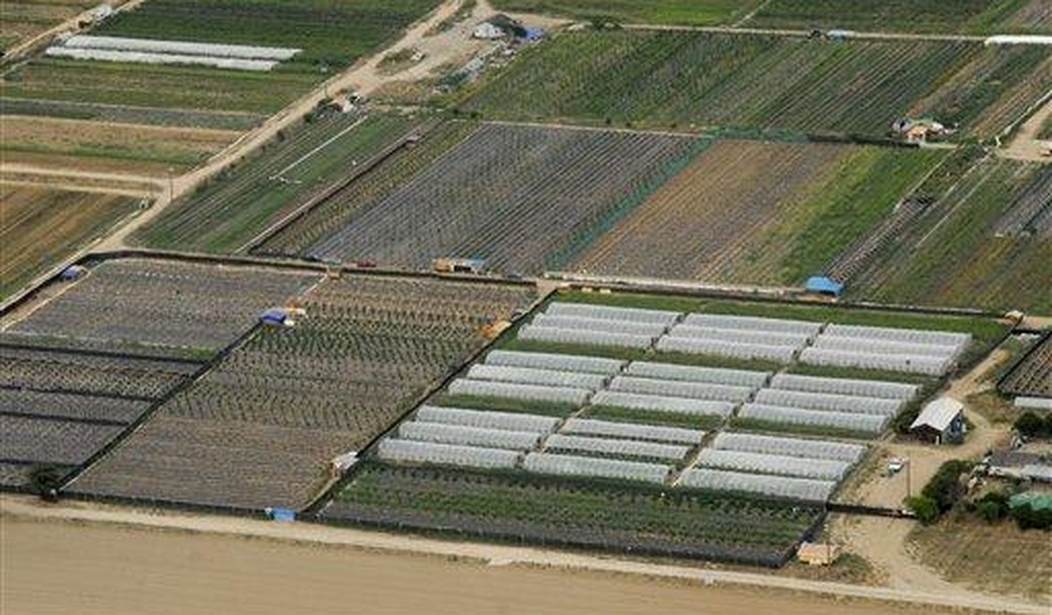
As the Chinese Communist Party (CCP) sets its sights on the United States, federal and state lawmakers are taking proactive steps to combat this threat. How so? By banning CCP-affiliated individuals, governments, and firms from purchasing U.S. farmland.
The motivation behind this is two-fold: protecting national security interests while safeguarding food security. This issue rose to prominence after it was revealed a CCP-linked firm was eyeing farmland near Grand Forks Air Force Base in North Dakota.
“According to the United States-China Economic and Security Review Commission, the Grand Forks Air Force Base has exceptional intelligence, surveillance, and reconnaissance capabilities, making the recently purchased land the ideal location to closely monitor and intercept military activity," a letter from 50 U.S. lawmakers noted. "The presence of a CCP-affiliated corporation near a military installation potentially undermines the integrity of our high-capability military bases, jeopardizing our strategic interests.”
But this isn’t the first instance of the CCP wielding influence here. Two proposed Texas wind farm projects – one close to Laughlin Air Force Base, another 200 miles northwest of San Antonio – were stopped between 2020-2021 over security concerns.
Exactly how much property– farmland and real estate–does China own in the U.S.? Do these holdings pose a threat, and should citizens be worried?
According to a recent National Association of Realtors report, Chinese investors spent $6 billion on U.S. real estate between March 2021-March 2022, accounting for six percent of foreign buyers. Canada and Mexico, our neighbors, have more holdings at 11% and 8%, respectively.
Relatedly, the most available U.S. Department of Agriculture (USDA) Foreign Holdings of U.S. Agricultural Land report found China “held 383,935 acres”— under one percent of approximately 40 million foreign-held acres.
This may seem like a paltry amount. However, it’s concerning that the CCP has gobbled up vast amounts of farmland in the last 10 years.
This prompted Congressman Chip Roy to reintroduce his bill, the Securing America's Land from Foreign Interference Act, during the 118th Congress.
“There is no reason we should allow one of our greatest adversaries — the Chinese Communist Party – to buy up land in the United States,” Rep. Roy said in a press release. “If the Soviet Union had been doing this in the 80s, we’d have recognized the threat. China is not our friend; they want to dominate us and destroy our way of life; we need to wake up and start acting like it.”
Congressional Western Caucus Chairman Dan Newhouse also drafted legislation last year to ban the CCP from purchasing public or private farmland. The bill would further prohibit the CCP, specifically, from “participating in any United States Department of Agriculture programs except food safety inspection.”
Last month, South Dakota took proactive steps to prohibit CCP-linked entities from purchasing U.S. farmland–especially holdings near military installations.
As I noted at Townhall last month, Governor Kristi Noem formed a new board, the Committee on Foreign Investment in the United States – South Dakota (CFIUS-SD), to “investigate proposed purchases of ag land by foreign interests and recommend either approval or denial to the Governor.”
“With this new process, we will be able to prevent nations who hate us – like Communist China – from buying up our state’s agriculture land,” Governor Noem said last month. “We cannot allow the Chinese Communist Party to continue to buy up our nation’s food supply, so South Dakota will lead the charge on this vital national security issue.”
Two more states–Florida and Texas– are eyeing similar moves.
Governor Ron DeSantis (R-FL) recently told reporters, “We do not need to have CCP influence in Florida’s economy.” The Florida legislature is expected to act on CCP holdings of U.S. farmland when it convenes this year. This is in response to Governor DeSantis issuing an executive order sanctioning seven hostile nations–including China–for malign influence.
Governor Greg Abbott (R-TX) wants similar restrictions in his state too. One proposal, Senate Bill 147, was pre-filed in the Texas Senate. If passed, this bill would block individuals, governments, and affiliated entities – including China – from purchasing land in Texas.
"The growing ownership of Texas land by some foreign entities is highly disturbing and raises red flags for many Texans," said Senator Kolkhorst, the bill’s chief sponsor. "By comparison, as an American go try to buy land near a Chinese military base and see how it works out for you. It would never happen there and it shouldn't happen here. Passing this law delivers some basic safeguards to ensure Texans remain in control of Texas land."
Like Florida, Texas has already taken action against China and similar hostile nations. Abbott signed the “Lone Star Infrastructure Protection Act” of 2021 into law–a measure that bars Texas “contracts or other agreements with certain foreign-owned companies in connection with critical infrastructure.”
In a heavily divided Washington, there should be bipartisan consensus on this issue. But will the Senate and White House act, as House members and states have? That remains to be seen.
This issue isn’t going away in 2023.

Join the Conversation
VIP members get the ability to comment on articles.