


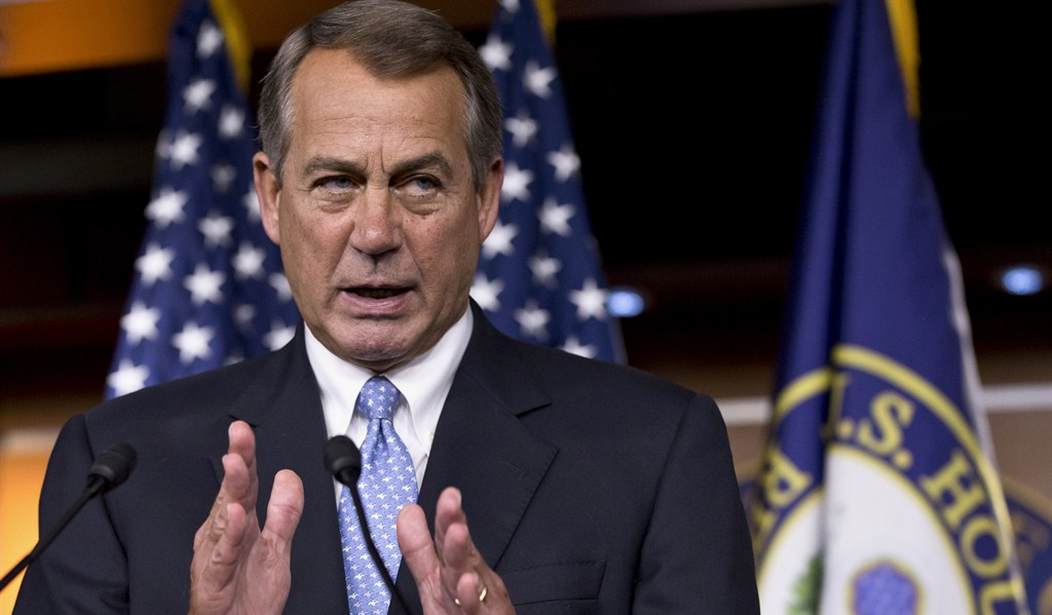
“After two years of harrowing confrontations in Washington,” begins a recent Washington Post article, “the national debt is no longer growing out of control and policymakers from President Barack Obama to House Speaker John Boehner, R-Ohio, have rushed to take credit.”
Credit? Considering how so much government spending is funded these days, that’s an ironic word to use.
To say that it’s way too early to take a victory lap on the national debt is an understatement. Sure, the deficit picture has improved somewhat because of the fiscal cliff tax hikes and cuts in discretionary spending under the Budget Control Act. But a) our government is still carrying a huge load of debt, and b) this latest improvement certainly won’t last. In fact, absent real reform, it’s set to get much worse.
How much worse? If no other changes are made, debt will increase from $11 trillion in 2012 to $19 trillion in 2023. Debt subject to the legal debt limit -- which includes debt owed to federal trust funds such as Social Security’s -- will swell by $9 trillion, reaching $25 trillion after a decade, notes budget expert Alison Fraser.
When the debt rises like that, government has no choice but to pay more and more of our tax dollars just to pay the interest on it.
We throw these terms around so much, it’s easy to lose sight of how much a trillion dollars is. That’s 12 zeroes. If you paid one dollar a second (with no interest), it would take about 32,000 years to pay down just $1 trillion of our national debt. Yet the total amount is much, much higher than that -- and primed to climb still higher.

It’s easy to shrug off such giant numbers, but we shouldn’t. Such massive deficits have real-world consequences that can prove very harmful. For now, the economy is enjoying low interest rates, but we can’t expect that to remain the case under a sharply increased national debt. Interest rates would likely spike, slowing the economy.
That means some families and businesses won’t be able to borrow money to get mortgages and car loans. It could place the dream of starting a business out of reach for many Americans.
And that’s only the beginning. There are other ways that a soaring national debt can adversely affect all of us.
Personal income would suffer, for example. A study by the International Monetary Fund shows that the drag on the economy the debt creates could cause families to lose up to $11,000 every year.
Another danger as debt soars: higher inflation. The government, through the Federal Reserve, could decide to try to reduce the debt by creating more currency. But inflating the money supply can’t help but weaken economic growth.
Inflation has been low for so long that most Americans forget how costly it is to live in a high-inflation economy. A rapidly escalating debt could remind them very quickly.
It can also mean bad news for Medicare, Medicaid, and Social Security. These massive programs are the main reason debt is growing by leaps and bounds. Yet Congress still hasn’t taken the steps necessary to make these programs affordable and sustainable. Such a head-in-the-sand mentality can only jeopardize benefits for those who need them the most.
Spending can’t continue to rise at these unsustainable levels. In 2012, Washington collected $2.4 trillion in taxes, more than $20,000 per household. Sounds like a lot -- and it is. But it wasn’t enough. The federal government actually spent $3.5 trillion.
“Lord, the money we do spend on government,” Will Rogers once quipped. “And it’s not one bit better than the government we got for one-third the money 20 years ago.”
More than 80 years after he said that, the problem’s only worsened. Too much drag makes it impossible for an airplane to fly. The same is true for economies. Lawmakers need to get serious about taming the debt, not take bows for fleeting improvements.









Join the conversation as a VIP Member