





Until this month, supporters of racial preferences in California have enjoyed a cozy narrative. They were able to dismiss the 55 percent of voters who passed Proposition 209, which barred race and gender preferences in university admissions, hiring and public contracts in 1996, as over-entitled fear-obsessed white folks with little understanding of and sympathy for the obstacles that daunt minority students.
That ended Monday when California state Sen. Ed Hernandez was forced to put a hold on a measure to allow voters in November to restore racial preferences in public education. It was a huge about-face. His Senate Constitutional Amendment 5 had won a supermajority of the Senate vote, all from Democrats. Hence, SCA5 should have sailed through the Assembly, but perhaps that was the problem.
Hernandez blamed "scare tactics and misinformation" for his retreat. Same stuff critics said in 1996. But I doubt Hernandez was enjoying himself, because this time he was responding to pressure from fellow Democrats who also are people of color.
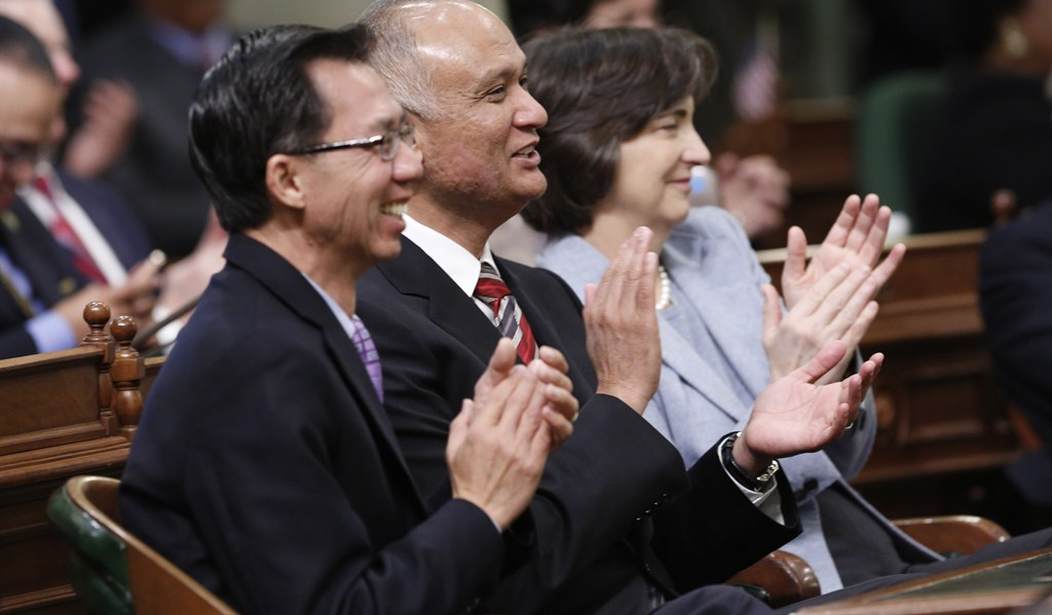
There's an emerging Latino-Asian split in the Democratic caucus. In an ugly case of voter remorse, three state senators -- Southern Californians Ted Lieu and Carol Liu and Leland Yee, D-San Francisco, who had voted for SCA5 -- asked Hernandez to halt it.
"As lifelong advocates for the Chinese American and other API communities, we would never support a policy that we believed would negatively impact our children," they wrote. They said they had heard no opposition prior to the vote, but having heard from thousands of unhappy Californians, they were getting wobbly. (OK, maybe they didn't use the word wobbly, but you get the idea.)
They didn't hear any opposition? "That's no defense at all," countered S.B. Woo, a former Democratic lieutenant governor of Delaware waging a campaign to rally Asian-Americans against SCA5. "In the future, don't ever use that argument. You are supposed to find out," said Woo, now in retirement in Florida.
Although, to be fair, there wasn't much of a fuss before the vote.
I mentioned to Woo that in 1996, most Asian voter groups opposed Proposition 209. What happened?
Over the years, Woo told me, many Asian parents complained that their children had to surpass white, Latino and black students to get into good schools. Still, his Asian-American political action committee did not take a position on college admissions until about two years ago. His community thought, "Maybe we should be more noble." But when post-209 research suggested that racial preferences ill-served African-American, Latino and Asian students, Woo said, "We thought there is no sense in being noble."
Gail Heriot, a UC San Diego law professor and Proposition 209 co-chair, argues that racial preferences pushed some underprepared and under-represented minority students into top universities in which they languished toward the bottom half of their class. The results were higher dropout rates for African-American and Latino students and more of those students abandoning science and engineering in favor of other majors.
"Some of the liberals believe in theories but don't look at empirical data," Woo concluded.
Roger Clegg of the pro-Proposition 209 Center for Equal Opportunity believes that universities funded by taxpayers cannot sort out people "according to their skin color" or their parents' country of origin. It's as wrong to tell deserving Asian students that their best work might not count as it is to shortchange white students. It turns out, black and white representation in the University of California system relative to population has dipped since Proposition.209 passed, while Asian participation is up.
With SCA5 on hold, affirmative-action supporters might begin to suggest that Asian opponents are racist and selfish. Sens. Lieu, Liu and Yee, welcome to my world.
Even without an Assembly vote, an Asian-American voter revolt has begun. On his website, Woo urged voters to "register as Republican voters today, they'll really get your message. They'll never touch SCA5 again!"
As a Republican, I would love to see Democrats put SCA5 before California voters. Let the Democratic machine feel what it's like to be branded as racists for standing up for their principles. Will the media consensus spin then be that with their old-school grievances, Democrats are chasing away hard-working Asian and immigrant voters, and the party better change to stay competitive? What do you think?

Join the Conversation
VIP members get the ability to comment on articles.