




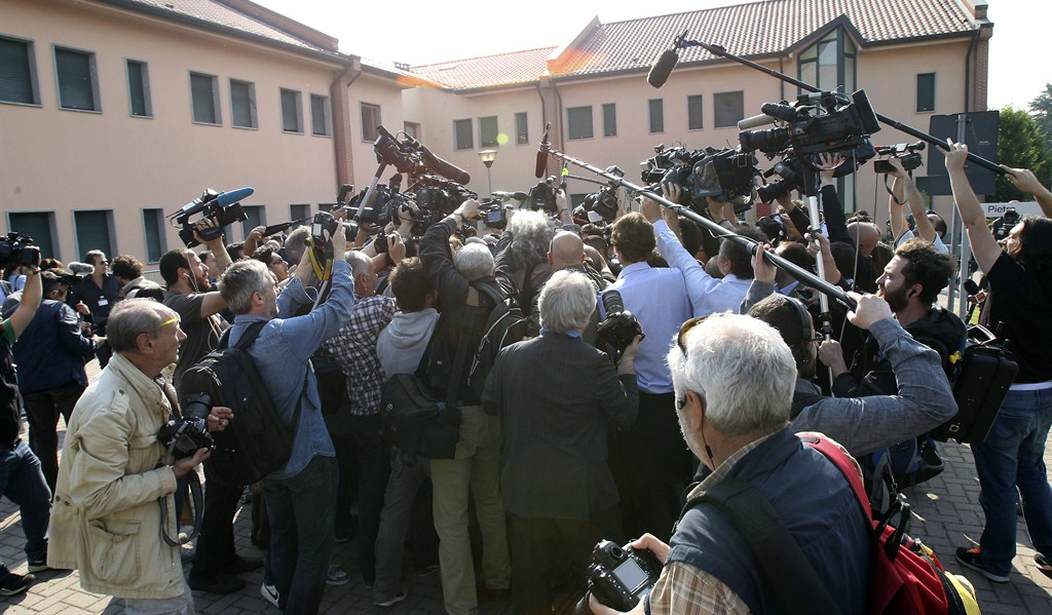
Since America's colonial days the press has been a target of those who believe journalists have a point of view that shapes their reporting.
There have been numerous articles and studies revealing a journalistic predisposition to opinions and subjects that reinforce liberal points of view.
Now comes an excellent critique from World Magazine editor Marvin Olasky. His latest book, "Reforming Journalism," is a philosophical and even theological deconstruction of historic and contemporary media.
Olasky dismisses the notion of "objectivity" in journalism. Everyone has a belief system, he argues, and it influences how each person approaches stories.
The author says American journalism has gone through four phases: In phase one, "many early American journalists assumed God is objectively real, with an existence independent of our minds." Noting that the spiritual, then, regularly shaped the way journalists looked at the world, he adds, "Although no one in early American journalism used the term 'objective reporting,' some editors obviously understood that factuality demanded taking into account the spiritual."
Then came phase two: "Starting midway through the 19th century, though, a new phase in the understanding of objectivity took hold among American journalists. They began to see 'fact' only as that which was scientifically measurable. As photographs began to provide a record of the visible, many journalists equated the visible with the real and began seeing the world as largely non-mysterious. They did not use the term 'objectivity,' but they made their own eyes the standard of authority: they were human cameras."
Recommended
What did those human cameras produce? Phase three, which was influenced by the rise of Marxism and Freudianism: "Objectivity could be reached, they thought, only through a balancing of multiple subjectivities. The outcome might be neither truthful nor accurate, but who knew what accuracy, let alone truth, really was? The triumph of theological liberalism in major Protestant denominations in the United States occurred at the same time. ... This was no coincidence, since the balancing-of-subjectivities mode often suggests right or wrong does not exist -- just opinion."
Phase four was characterized by "disguised subjectivity, sometimes called 'strategic ritual' (pseudo-objectivity that provides defense against criticism). A key aspect of strategic ritual is choice of sources and selection of quotations. With half a dozen legitimate spokesmen on a particular issue, reporters can readily play journalistic ventriloquism by using the one who expresses their own position. As NBC reporter Norma Quarles acknowledged, 'If I get the sense that things are boiling over, I can't really say it. I have to get somebody else to say it.'"
Late in the last century, Olasky writes, "...some well-known American television journalists attacked the entire concept of objectivity. Robert Bazell said, 'Objectivity is a fallacy. ... There are different opinions, but you don't have to give them equal weight.' Linda Ellerbee wrote, 'There is no such thing as objectivity. Any reporter who tells you he's objective is lying to you.' In the United States, some writers argued for a 'new journalism' in which reporters emphasized their own subjective impressions."
Beyond the predictable distrust of journalists this has caused, the claim of objectivity has had considerable limitations. Some examples: "Reporters have never felt the need to balance anti-cancer statements with pro-cancer statements. In recent practice, secular-liberal reporters have seen pro-life concerns or 'homophobia' as cancerous, and many other Christian beliefs as similarly harmful. Objectivity was a reporting of multiple subjectivities, and truth was out there at a constantly receding horizon. If journalists in phase two happily saw themselves as cameras, journalists in phase three unhappily started to see themselves as stenographers or tape recorders."
See how this works? It's the same with "climate change," abortion and many other issues. Anyone who goes against the faith of the secular-progressive culture is simply ignored, or ridiculed. In totalitarian societies it's called propaganda.
Olasky's faith shapes his positions, as the non-faith of secular progressives shapes theirs. For journalism to recover its reputation, a degree of fairness, accuracy and at least small doses of "objectivity" when reporting issues needs to be restored. Olasky's book shows the way.




Join the conversation as a VIP Member