





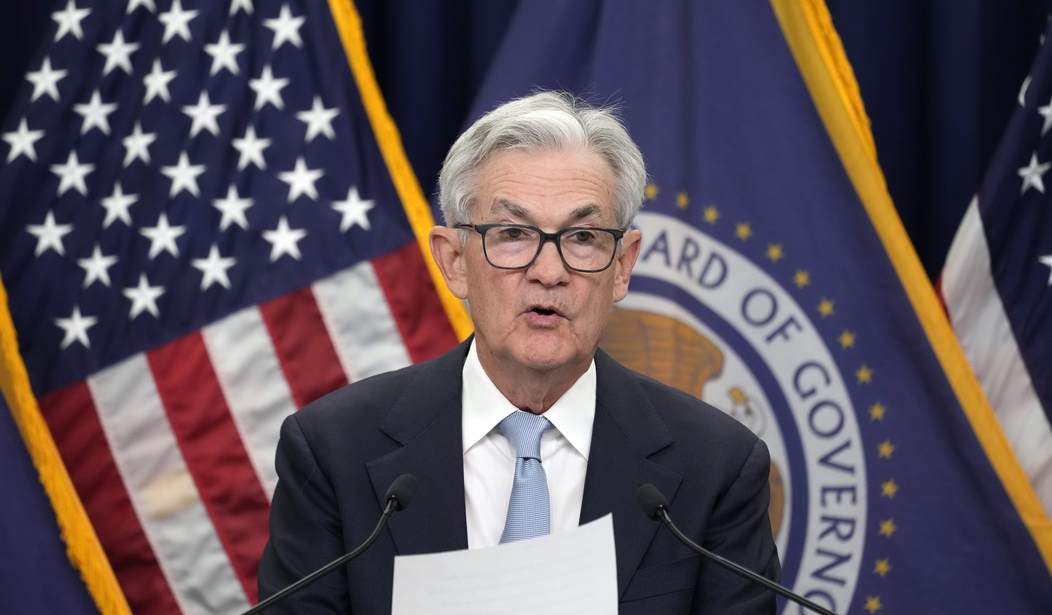
As a result of President Biden's inflationary "Build Back Better" policies, the Federal Reserve engaged in more than one year of consecutive interest rate hikes that sent them to a level not seen in four decades. According to Fed Chairman Jerome Powell on Friday, a few furtive "pauses" to interest rate hikes in recent months do not mean additional increases are out of the question.
That is, inflation is not over and — despite what the Biden administration has desperately tried to argue — inflation is not falling, only the rate of price increases has showed some slowing in recent months. In fact, he costs being faced by Americans are still more than 16 percent higher since Biden took office.
In remarks delivered from Jackson Hole to a regular gathering of central bankers, Powell himself said that inflation "remains too high" as it has since soon after Biden took office, staying above the Fed's goal of just two percent.
As a result of this still "too high" inflation, Powell said the Fed is "prepared to raise rates further if appropriate, and intend to hold policy at a restrictive level until we are confident that inflation is moving sustainably down toward our objective."
As Powell admitted himself, "core goods inflation remains well above its pre-pandemic level" and "sustained progress is needed" which, Powell said, "restrictive monetary policy is called for to achieve that progress." How's that for "Build Back Better"? It's no wonder the White House is trying to retread BBB as "Bidenomics" after failing to build the economy back to pre-pandemic status, let alone make it any better.
Referencing the Fed's preferred gauge for prices, the PCE Price Index, Powell cited July's print which showed the core number — excluding volatile food and energy indexes — at 4.3 percent, more than double the Fed's goal but slightly lower than the metric's peak. Still, Powell said we "can't yet know the extent to which these lower readings will continue," opening the door to more rate hikes a bit wider.
The result of already enacted rate hikes are another hit for Americans as a result of Biden's economic policies. Powell outlined how "interest rates on auto loans have nearly doubled since early last year, and customers report feeling the effect of higher rates on affordability." In addition, "mortgage rates doubled over the course of 2022, causing housing starts and sales to fall and house price growth to plummet."
As Townhall reported recently, average mortgage rates are now higher than they've been in 20 years, making it unaffordable for buyers to buy or for sellers to sell while recent homebuyers are now stuck without hope of refinancing anytime soon.
Despite all the rate hikes since early 2022, Powell said the Fed remains "attentive to signs that the economy may not be cooling as expected," something the average American could have told him after a trip to the gas station or grocery store.
Concluding his remarks with his usual stating of the obvious, Powell reiterated that "doing too little could allow above-target inflation to become entrenched and ultimately require monetary policy to wring more persistent inflation from the economy at a high cost to employment" but "doing too much could also do unnecessary harm to the economy."

Join the Conversation
VIP members get the ability to comment on articles.